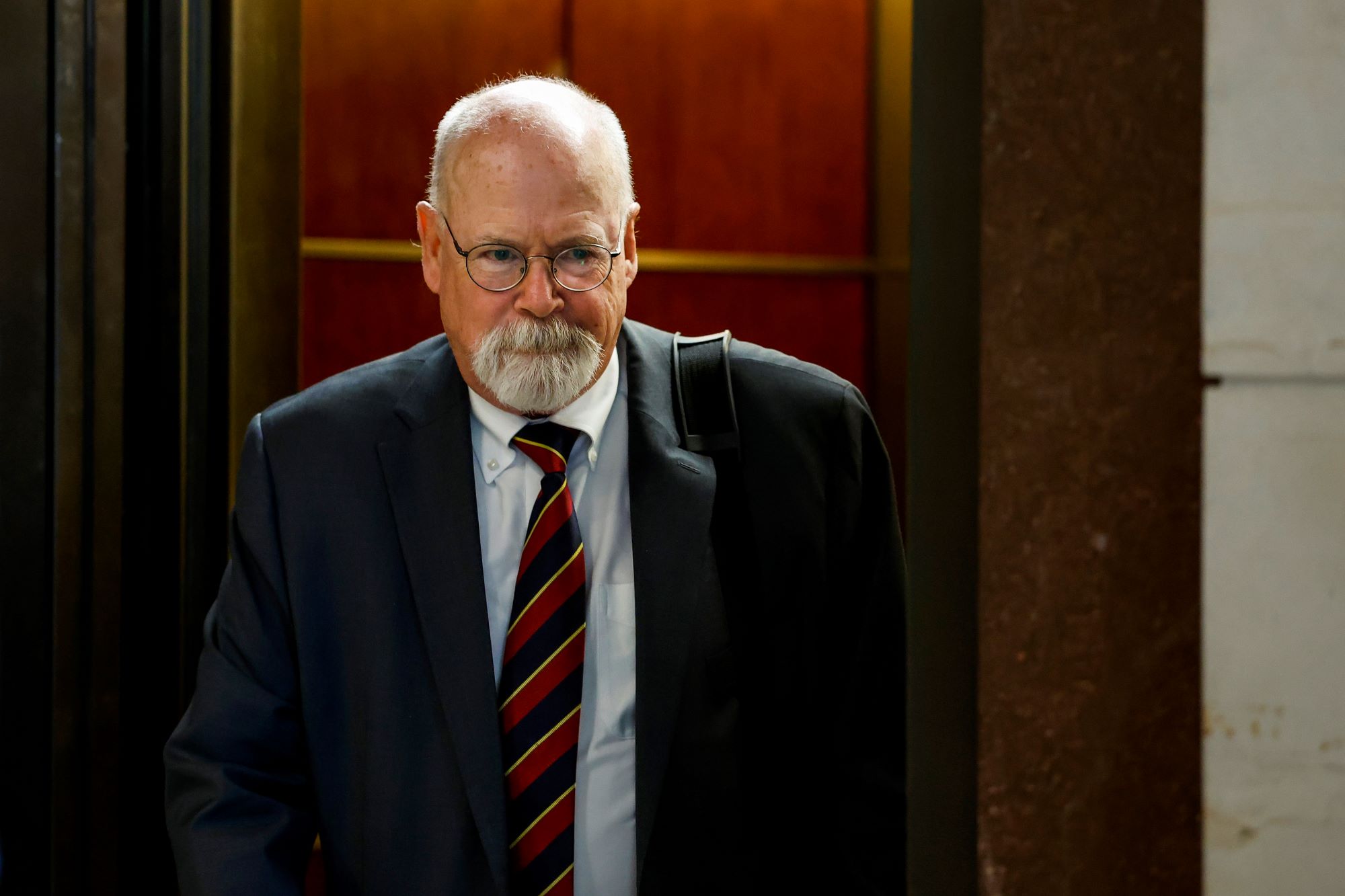
Former special counsel John Durham assessed that two emails describing a 2016 Clinton campaign plan to smear then-candidate Donald Trump by linking him with Russian hackers were likely fake, even though the Clinton campaign appeared to be carrying out the very plan described within.
The revelation is part of a newly declassified annex to the Durham report released by Sen. Chuck Grassley (R-Iowa) on July 31.
The special counsel’s best assessment was that the emails—purportedly sent by Leonard Benardo of the Open Society Foundations—were likely fakes constructed from fragments of emails, attachments, and documents Russia stole by hacking prominent American think tanks.
The key email in question, allegedly sent by Benardo on July 27, 2016, stated that Hillary Clinton approved a plan “about Trump and Russian hackers hampering U.S. elections.” The email was contained in a document attached to a Russian intelligence report email, according to the report.
Durham’s investigators obtained emails from Open Society Foundations and other think tanks compromised by Russian hackers. They were unable to locate the Clinton-plan emails, but during the search, they discovered fragments of the exact verbiage from the emails as part of the authentic emails, documents, and attachments.
The newly declassified report details Durham’s efforts to ascertain the authenticity of the Clinton-plan emails. The U.S. intelligence community received the emails as part of intelligence shared by a source described only as “T1.” The intelligence contained emails with Russian intelligence analysis reports, as well as the text of what appeared to be emails between the Democratic National Committee chair Debbie Wasserman Schultz, and Benardo and his Open Society Foundation colleague Jeffrey Goldstein.
Though Durham concluded that the emails were likely fake, some of the analysts and officers interviewed by the special counsel believed that the emails were authentic and that the Russians hacked Benardo’s emails. Others believed it was possible that Russians could have fabricated or altered the emails.
Whether the emails were real or fake, Durham highlights that Julianne Smith, the campaign staffer whose plan Clinton purportedly approved, sent communications, including on the day of the alleged approval of the plan, which suggest she was playing a role in the campaign’s strategy on Trump and Russia.
The declassified annex shows that Durham’s team interviewed Benardo on May 21, 2021. When shown the emails he allegedly authored, Benardo said that the materials didn’t look familiar to him and that he would not have used certain terms within.
“Benardo stated that, to the best of his recollection, he did not draft the emails,” the report states. “Benardo stated, however, that the last sentence in the email—noting that ‘things are ghastly for U.S.-Russian relations’—sounded like something he would have said.”
When the special counsel presented Clinton with the information on May 11, 2022, she said it “looked like Russian disinformation.”
Former Clinton Campaign chair John Podesta told the special counsel that he’s never seen the materials, described them as “ridiculous,” and denied that the campaign executed the alleged plan.
The Epoch Times contacted Clinton’s office for comment on Thursday.
Other members of the campaign, including Senior Policy Advisor Jake Sullivan and an unnamed foreign policy advisor, told the special counsel that the campaign was broadly focused on Trump and Russia, but denied that the strategy was designed to distract from the Clinton email scandal.
The substance of the emails in question was first made public in 2020 by then Director of National Intelligence John Ratcliffe. In a letter to lawmakers dated Sept. 29, 2020, Ratcliffe noted that the U.S. intelligence community was unable to verify the authenticity of the report.
Addressing the entire collection of the Russian intelligence on the purported Clinton plan, the special counsel was ultimately unable to verify whether the “plan was entirely genuine, partially true, a composite pulled from multiple sources, exaggerated in certain respects, or fabricated in its entirety,” the annex states.
The report nonetheless points out that then-CIA Director John Brennan treated it as significant enough to brief President Barack Obama and others at the White House shortly after receiving it.
Brennan briefed Obama about the Clinton-plan intelligence on Aug. 3, 2016, at a meeting in the White House which also included Vice President Joe Biden, Director of National Intelligence James Clapper, and FBI Director James Comey.
A month later, in early September, the CIA forwarded the information to the FBI as an investigative referral.
“Thus, the record reflects that the FBI was fully alerted to the possibility that at least some of the information it was receiving about the Trump campaign might have its origin either with the Clinton campaign or its supporters, or alternatively, was the product of Russian disinformation,” the newly declassified annex states. “Despite this awareness, the FBI appears to have dismissed the T1 information as not credible without any investigative steps actually having been taken to either corroborate or disprove the allegations.”
Sen. Grassley highlighted this conclusion in a press release accompanying the publication of the declassified annex.
“Based on the Durham annex, the Obama FBI failed to adequately review and investigate intelligence reports showing the Clinton campaign may have been ginning up the fake Trump–Russia narrative for Clinton’s political gain, which was ultimately done through the Steele Dossier and other means,” Grassley said. “These intelligence reports and related records, whether true or false, were buried for years.”
The declassification of the Durham annex is the latest in a series of four records releases by the Trump administration in July targeting aspects of the Russia controversy surrounding the 2016 presidential election.
Among other revelations, the new releases show that the U.S. intelligence community used a single scant and unverifiable report as the basis for accusing Russia of interfering in the 2016 election to help tip the scales in Trump’s favor.