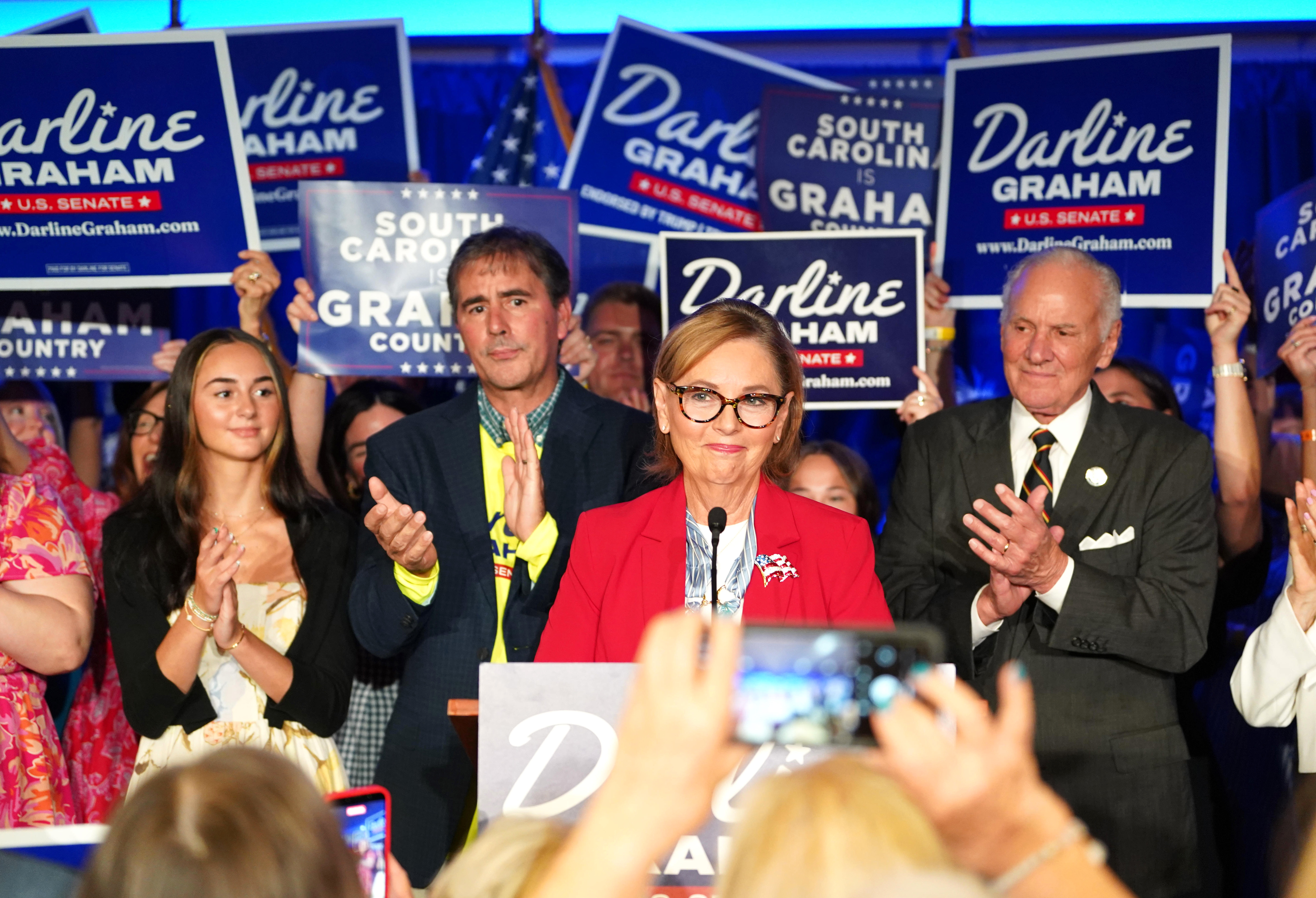

Sen. Darline Graham (R-S.C.) on Aug. 25 defeated Rep. Ralph Norman (R-S.C.) in the South Carolina Republican Senate runoff for the seat that was held by the late Sen. Lindsey Graham.
The candidate, backed by President Donald Trump, won with about 52.4 percent of the vote to Norman’s 47.6 percent, with 91 percent of the votes counted when The Associated Press called the race at 9:01 p.m.
Darline Graham will face off against Democratic nominee Dr. Annie Andrews in November. Andrews won her primary on June 9 with about 61.5 percent of the vote. Darline Graham is expected to win the race in November, with nonpartisan elections forecaster Cook Political Report ranking the seat as solid Republican.
Darline Graham was appointed to the post by South Carolina Gov. Henry McMaster following her brother’s death and a recommendation by Trump.
At a victory event after the results were announced, attended by McMaster, Darline Graham thanked Trump for his support.
“Our victory would not have been possible without you, and we are truly grateful,” she said.
After Darline Graham announced that she would seek a full term, Trump hosted an Aug. 21 rally in Myrtle Beach to encourage voters to back the candidate.
Trump urged voters to consider a vote for Darline Graham as a vote for himself.
“They say again that Trump gets a lot of votes, but if he’s not on the ballot, people don’t vote so much,” he said. “I am on the ballot. We’re all on the ballot. Our country is on the ballot. You have to get out. You have to vote.”
She also had the endorsement of Sen. Tim Scott (R-S.C.), now serving as South Carolina’s senior senator since Lindsey Graham’s death.
Norman is a Seventh Congressional District lawmaker whose tenure in Congress has been marked by public disputes with House leadership.
As a member of the right-wing House Freedom Caucus and the House Rules Committee, Norman has often blocked and delayed party-line votes amid budget and other concerns about the state of the federal checkbook.
He also boasted a powerful endorsement in the state: that of former South Carolina Gov. Nikki Haley. He was also endorsed by Mark Sanford, a former South Carolina governor and Charleston-area U.S. representative.
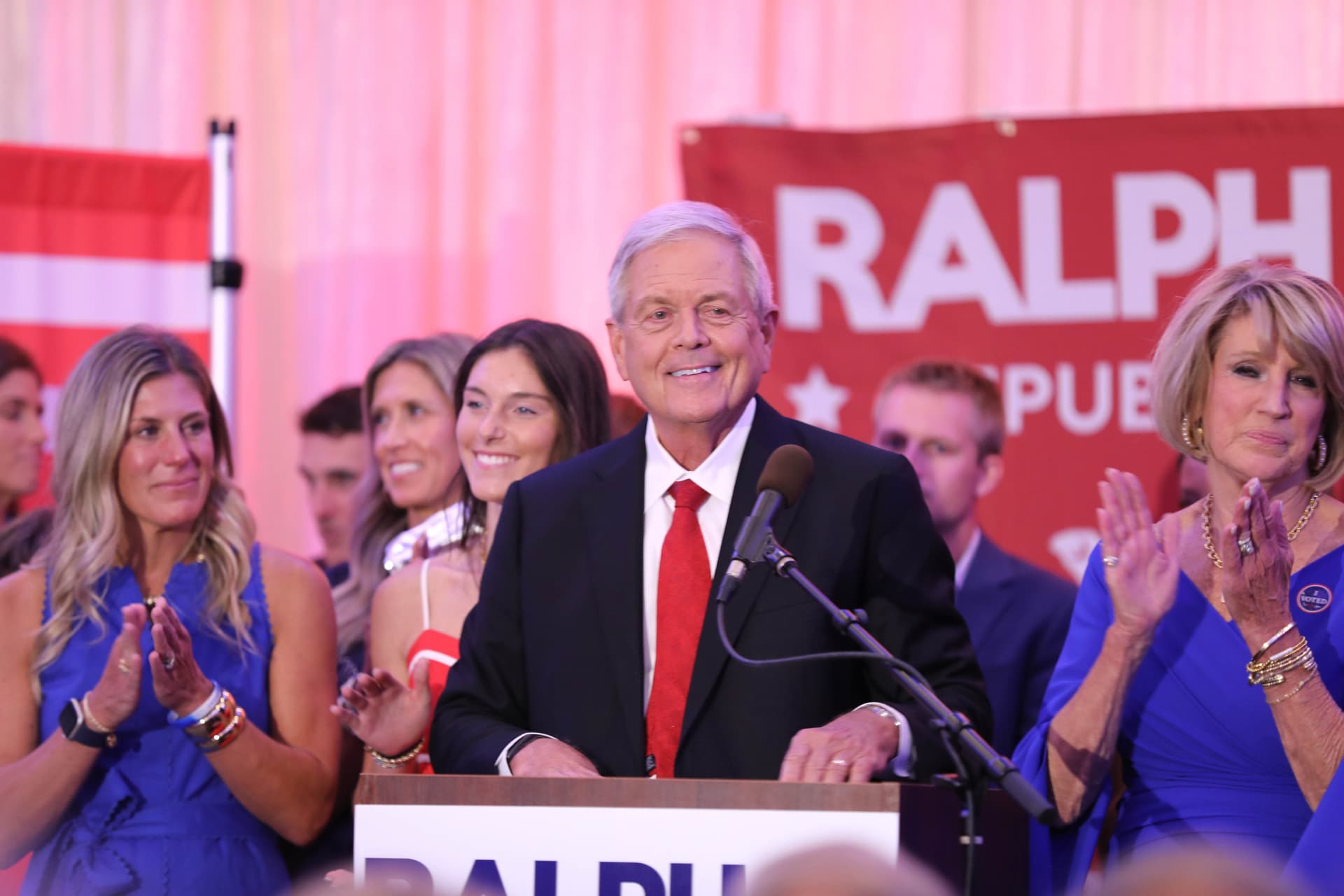
Rep. Ralph Norman (R-S.C.) speaks to supporters after losing the special U.S. Senate runoff in Rock Hill, S.C., on Aug. 25, 2026. (Jeffrey Collins/AP Photo)
Lindsey Graham had a complicated relationship with the president in the past that bloomed into a close political alliance and friendship by the end of his life.
In Myrtle Beach, Darline Graham told attendees that Trump was one of her brother’s closest friends when he died.
However, she indicated that her focus would be different from that of her brother, who was best known for his support of U.S. military intervention in various global conflicts—particularly, a more aggressive posture toward Iran.
The younger Graham has said, “National security is not my thing”—a comment that drew controversy in the final weeks of the race in a state that features a critical naval base and a strong presence of military veterans and their families.
Haley was critical of the comment, saying that national security expertise “is not something you inherit.”
Norman, echoing the sentiment, said of the comment, “This isn’t a get training on the job, you can’t do that.”
Trump on Aug. 21 addressed the criticism, telling reporters before flying out to South Carolina that Darline Graham “was being honest” with her remarks.
He said he trusts her team, which worked closely with her brother on foreign policy.
“She’s surrounded by very good people, and she said that she’s totally for the military,” he said.
However, despite the controversy, South Carolinians ultimately decided to go with Darline Graham, choosing to trust the endorsement of a president they backed by about 18 points in 2024.
Norman had described himself as a political outsider and maverick, noting that he had not won the same level of critical endorsements from Washington Republicans or funding in the race as Darline Graham.
Now, Darline Graham’s focus will turn to the November showdown with Andrews.
Dennis Browne, the state executive committeeman for the Charleston region of the South Carolina Republican Party, told The Epoch Times that keeping Andrews out of the seat would be voters’ top priority in their vote on Aug. 25 ahead of the results.
“I think people are going to take a hard look at who’s in the best position to take on Annie Andrews in November,” Browne said. “I think that’s going to play a major factor in all this, because ... at the end of the day, having Annie Andrews as our next senator is not something—I’m certainly not comfortable with [it], and I think a lot of people feel the same way.”
Polling on the general election has been limited, and either Republican is favored to win in the conservative state.
The national political environment is set to be challenging for Republicans.
Democrats lead polling in Senate races in Georgia, North Carolina, Texas, Ohio, and Alaska. All were formerly perceived as relatively safe red states.
With South Carolina’s neighbors to the north and south each favoring the Democrat in the Senate race, it is unclear whether Andrews will be able to tighten the margins or pull off an upset victory in the race.
Correction: An earlier version of this article misspelled the name of the late Sen. Lindsey Graham (R-S.C.). The Epoch Times regrets the error.