
China may be approaching the end of its growth era.
Beijing has already set the lowest growth target since 1991, at 4.5 percent to 5 percent. China’s economy could stall entirely as a collapsing property market, rising debt, and a declining population converge.
Derek Scissors at the American Enterprise Institute estimated that growth will grind to a halt in the 2030s. The exact timing would be difficult to determine because of the regime’s lack of transparency about its data.
Tune in to China Watch, a podcast on Chinese politics, technology, and business.
“However, at some point, China will stop admitting that growth has slowed, claiming some reason for it to have stabilized, such as [artificial intelligence] effects,” he told The Epoch Times, outlining indicators to watch. “In the years following, their economic statistics will become less and less consistent.”
If the United States maintains growth near 2 percent, the gap between the world’s two largest economies could widen over time. Such a shift could reduce the scale of China’s economic challenge to the United States.
In the meantime, the United States has leverage to disrupt China’s export-driven model, according to Thomas Duesterberg, a senior fellow at the Hudson Institute.
His latest paper connects the dots between Chinese people’s savings and China’s overcapacity. The regime uses the savings of the Chinese people to fund overproduction in selected sectors favored by Beijing’s industrial policies, he wrote.
At the same time, Beijing has increasingly relied on monetary expansion to keep banks and state-backed sectors afloat.
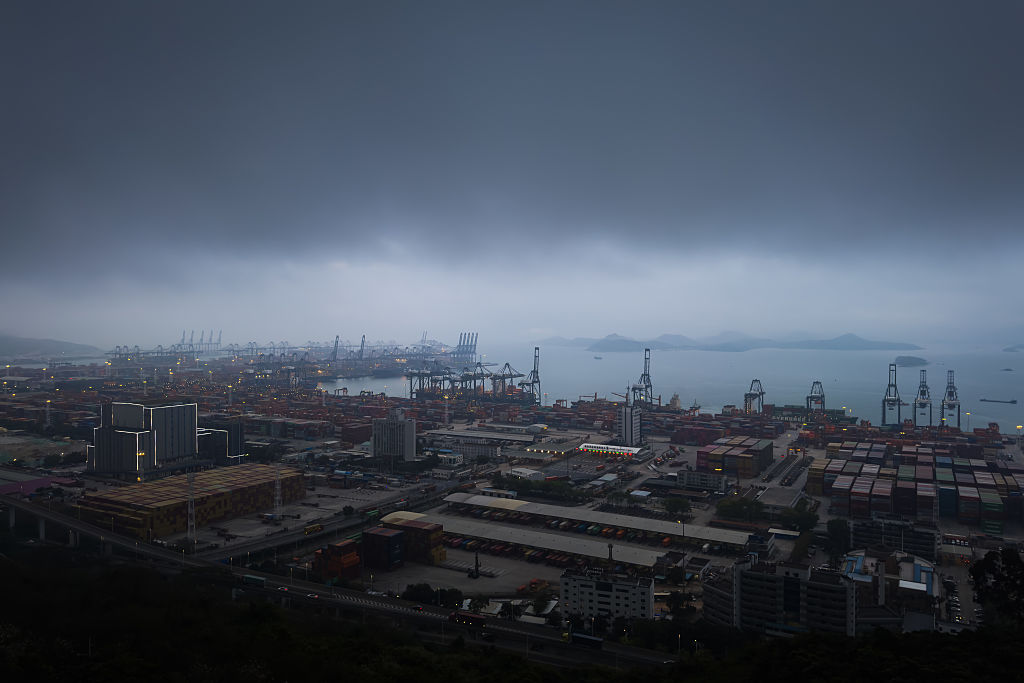
China’s total money stock grew six times faster than the United States’ stock since 2000, although the economy is still only two-thirds the size of the United States’, according to his paper. The total amount of money circulating in the Chinese economy is more than that of the United States and the European Union combined, yet China’s growth is slowing.
“The only way that China is able to keep its economy stable is to print more money,” he told The Epoch Times.
At a certain point, he added, China will not be able to incur any more debt.
However, slower growth does not mean lower risk. It may increase it.
The widened economic gap with the United States may be viewed by Chinese leader Xi Jinping as a lost “once-in-a-century” opportunity to overtake the United States, China expert Alexander Liao told The Epoch Times. That, he argued, could increase the risk of more disruptive actions by the regime, including potential military moves against Taiwan.
All Roads Lead to Weak Consumption
China’s biggest constraint is not production, analysts say. It is the fact that people are not spending. Efforts to increase spending in recent years have produced limited results.
Household consumption in China remains below 40 percent of gross domestic product, compared with 70 percent in the United States.
China has elevated the priority of expanding demand, but a declining population, shrinking income, and an underfunded social welfare system converge on a single constraint: weak household consumption.
U.N. data show that China’s population will continue to decline; by 2050, it will fall below the 2000 level of about 1.3 billion.
According to the World Bank, the Chinese people’s saving rate is almost double the global average, while their disposable income has been declining sharply.
At the household level, the issue is insecurity. Many Chinese consumers fear that spending today will leave them vulnerable tomorrow, William Lee, chief economist at consultancy Global Economic Advisors, told The Epoch Times. He called “dying poor” the “biggest fear” of people in China.
Out-of-pocket health spending accounts for about 27 percent of total health expenditures in China, compared with roughly 11 percent in the United States, according to Duesterberg.
Yet the regime has been reluctant to expand social welfare. Xi, in particular, has warned against excessive welfare, saying that it would make people “lazy.”
Lee argued that policy priorities continue to favor industrial production over household consumption. Xi wants people to work hard to over-manufacture products and sell them abroad, he said.
Artificial intelligence and other high-tech sectors that Xi has prioritized may create higher-paying jobs in the coming years. But the question is no longer whether China can still grow selected sectors but whether it can boost domestic spending to sustain overall growth.
Those AI gains are likely to be offset by the long-term impact of a population decline and the lack of security in a society ruled by the Chinese regime, Lee said.
“The higher income is not going into domestic consumption,” he said. “It’s going into domestic savings, and that’s the key.”
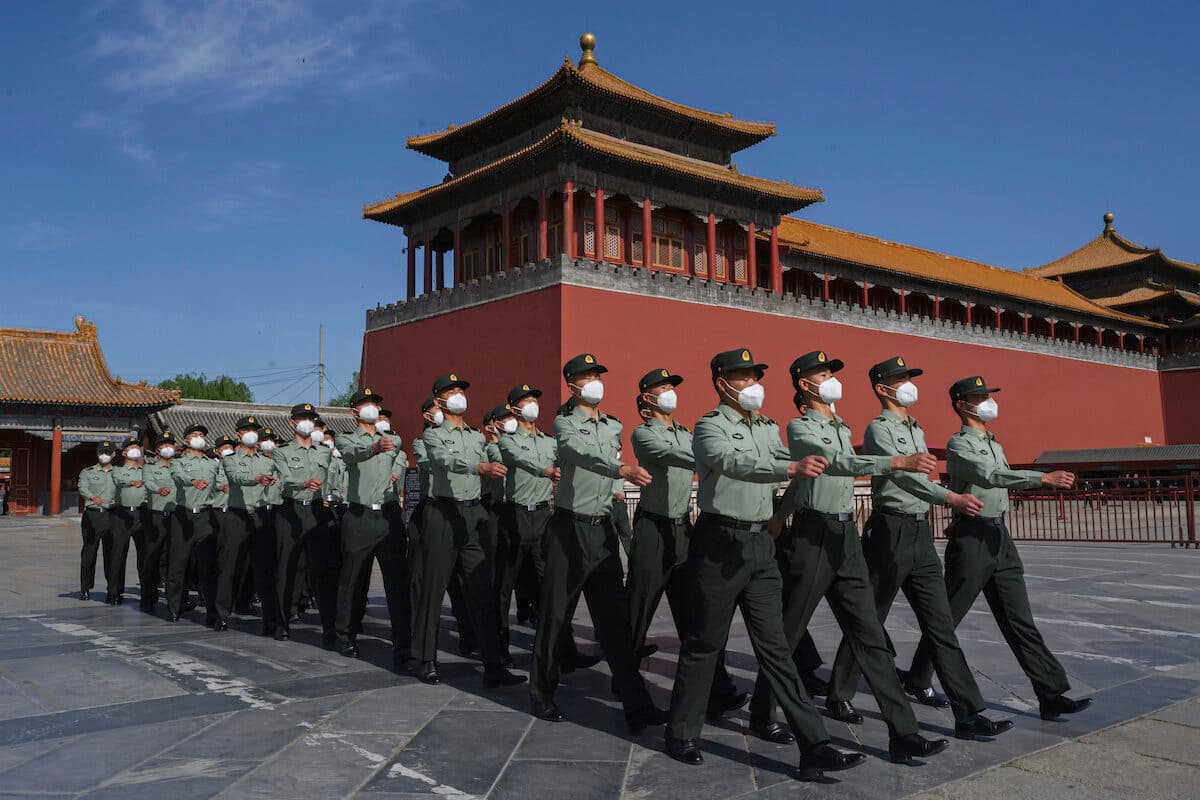
Soldiers of the People's Liberation Army's Honour Guard Battalion march outside the Forbidden City, near Tiananmen Square, in Beijing, on May 20, 2020. (Kevin Frayer/Getty Images)
Slower Growth, Shifting Risks
The shift in China’s growth model could create openings for the United States.
In Duesterberg’s view, the current Trump administration has already installed trade barriers that exposed the limitations of China’s growth model.
He sees an opportunity to counter the mercantilism of China, which seeks to accumulate national power through trade surpluses. He proposed working with allies to restrict excess exports and potentially sanctioning Chinese banks involved in currency manipulation that undervalues the Chinese yuan in favor of more exports.
However, the U.S.–China competition will remain with a weakened China, Duesterberg said, with tensions continuing to manifest in trade disputes.
Within China, societal discontent will brew as the economy deteriorates. For decades, economic growth has been a central source of the regime’s legitimacy. Slower growth is likely to push Beijing toward tighter surveillance and social control.
As China’s growth slows further, the risk is not retreat but escalation—within China and abroad.
The regime could take extreme measures, including military action against Taiwan, with China’s industrial overcapacity shifting from a peacetime liability to a wartime advantage, Liao said.
Xi has signaled a willingness to confront external pressure. Speaking in 2022 at the 70th anniversary of China’s entry into the Korean War, he warned that China is “not to be messed with.”
“Pushing too far, the consequences won’t be easy to deal with,” he said.