“AuH2O in ‘64” was a clever campaign bumper sticker for Republican Sen. Barry Goldwater (1909-1998). The Au and H20 are the chemical symbols for gold and water.
The slogan was catchy but made little difference in Goldwater’s presidential run. Lyndon B. Johnson and the Democrats buried the Republican Party’s bid for the White House in one of the most lopsided wins in American history.
Besides the advantage of running as an incumbent in the immediate aftermath of John F. Kennedy’s assassination, Johnson and the Democrats played on the country’s anxiety to label Goldwater as a threat to peace. When he said in his convention speech, “Extremism in the defense of liberty is no vice,” various pundits and politicians shortened it to “Extremism is no vice,” rousing fears that Goldwater was a loose cannon. Their famous “Daisy Ad,” which depicted a little girl picking daisies, followed by the explosion of an atomic bomb and Johnson’s voice intoning “These are the stakes” and “We must either love each other or we must die,” reinforced those concerns about the senator from Arizona.
And so Goldwater was crushed in the election. But from the ashes of that campaign arose a movement that remains a political force in America even today.
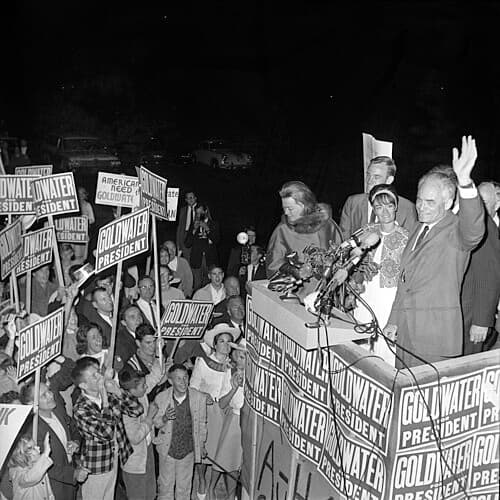
Barry Goldwater with family waving to crowd at Lockheed Air Terminal during presidential campaign in Burbank, Calif. (Los Angeles Times/<a href="https://commons.wikimedia.org/wiki/File:Barry_Goldwater_with_family_waving_to_crowd_at_Lockheed_Air_Terminal.jpg">CC BY-SA 4.0</a>)
The Book
An entrepreneur—he had dropped out of college following his father’s death to manage the family’s department store—and a World War II veteran, Goldwater was elected to the Senate in 1952. There, he gained a reputation as a staunch anti-communist and a conservative opposed to the growth of the federal government. He was known for his forthright speech and his openness in his political stances.
But it was his 1960 book, “The Conscience of a Conservative,” that first thrust Goldwater into the national spotlight. Though largely ignored or criticized as insignificant by the press and reviewers, this manifesto seized the attention of many Americans. Fed up with a rapidly expanding federal government and a perceived diminution of liberty, they put “Conscience” on the bestseller list.
This passage offers insight into the book’s premises:
“I have little interest in streamlining government or in making it more efficient, for I mean to reduce its size. I do not undertake to promote welfare, for I propose to extend freedom. My aim is not pass laws, but to repeal them. it is not to inaugurate new programs, but to cancel old ones that do violence to the Constitution, or that have failed in their purpose, or that impose on the people an unwarranted financial burden. I will not attempt to discover whether legislation is ‘needed’ before I have first determined whether it is constitutionally permissible.”
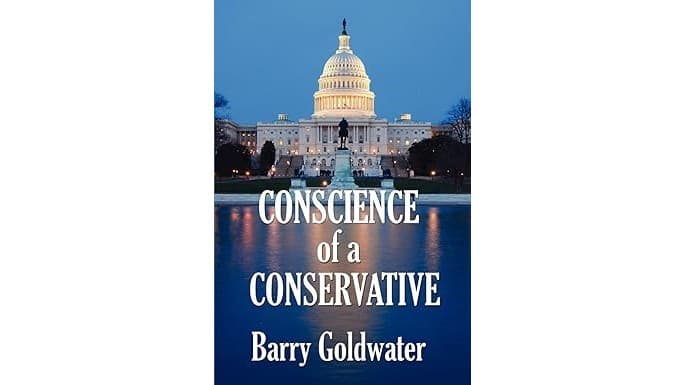
The cover of Barry Goldwater’s influential book, “The Conscience of a Conservative,” was originally published in 1960 and became a surprise bestseller that helped thrust the Arizona senator into the national spotlight.
In 1964, Goldwater demonstrated that he meant what he said about “constitutionally permissible” when he voted against the Civil Rights Act of that year. Opponents and critics who attacked him for that vote, including Martin Luther King, Jr. and Republican Nelson Rockefeller, conceded that Goldwater was no racist, but was instead troubled by the bill’s implications for states’ rights and individual liberties.
“The Conscience of a Conservative” has never gone out of print and even today finds a place in political science courses as a classic of conservative thought.
The Speech
Goldwater’s book helped win him the Republican nomination for president, and his address to Republicans and the nation at the convention made clear that the principles he had embraced in print were not a façade. Historian Lee Edwards has since called it “the most controversial speech in the history of national political conventions.”
Goldwater laid out his general political philosophy, stressing, for instance, the difference between liberty and what he regarded as the growing collectivism within the federal government: “Equality, rightly understood, as our founding fathers understood it, leads to liberty and to the emancipation of creative differences. Wrongly understood, as it has been so tragically in our time, it leads first to conformity and then to despotism.”
He also addressed specifics. Interestingly, the man whom opponents accused of being a warmonger warned about the dangers of America’s increasing involvement in Vietnam. “Make no bones of this. Don’t try to sweep this under the rug. We are at war in Vietnam. And yet the President, who is the Commander-in-Chief of our forces, refuses to say—refuses to say, mind you—whether or not the objective over there is victory.”
When the war escalated—it would cost Johnson his bid for a second term—some Republicans would joke, “They told me that if I voted for Goldwater we’d go to war in Vietnam. Well, I did, and damned if we didn’t.”
One reporter at the convention could hardly believe what he was hearing. “My God,” he cried, “he’s going to campaign as Barry Goldwater.”
And so he did. And so he lost.
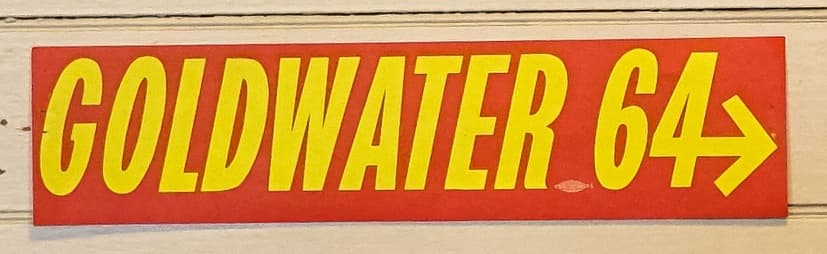
A Goldwater bumper sticker from the 1964 presidential campaign. (CC BY-SA 2.0)
The Legacy
Goldwater returned to the Senate, where he later saw many of his ideas included in the policies and speeches of Ronald Reagan. His later libertarian stances on issues like abortion and gay rights distressed conservatives, especially on the religious right, yet none can deny the vital part he played in bringing conservatism to the forefront of American politics.
In remembering the man, his character, his book, and his speech, we might look to a 1963 editorial at The Harvard Crimson written by a student, Ben W. Heineman Jr., just weeks before the assassination of President Kennedy. Heineman praised Goldwater for his integrity and weighed his positions on civil rights and foreign policy. He concluded with this telling observation:
“It is often fruitless to predict what type of President a man will be from his past record. John F. Kennedy, for one, has hardly been a paragon of consistency. But Barry Goldwater seems a different sort of politician. There is no objection from his opponents that he does not say what he means. Rather they fear that he means what he says.”
What arts and culture topics would you like us to cover? Please email ideas or feedback to features@epochtimes.nyc