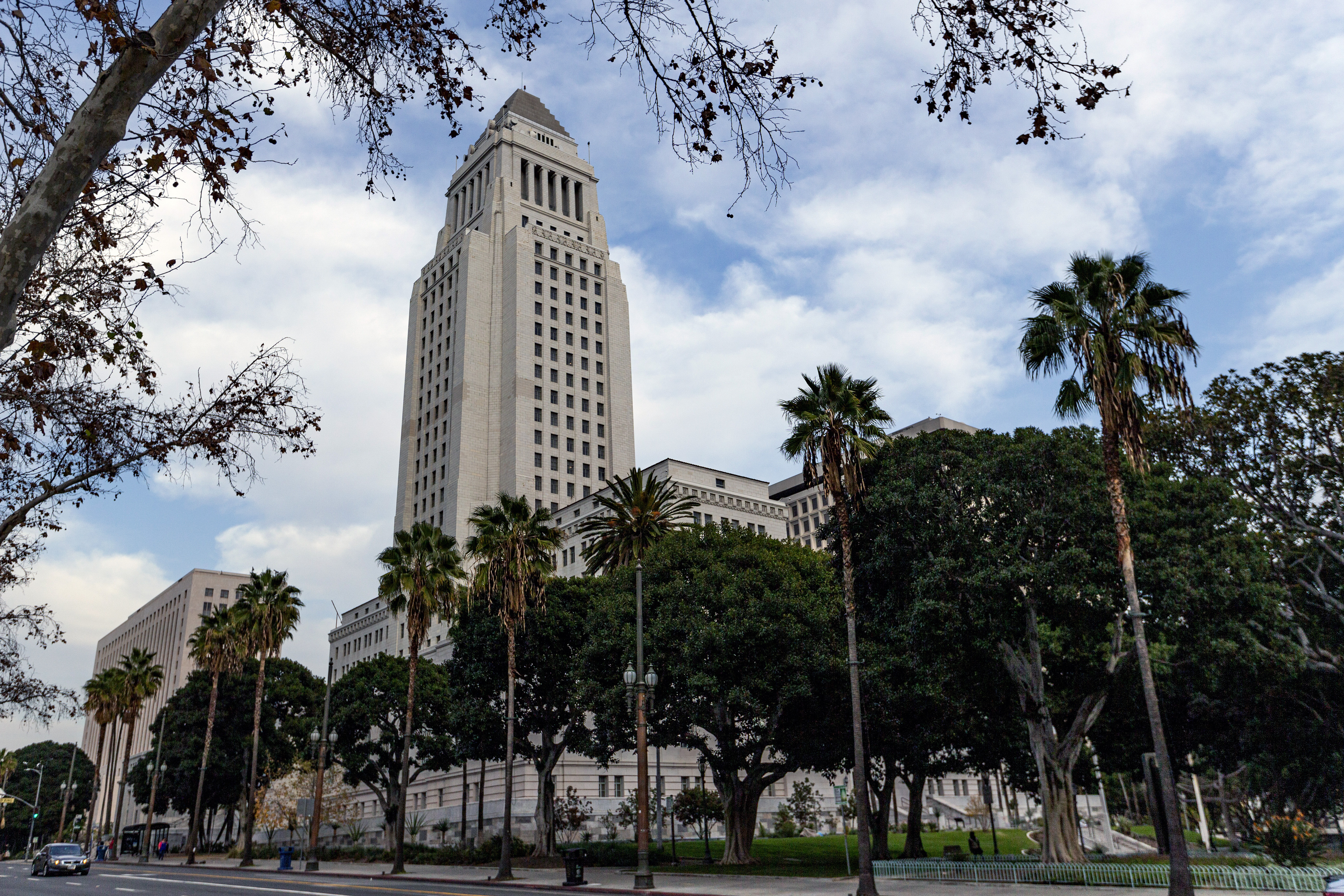

Los Angeles Mayor Karen Bass faced intense scrutiny in a televised debate for her actions before, during, and after last year’s catastrophic fires that left about 30 people dead and destroyed thousands of homes.
The May 6 debate hosted by NBC 4 and Telemundo 52 covered everything from Hollywood to homelessness and illegal immigration, as Bass faced challengers Spencer Pratt, a media entrepreneur and former reality TV host who lost his home in the fires, and Los Angeles City Councilwoman Nithya Raman, an urban planner.
“When I took over as mayor, LA was definitely facing an awful lot of tough problems, and obviously Jan. 7 was horrible,” Bass said, referring to the day the Palisades wildfire started. “It was one of the worst moments of my life to not be here when my city needed me, and it didn’t matter where I was or why I was away.”
Bass, who was visiting the Republic of Ghana in West Africa during the fires, blamed some of the devastation on former Los Angeles Fire Department Chief Kristin Crowley, who, she said, sent home 1,000 firefighters.
Although Bass admitted that some of the trucks “were broken,” she said, “We actually had fire trucks with not enough firefighters.”
She fired Crowley in February 2025.
Pratt put the blame back on Bass, saying that fire engines were not available for the 1,000 firefighters because Bass denied Crowley’s request for $17 million nine weeks before the fires.
He also blamed Bass for dry water reservoirs and fire hydrants, and for fire helicopter crews having to “fly all the way to Malibu and Encino to get water.”
“That, to me, is the most dangerous thing that this mayor put us up against,” Pratt said.
He dismissed claims that “hurricane force winds” in the Pacific Palisades were to blame for the severity of the fires, saying that winds never exceeded 40 miles per hour (mph) for the first six hours and dropped to less than 27 mph after that.
When asked by an NBC moderator what he would do as mayor if the city were to face the same situation again, Pratt said he would never drain reservoirs needed for wildfire protection and that he would create a network of 20 “dip sites” where helicopters could access water from pools.
Bass countered that the reservoir, originally used for wildfires, had been used to store drinking water for the past 30 to 40 years and that the winds reached speeds close to 100 mph, dismissing Pratt’s claims as “completely inaccurate.”
Pratt said, “She’s an incredible liar,” prompting a reprimand for name-calling from NBC moderator Colleen Williams.
Raman was asked what she did proactively to ensure that her district was prepared for wildfires. Raman replied that mudslides have been the biggest issue in her district, but that brush was cleared to prevent flooding.
“We do brush clearance and make sure that all of the departments that are supposed to be doing brush clearance are actually doing that work,” she said. “Before this set of fires, we sent out an email.”
Raman said it is the mayor’s job to act as CEO of the city, prepare for disasters, and coordinate emergency operations.
“As a council member, you’re a legislator, you push for your district ... but really it is the mayor’s role,” she said.

Mayor Karen Bass speaks during an immigration rally in Los Angeles on Sept. 20, 2025. (Ethan Swope/AP Photo)
Public Safety
With the Los Angeles Police Department reporting that the overall crime rate is down, city residents still say they do not feel safe, Williams told candidates.
“We’re seeing yet another series of home burglaries in the San Fernando Valley, and just today, federal authorities arrested at least 18 people connected to a drug trafficking investigation,“ she said. ”They called it Save MacArthur Park.”
Bass said the city was “very well aware of the drug dealing that was taking place there” and collaborated with “the feds” who led the drug bust that had been in the works for months.
The police department is understaffed, and the current budget allows for the hiring of only 512 more officers, “which is still not enough,” Bass said.
“I have been fighting to hire more officers,” she said.
“Unfortunately, I have not had the cooperation from the City Council, including, unfortunately, my colleague next to me,” Bass said, referring to Raman. Bass said Raman ”has voted repeatedly against hiring officers.”
She said the city is losing police officers because of attrition and because salaries are not competitive.
Raman replied that she voted against “a contract that gave the police union more money than the city had,” which led to a billion-dollar budget deficit last year and cuts to essential services.
Pratt claimed that he has talked to “thousands of moms” who do not feel safe in the streets. He said the city’s public safety woes are “unbelievable,” and encouraged federal agencies such as the FBI, Drug Enforcement Administration, and Centers for Disease Control and Prevention to step in.
“No matter what these crime statistics are telling anybody, it’s not how people feel on the street,“ he said. ”There’s a difference between people reporting crime and feeling unsafe on the street.
“The good news is, when I enforce the law and clear the street of the drug addicts that have taken over 40 blocks of downtown LA—abandoned buildings that have drug addicts just lighting them on fire every other day—I will have potentially 20,000 units available to build. And thankfully, I spent a lot of time in a town that has a lot of builders, and I see all the new 3D printing and the potential [of] how fast we can do it.”
Raman, a Democratic socialist, said she was not sure how to respond to Pratt’s vision of the city.
“This is a [Make America Great Again] Republican’s idea of what Los Angeles looks like,” she said. “We have to work so hard to ensure that this city works for everyone who lives in it.”

Heidi Montag and Spencer Pratt attend the Prime Video Summer Solstice Party at Santa Monica Proper Hotel in Santa Monica, Calif., on June 21, 2022. (Amy Sussman/Getty Images for Prime Video)
Illegal Immigration
When asked a yes-or-no question about whether noncitizens should be allowed to vote in local elections, Pratt replied, “no,” while Bass said, “It depends.”
But when pressed, Bass replied that not all “noncitizens” are in the United States illegally or “undocumented.”
“They can have green cards; they could be here perfectly legal,“ she said. ”And there’s a lot of states and cities that do that on very, very local elections.”
Pratt was asked whether he supports city police working with U.S. Immigration and Customs Enforcement (ICE). He promised that if he were elected mayor, he would enforce all laws to get drug dealers, murderers, child traffickers, and rapists off the streets, regardless of whether they are in the country legally or illegally.
“If they are a danger to our city, I want them off our streets,” he said. “I’m going to target all criminals.”
To that, Bass said: “That’s not what ICE was doing. ICE was chasing people in car washes. ICE was chasing people in Home Depots and picking up vendors selling fruit.”
She alleged that more than 70 percent of the people whom ICE arrested had no criminal record, a claim that ICE and the Department of Homeland Security officials have repeatedly denied.
Reviving Downtown
When candidates were asked whether downtown Los Angeles was worth saving, all candidates agreed that change is needed to revive the area.
“We do definitely need to bring city and county workers back,” Raman said. “Right now, the lack of care that’s being demonstrated in downtown LA is part of our broken status quo.”
Downtown LA needs regular cleanups, maintenance, and more “public safety officials” on the streets, and the city needs to work with businesses to ensure that they “aren’t just fleeing,” she said.
Raman criticized Bass for dismantling the city’s economic development department.
“We don’t have a strategy to keep businesses here in Los Angeles, and we’re watching as they walk away,” she said.
Pratt said downtown restaurants are shutting down because it is too unsafe to serve food or dine outside, and that law and order must be restored and the homeless problem solved before downtown can be revived.
Bass said the city cannot afford to let downtown die because it is “an economic engine that absolutely needs to be attended to.”
“We have a strategy that is working,“ she said. ”We are working with the downtown business associations. We are increasing public safety there.”
Bass said she is pushing for vacant office buildings to be converted into housing for the homeless.
“Those conversions are taking place right now,” she said. “My number one obligation is to keep our city safe, so downtown is absolutely critical.”
But Raman said the city needs to respond to issues with a greater sense of urgency.
“I feel like we’re having a theoretical conversation here about the direction of our city,” she said. “Our mayor is the CEO of the city. She sets the direction of this city. And, if you are satisfied with the status quo, then I’ve got great news for you: The incumbent is on the ballot.
“We need real plans. We need real efforts to make sure that we’re keeping businesses here, that we’re keeping workers here, that we’re keeping residents in downtown LA.”
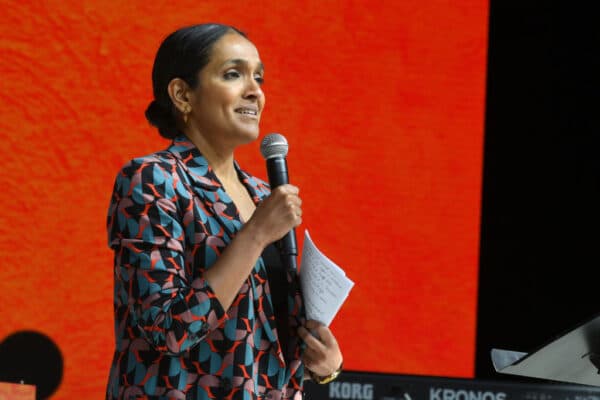
Nithya Raman speaks during a celebration of life for the mountain lion P-22 at The Greek Theatre in Los Angeles on Feb. 4, 2023. (JC Olivera/Getty Images for the National Wildlife Federation)
Housing, Homelessness, and Drugs
Bass told moderators at the outset of the debate that the city has seen a 17 1/2 percent reduction in street homelessness, referring to annual point-in-time homeless count data, and said housing affordability remains the city’s top issue.
However, according to the National Homelessness Law Center, recent homeless counts have underestimated the actual number of homeless people, and a RAND Corp. report suggests that the Los Angeles Homeless Services Authority’s count in 2024 and 2025 may have undercounted the true homeless population by as much as 32 percent.
Raman, claiming that there has been a 54 percent reduction in tents and encampments in her district in a little more than three years, said the way to address homelessness is to invest in more shelters and services to get people off the streets.
But Pratt dismissed the idea of providing open treatment beds rather than mandatory treatment as a waste of taxpayer dollars.
“The reality is no matter how many beds you give these people—they are on super meth; they are on fentanyl,” he said. “I will go below the Harbor Freeway tomorrow with her and we can find some of these people she’s going to offer treatment. She’s going to get stabbed in the neck. These people do not want a bed. They want fentanyl or super meth.”
Raman responded by accusing Pratt and Bass of attacking her “because they want to run against each other in the general election.”
“They don’t want to run against me,” she said, because her ideas are based on “real results“ in her district and on “real data, a real analysis of the system, and a focus on accountability, and using every dollar as effectively as possible.”
Pratt denied the accusation that he and Bass are working together, saying that he blames her for the burning of his house, his parents’ house, and his town.
High-Density Housing Mandates
Candidates were asked about the city’s delays in building high-density housing near public transit centers required under state law.
Bass said she does not appreciate the state telling the city that high-density housing can be built in any residential neighborhood, and that Sherman Oaks residents, for example, do not want their neighborhood disrupted by state mandates.
“There’s ways to do it,” she said. “We did not need Sacramento to tell us what to do.”
Raman said the city is not taking enough responsibility to meet the demand for housing and blamed Bass for pushing back against the mandates.
“Let’s actually plan for the housing that we need,“ she said, advocating for affordable, high-density housing the state wants. ”Let’s build out the neighborhoods that we want to build. Let’s make them beautiful.
“We can do it if we plan for it, and as mayor, that’s exactly what I would do.”
Pratt said that once homeless encampments are cleared, there will be room for high-density housing.
“I’m going to have 40 blocks when I get rid of all the drug addicts that are sleeping on the sides of all these empty buildings, so we will have so much high density,” he said.
“We have plenty of places to build. We don’t need to put a seven-story cement structure in a [single-family-home] neighborhood with no parking.”
New housing units should have “some style” and “look a little better than what Councilwoman Raman wants—like prison-like boxes,” he said.
Bringing Back Hollywood
All three candidates agreed that more needs to be done to save the film and television industry.
Bass said the city has expedited permits, established concierge services for the industry, and lowered the cost to film, cutting some fees by as much as 70 percent.
She cited her time as state Assembly speaker from 2008 to 2010, when she advocated for tax credits to promote the entertainment industry.
“We have a long way to go, but we are absolutely making headway because of policies that I put in place,” Bass said.
When asked whether the city was ready to bring back Hollywood, Pratt replied, “Absolutely not,” noting that other states offer better tax credits.
“We needed a mayor three years ago that was going to Sacramento and fighting the governor to get uncapped tax credits,” he said.
Raman, noting that her husband is a longtime writer in the industry, said, “We desperately need to keep Hollywood here.”
The mayor’s role is to be the loudest advocate for policies such as “a tax credit that has no cap” and is guaranteed years into the future, so that production studios will invest in Los Angeles, she said.
City Hall should reduce red tape to ensure that productions are not facing unnecessary obstacles to film in LA, she added.
“I also would create a real film office here,“ she said. ”We don’t have enough people at the city to make sure that filming can happen quickly and efficiently. We need people who know the industry and know the city and can make sure that we’re working across county jurisdictions.”
Pratt blamed both Bass and Raman for the decline of the film industry and “the reason why there’s no more Hollywood.”
He said producers now have to pay gang members to keep the streets safe enough for them to film anything on the streets of Los Angeles.
Even if the city tries to revive the film industry, he said, drug addicts will remain on the streets because of the city’s failure to impose mandatory treatment policies.
“These two politicians have failed Hollywood times a thousand,” Pratt said.