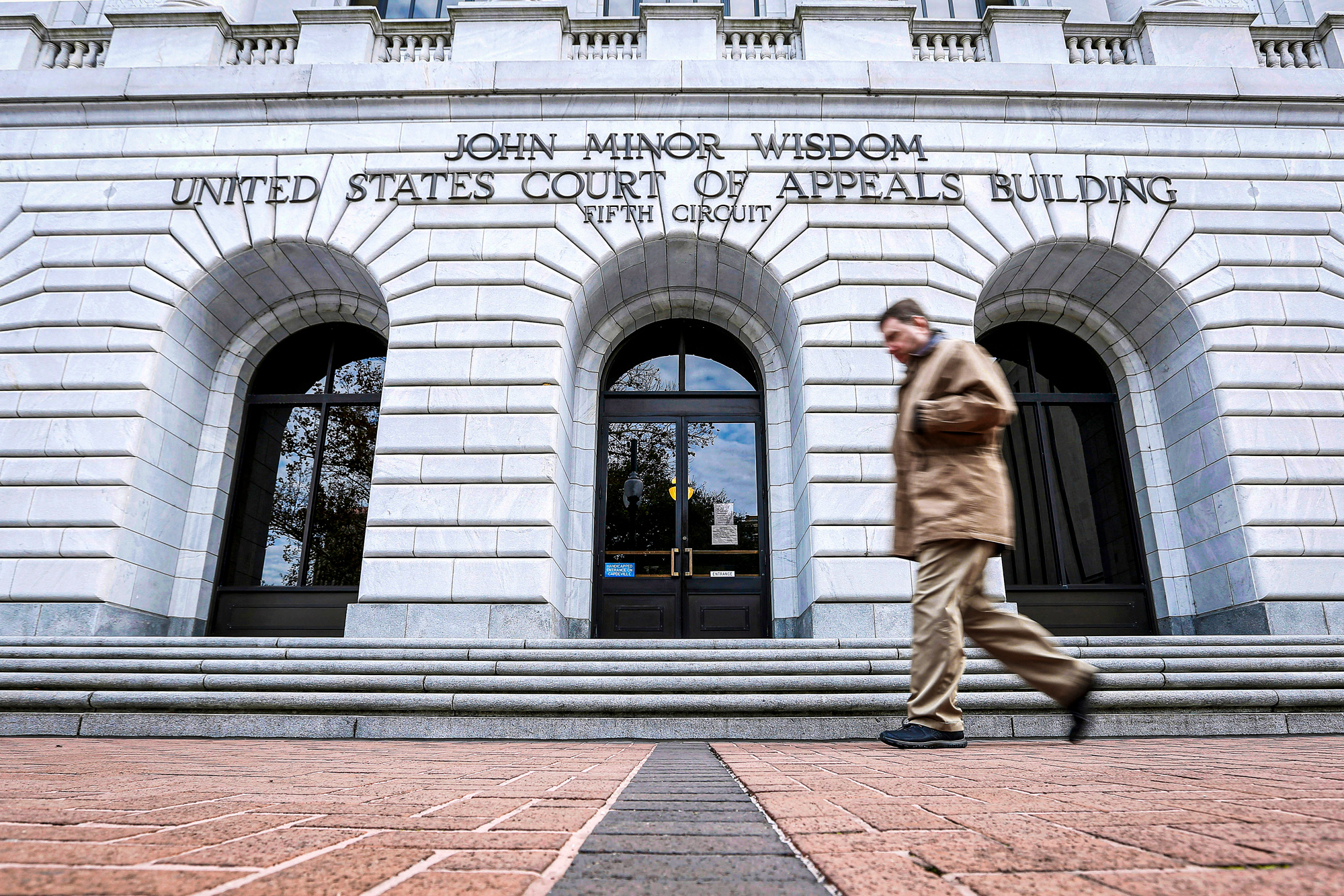

A federal appeals court on Jan. 22 grappled with whether President Donald Trump may use the Alien Enemies Act to try to remove alleged members of a foreign terrorist group.
The U.S. Court of Appeals for the Fifth Circuit in New Orleans held an hour-long oral argument in the extensively litigated case known as W.M.M. v. Trump.
The federal government argues that the president may use the act to defend the country from foreign invasion even if war has not been formally declared by Congress, but detainees argue that Trump is misusing his war powers.
On March 14, 2025, Trump signed Proclamation 10903, declaring that Tren de Aragua (TdA), a designated foreign terrorist organization associated with Venezuela, “is perpetrating, attempting, and threatening an invasion or predatory incursion against the territory of the United States.”
The group is using mass illegal immigration to the United States to harm U.S. citizens, undermine public safety, and support the goal of the Venezuelan socialist regime to destabilize “democratic nations in the Americas, including the United States,” the proclamation states.
Trump invoked the Alien Enemies Act of 1798 to authorize the “immediate apprehension, detention, and removal” of members of the group who are Venezuelan citizens 14 years of age or older and who are not U.S. citizens or lawful permanent residents of the United States.
The act allows the president during wartime or an “invasion or predatory incursion” to detain and remove foreign nationals who come from an enemy country.
Venezuelan men detained under the act in Texas sued in federal district court on April 16, 2025, to challenge their detention.
The next day, Judge James Wesley Hendrix of the U.S. District Court for the Northern District of Texas denied the detainees’ motion to block removal after the detainees alleged that the federal government planned to deport them imminently.
The detainees appealed to the Fifth Circuit, and on April 18, 2025, a three-judge panel dismissed their motion to block Hendrix’s order, finding that the motion was brought prematurely.
On May 16, 2025, the Supreme Court intervened in the case, making preliminary findings without ruling on the merits of the case. It issued an order vacating the Fifth Circuit’s ruling while the litigation plays out and finding that the circuit court erred when it found that it lacked jurisdiction, or authority, to hear the case. The high court also found that detainees were entitled to more legal process than the federal government had provided.
On Sept. 2, 2025, a divided Fifth Circuit panel reversed Hendrix’s order and held that the detainees would likely succeed in their challenge claiming that the preconditions for detention under the Alien Enemies Act—invasion or predatory incursion—were not met. The circuit court granted a preliminary injunction preventing the federal government from removing the detainees under the act.
On Sept. 30, 2025, the Fifth Circuit vacated the panel’s ruling and ordered a new en banc hearing in front of all the judges of the circuit. No legal rationale was provided in the order.
At the en banc oral argument on Jan. 22, the detainees’ attorney, Lee Gelernt of the American Civil Liberties Union, said there are members of TdA who are committing crimes in the United States but that these are “ordinary crimes that have been dealt with by law enforcement.”
The issue is whether the “extraordinary power” of the Alien Enemies Act is “the right fix here,” he said.
The act is concerned with wartime and the military and is not for pursuing dangerous individuals in peacetime, “even if somehow they’re informally connected to a corrupt regime,” Gelernt argued.
The act is not a “blank check” the president may use at will, he said.
Deputy U.S. Assistant Attorney General Drew Ensign said the government believes that Proclamation 10903 is lawful.
The act does not require the existence of “ongoing armed hostilities” for the president to take action and the president’s proclamation is “subject to only extremely limited and deferential review” by the courts, he said.
Ensign said evidence “powerfully supports” the president’s finding that TdA is involved in a predatory incursion of the United States. The group has “infiltrated at least 40 states and taken over entire apartment buildings,” he said.
The FBI has said that TdA is likely to carry out targeted assassinations in this country as the group has done in Chile, according to Ensign.
Circuit Judge James Ho told Ensign that the presidential proclamation seemed to satisfy the act’s requirements, suggesting that it resembled a congressional declaration of war.
Both a proclamation and a declaration could trigger the provisions of the act, he said.
“Declaration comes from Congress,“ Ho said. ”Invasion comes from president.”
Chief Judge Jennifer Walker Elrod asked whether there was a limit to how much the courts have to defer to the president.
“What if the proclamation said we’re having a British invasion?” she said, referring to the wave of UK musical acts that became popular in the United States in the 1960s. “They’re sending all these musicians over to corrupt young minds, and the prime minister is in on it?”
“Is there never a rule, or is there some point where it becomes preposterous on its face, or is it always defer, defer, defer?” she said.
Ensign said this is a question for the political branches of the government, not the courts, but that even if one disagrees with that, in the context of this case, “extreme deference” to the president is still required.
Ensign also said the Supreme Court’s 2018 decision in Trump v. Hawaii applies to this case. That ruling upheld Trump’s first-term proclamation that restricted travel to the United States by individuals from several nations, including Venezuela, Iran, and North Korea.
In the Hawaii decision, the court held that the president’s proclamation was entitled to judicial deference and that he had broad discretion to restrict the entry of noncitizens to the country.
It is unclear when the Fifth Circuit will issue a ruling on the case.