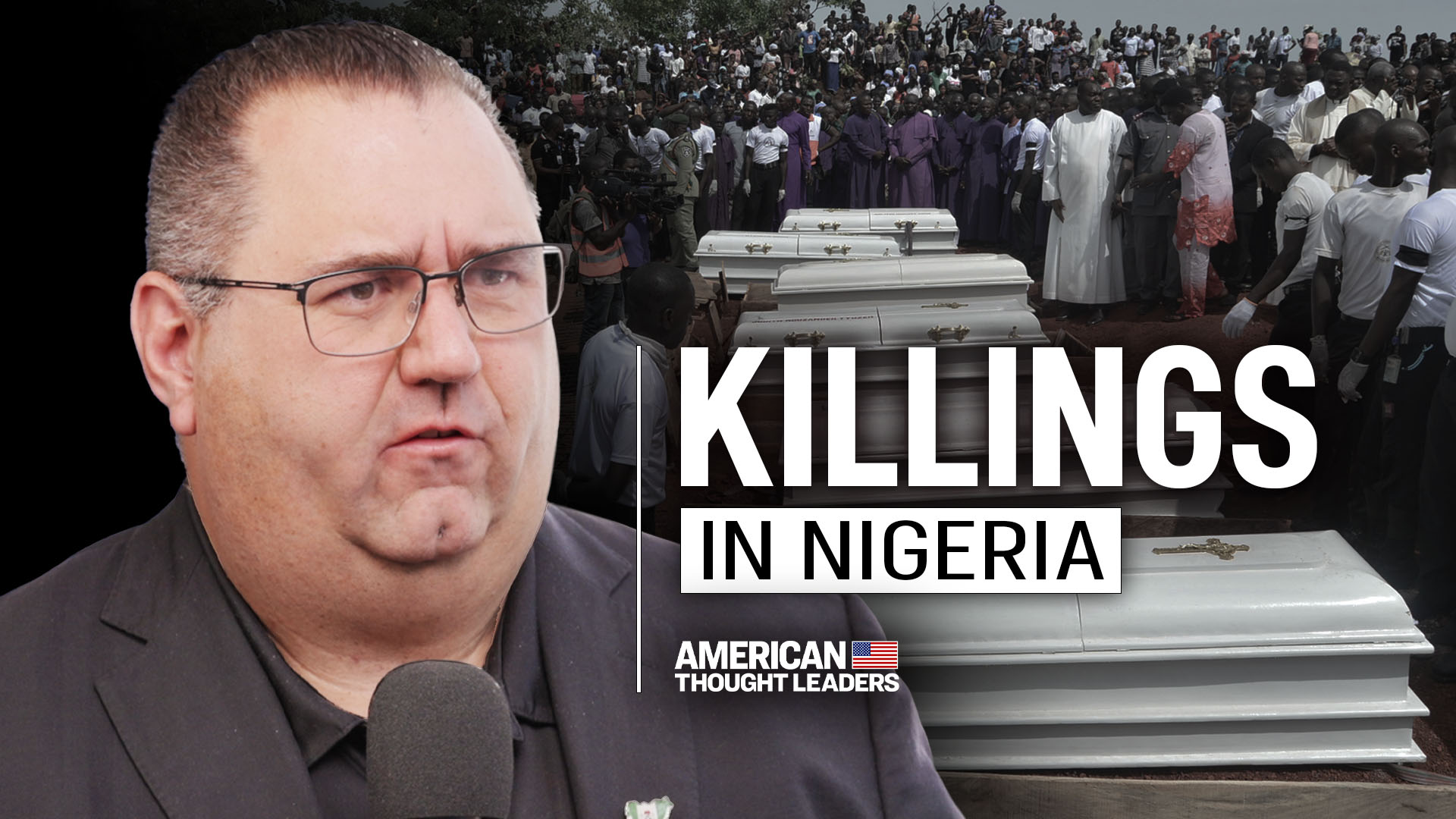
[RUSH TRANSCRIPT BELOW] Nigeria has become perhaps the deadliest place on earth for Christians, accounting for the vast majority of Christians killed worldwide for faith-related reasons.
Beyond the killings, millions more have been displaced into camps, where many now die slowly from malnutrition rather than violence, says Judd Saul.
He is an award-winning documentary filmmaker, entrepreneur, and Christian missionary based in Iowa who founded Equipping the Persecuted, an organization dedicated to helping Christians facing jihadi violence in Nigeria.
Saul first traveled to Nigeria in 2011 on a mission trip with his grandfather, Duane Wessels.
It was an experience that reshaped the direction of his life and work. Since then, he has visited Nigeria multiple times a year.
In our interview, Saul explains what forces drive the violence against Christian Nigerians, who make up about 50 percent of the population.
“This is a well-organized and funded Fulani Islamic militia who are hell-bent on turning Nigeria into a caliphate,” he told me.
According to Saul, an estimated 5,000 to 10,000 Christians are killed each year, averaging about 35 deaths per day.
Roughly 800 Christian communities have been wiped off the map over the past three decades.
Views expressed in this video are the opinions of the host and the guest and do not necessarily reflect the views of The Epoch Times.
RUSH TRANSCRIPT
Jan Jekielek:
Judd Saul, such a pleasure to have you on American Thought Leaders.
Judd Saul:
Thank you for having me on, sir.
Mr. Jekielek:
In a nutshell, explain to me the situation of Christians in Nigeria.
Mr. Saul:
Right now, for the last five years, 90 percent of all Christian persecution deaths worldwide have occurred in Nigeria. And it’s not just persecution deaths, which is absolutely horrible, but it’s the five million Christians that have been displaced from their homes. So when a village is attacked, these people have lost everything they own. Survivors are shoved and pushed into IDP camps, which stands for internally displaced person.
These are refugees within their own country, and they can’t go back to the way they used to live. They can’t farm. They can’t do anything. And they’re basically starving to death. So you have the killings, the immediate killings that are taking place, but now you have more Christians dying because of starvation and malnutrition.
Mr. Jekielek:
So it’s kind of this one-two situation. So I just want to try to imagine for people, and this is very out of the normal realm of our experience, right?
Mr. Saul:
Yes.
Mr. Jekielek:
So you’re talking about villages that are in the countryside where an armed gang will come and kill a bunch of people and displace the rest.
Mr. Saul:
Let’s not say armed gang. We know who the killers are. It’s not just some random gang. This is a well-organized and funded Fulani Islamic militia who are hell-bent on turning Nigeria into a caliphate. That gets in their way, and they believe they have a religious justification to do so.
Mr. Jekielek:
Explain who the Fulani are.
Mr. Saul:
The Fulani are a non-indigenous tribe to Nigeria that came in from the north in the Sahel. And what we’ve seen over the last 30 years is they have been taking territory after territory, slowly but surely. I call it death by a thousand attacks. And they’ve gained a lot of political control within the Nigerian government, and they now control the Nigerian security apparatus.
So, what’s happening is you have all these killings taking place, all these villages being wiped out, and then because they’re in control of the Nigerian government and security apparatus, the Nigerian government’s looking the other way. So, it’s not gangs or unarmed gunmen or bandits. The Nigerian government and the media do not like to say who’s actually doing the killing, and it’s radical Islamists.
Mr. Jekielek:
A group has taken control of a piece of the government. I mean, they could have a large amount of influence, but explain to me your evidence for that.
Mr. Saul:
They’ve systematically taken control of more territory. So when they take over entire states, right, then they implement Sharia law in these states. Then they start sending their politicians to the Nigerian government. And when the politicians get more political control, Fulani get nominated to government positions.
So currently, right now, we have a Fulani that’s in charge of the security apparatus. His name is Ribadu. He’s the national security advisor to the Tinubu administration. He’s the one in charge of all of national security. And we have documented evidence of time after time when attacks are occurring and people call for help. They call the military and the police. The military and police are told to stand down as attacks are taking place.
Mr. Jekielek:
Tell me a little bit about your background. How did you end up working in Nigeria? Tell me about Truth Nigeria, your organization.
Mr. Saul:
Okay. So I’ve been going to Nigeria since 2011. My grandfather is an evangelist. He’s working with a missionary there. And I just felt called to go see what was going on, see what’s going on in Nigeria. And the first time I set foot in Nigeria, it just became a passion of mine. I woke up thinking about Nigeria. I went to sleep thinking about Nigeria. I fell in love with the people. Wonderful people in that country. And I kept on wanting to go back. So every year I would go back and serve.
And as we saw the killings increase and become more brazen, we saw very few people doing anything about it, let alone talking about it. Because I kept on going, like, you know, this village is attacked. I have friends that are being killed in Nigeria, people that we’ve done ministry with. I’m going, why is the media not talking about this? What’s happening? So one of the things when we started our mission, equipping the person, was we needed to get the truth out.
And so one of the things I found was I found citizen journalists that were documenting what was going on, going on social media, but that’s the only outlet they had. And I said, you know what? What if we put together a news organization, truthnigeria.com, giving journalists, citizen journalists, a chance to get the word out? Because they would even try to go to the mainstream press, they try to go to AP [Associated Press], they try to go to Reuters, they would try to submit articles and no one would pick them up.
Mr. Jekielek:
Well, so I'll speak to the challenges of this. So we actually worked with a number of journalists out of Nigeria. I think some of them actually have ended up working for you. But the challenge was that we couldn’t, they would put themselves in situations unbelievably dangerous, of course, right? And we just couldn’t, we didn’t have the infrastructure to support them. So we just couldn’t, in good faith, do it anymore, right? Because we say, hey, I don’t think it’s a good idea to go there, but the guy, you know, he’s committed. Get the information out, and God bless them, right?
Mr. Saul:
But I’m saying that says a lot about Epoch Times and you guys being one of the only organizations that was actually picking up stories on this issue. I mean, I think you’re the only one that was actually picking up stories that were doing this. And like I said, the infrastructure wasn’t there to do it. But I have to thank you guys for getting the word out about this before anybody else. So that’s a tribute to you and your organization. We thank you guys.
Mr. Jekielek:
But you’ve kind of, you’ve now, if I may transition, you’re actually providing some of that infrastructure, I think, right? That’s part of your…
Mr. Saul:
Yes, so we have 25 journalists on the ground in Nigeria all throughout the Middle Belt, and we’ve given them a voice. And not only that, we’ve also helped them earn a living by telling stories and also training them in journalism. We have a great guy, Doug Burton is his name, and he’s been coming alongside these journalists and training them how to be professional, how to write better. And so they’re actually gaining a lot of skills in this, but it also gives them a voice because they felt like they’ve been ignored for so long.
Mr. Jekielek:
And Doug was the centerpiece of our program at one point, yes, absolutely.
Mr. Saul:
So Doug’s been a good help in training, helping train the journalists. But the thing is, why we created Truth Nigeria was because we found out that everything that comes out of Nigeria has been filtered through Al Jazeera. So, for instance, and this happens all the time, let’s say there are 200 people that were killed in an attack done by the Fulani Ethnic Militia [FEM] or even Boko Haram. By the time it gets to the mainstream press, after it’s filtered through Al Jazeera, you say that 50 were killed by unknown gunmen. So it really kind of whitewashes what’s going on.
Mr. Jekielek:
And you’re saying that the reporting becomes kind of a lot less than the reality?
Mr. Saul:
A lot less than the reality, but by saying unknown gunmen or by saying bandits and even diminishing the numbers. By the time it gets to the U.S. or the rest of the world, it’s just like, oh, well, it’s like tribal conflicts going on in Nigeria. When the Nigerian government and the rest of the people know who did the killing, they actually know how many people were actually killed, but they always underplay the numbers and they never say who did it. And I said, we need to fix that problem. And that’s why we, that’s another reason why we created Truth Nigeria so people can get real time information, real numbers about what’s going on and who did it.
Mr. Jekielek:
So, you know, one of the narratives that you hear about why this is happening is because of, you know, I think it’s like, basically, changes in climate. You’ve heard this?
Mr. Saul:
Sorry for laughing so much. Yes, that has been the official narrative. That was the narrative of the Biden administration. That was the narrative of the EU [European Union]. They said all the killing is taking place because of climate change. I mean, how innocuous is that? It’s ridiculous because climate change, the change in weather by a few degrees, does not motivate people to load up their guns to go into a village and kill men, women, and children while screaming Allahu Akbar and praising Allah for the killing they just did. That has nothing to do with climate change.
And the funny thing is that the Fulani leadership, the Imams, and the Ardos will tell you exactly what they want to do and how they want to accomplish it. So if they tell you we want to take over Nigeria and turn it into a caliphate, we should probably take them at their word instead of saying, Oh, no, no, no, no, you’re not trying to take over Nigeria and turn it into a caliphate. It’s just climate change. I don’t know. People that use that excuse are complicit in the genocide against Christians.
Mr. Jekielek:
Why is it genocide? Why am I asking this question? This word is brandished about in all sorts of ways. People use it, they tend to use it, I mean, some people even use it for things that aren’t killing, but typically, I hear it being used as just large amounts of killing amounts to genocide. I think when you say genocide, you mean something different. And I'd like to clarify this because I feel this word is being watered down itself.
Mr. Saul:
And people that water it down do a disservice to the word and the meaning of what it is. But what is happening in Nigeria is a genocide because of the number of Christians that are being slaughtered. And the survivors, if they even try to go back to the land that they once lived on, they get killed. It’s a genocide because they are wiping out entire communities.
Mr. Jekielek:
And since this started happening, and now that community’s gone, completely wiped off their land.
Mr. Saul:
Even in the displaced communities and the camps that are in there, those camps are still attacked and they’re targeted by these terrorists. And there’s a lot of underreporting from the Nigerian government and the mainstream media on the actual numbers of people that have been killed on average per year, and it’s been getting worse. We’re estimating between five to ten thousand Christians are killed immediately by the immediate attacks.
But no one’s talking about the long-term death that occurs after these people are put into camps. That seems like a lot of people. Just the killing is on average, 35 Christians are killed a day in Nigeria. The Nigerian government is not protecting them. And the world is out there saying that this is caused because of climate change.
Mr. Jekielek:
Right. We know the truth, or we know who’s doing it. Or random bandits, or both. Yes, I see. Okay, so aside from reporting on this, which I actually see Doug’s reporting come to me, I think through your newsletter periodically, what are the efforts being made to try to stop this?
Mr. Saul:
At Equipping the Persecuted, we’re trying to fight this on all fronts. So we have the Truth Nigeria side. We have our humanitarian side. Our organization, through the best of our abilities and our resources, responds to these attacks within 24 hours with food, aid, and medicine. Every single attack, we are there helping the wounded, feeding the people that need food. Because one of the first things is, I mean, they have lost everything they have—the clothes on their backs.
Mr. Jekielek:
Is this because the villages are destroyed in the process of the attack?
Mr. Saul:
Yes, they raze everything. They go into the village, they burn everything to the ground. They'll put petrol in the food supply. They burn and destroy everything that’s in the village. So they have nothing left. And then imagine, well, what do you do the next day? There’s no food. You can’t go back to your farm. Everything you have has gone.
So we come in with food aid and medicine to try to help. But what we’ve been doing a lot of lately is making sure that the wounded are being treated. In Nigeria, just because you have a bullet wound, you’re part of an attack. If you don’t pay, you don’t get treated. So we’re paying for the surgeries and the medical costs of the wounded to survive, saving legs, arms, and removing bullets from children. We’re trying to help in any way we can on that side.
And then on the other side of the spectrum we’re advocating politically. We’re advocating for international involvement, to get involved and intervene on behalf of persecuted Christians in Nigeria. We’re intervening, we’re advocating to the European governments to get involved because one little organization like us can’t solve the problem. We need international help.
Mr. Jekielek:
Basically, with a government saying, hey, what’s going on here, that actually makes a difference.
Mr. Saul:
Huge difference. It makes a huge difference. One, just shedding light on the problem. The more light you shed onto darkness, the more we can solve that problem. We can fix that situation.The problem, you can fix it. And that’s what we’ve been trying to do. And we’ve gotten a lot of ground with the United States government. We have a lot of work to do with our European counterparts, but we are gaining ground. Truth is finally getting out there.
Mr. Jekielek:
Some people may be wondering why these villages don’t just fight back.
Mr. Saul:
I get that question all the time. It’s like, why don’t the Christians just fight back? Well, Nigeria doesn’t have a Second Amendment. The citizens are not allowed to own firearms. But for some reason, the terrorists are allowed to own firearms. The terrorists are breaking gun laws in Nigeria every day, but no one gets arrested. But the minute a Christian acquires a weapon, they get arrested, they get put in prison, and the village is punished by the military or police.
So it’s a two-tiered justice system, and the Christians are the ones that are left defenseless. And when all they have access to is maybe a homemade pipe gun, a shotgun, slingshots, a bow and arrow, vs. AK-47s, that’s what they’re up against. It’s very hard to defend against that.
Mr. Jekielek:
So you’re doing support when these attacks happen. Yes. You’re helping in these displacement camps, also presumably with support and so forth. You’re asking for international assistance. You’re doing some kind of advocacy there. What else can people do that are watching?
Mr. Saul:
We encourage people to go to equippingthepersecuted.org. Equippingthepersecuted.org. I know it’s a long word.And we’re asking people to partner with us so we can further help our persecuted brothers and sisters. Even if you’re not a Christian, you’re helping people, well, you’re helping save lives. You’re helping people live. And then the other thing that our organization does is work with village security teams.
We try to train them on if there’s an attack, what do you do? How do we evacuate the women and children first? Where do we evacuate them to? Do we put up a first line of defense? How can we save the most amount of lives possible? Our efforts just through that alone, giving them a security mindset and some guidelines, has saved a lot of lives. And that’s the thing. All we’re trying to do is save lives in Nigeria.
Mr. Jekielek:
How many Christians are out of the overall population in Nigeria?
Mr. Saul:
The population is 50/50. So it’s 50 percent Christian, 50 percent Muslim.
Mr. Jekielek:
How many Christians in the government, relatively speaking?
Mr. Saul:
You have, so you have a Christian South. They have their people in the Senate and in their House of Representatives and are placed throughout. But because you have a Muslim president and a Muslim vice president, all the Christians have secondary roles. They have no major leadership roles where they have any real power to do anything.
Mr. Jekielek:
Fascinating. I mean, the scenario you’re describing, again, I think could be very difficult to comprehend—basically, very divided by religion.
Mr. Saul:
It’s very divided by religion, but the problem is, it’s not just divided by religion; it’s also divided by tribe. And that is why this has happened to the Christians. It’s because the Christians haven’t united as one. They divide themselves by tribe first and maybe Christian later, whereas the Fulani and their allies have a united front. The Christians are divided, and that’s what has allowed them to get conquered this whole way through; it’s because it’s tribal division versus uniting as one.
Mr. Jekielek:
Are you encouraging the Christians to work together better?
Mr. Saul:
Look, Nigeria has a complicated history of tribal conflict. This tribe had a war with that tribe 50 to 60 years ago. But if they want to stop this genocide, they need to forgive and unite. They need to unite as Christians first and put the tribes second. That’s my message to Nigerians. If you really want your country to live in peace, they have to unite and quit these tribal squabbles and address the real problem at hand.
Mr. Jekielek:
So tell me about this memorial that has been erected. I understand that you’re somehow involved in this first memorial. And I also don’t quite understand, given the realities you just painted, how a memorial like this can even exist in the first place.
Mr. Saul:
One year ago, on Father’s Day, one of the worst massacres in recent Nigerian history took place, where 271 Christians were killed over the span of four hours. Half of them were burned alive, and cries for help were ignored by the Nigerian government. And you can understand this village is off a main road, 30 minutes away from two major cities, from Lafia and Makurdi, and no police or military came to intervene. And this is an easily accessible village. 271 men, women, and children died that day.
And why this really strikes me as so frustrating is because we had intelligence. We had word that they were going to attack Yelewata. We knew they were going to attack. We got information about this. Like, it came across our desk, came across Truth Nigeria, word that there was going to be a major attack in Yelewata. 30 days out, we told the Nigerian government, we got information that they’re going to attack Yelewata.
One week out, we told the Nigerian government again, it was confirmed, they’re going to attack Yelewata. Then, 24 hours before, we told the Nigerian government, they’re gearing up. They’re armed. They’re getting ready. They’re going to attack. The Nigerian government did nothing. And that night, 271 Christians were slaughtered, and it could have been prevented. And we did everything we could to try to prevent the attack.
Mr. Jekielek:
Have they ever responded? Has the government in these situations where they’re alerted responded that you’re aware of?
Mr. Saul:
No, they don’t respond. They never respond. So we decided about four months ago.There’s a gentleman from Yelewata that actually lives in the U.S. now, and I befriended him. His name is Franc Utoo. We were talking, and he said, I would like to try to do a memorial in Yelewata. And I said, that’s a really good idea. It’s a really good idea because we’ve been trying to figure out how we’ve been helping the survivors from Yelewata for the last year.
And I said, you know what? Yes, we need to put a memorial out and also make a statement to the rest of the world. Because the problem is, Alia, the governor of Benue State, said that only 50 people were killed. The Nigerian government lied about the numbers of people that were killed in that massacre. And I said, we need to do something about this. And Frank said, you know, we should do a memorial. I said, yes, let’s do it.
So, Equipping the Persecuted, we funded and built the memorial because it’s the right thing to do to make a statement to the rest of the world and for Benue. If it helped the victims heal, that 271 people didn’t die in vain. They’re not just going to become some random statistic that’s thrown away that everyone’s going to forget. And we wanted to make a statement and a dedication to the victims of Yelewata. And also, it’s Christian-themed because these were all Christians that were killed. And this is the first Christian themed memorial dedicated to victims of these massacres.
Mr. Jekielek:
How is it that this memorial can exist without sort of official support?I mean, generally, memorials will have land appropriated for them.
Mr. Saul:
The local tribal leaders gave us the land for it. In fact, the governor was going to try to shut down the unveiling of the memorial of Benue. But Bishop Wilfred of Anagbe got all the priests together and told the government, I dare you to try to shut this unveiling down, and I dare you to try to stop us building this memorial. And the governor backed down. Courageous Bishop Wilfred Anagbe standing up saying, No, you’re not going to ruin this. And you’re not going to ruin this moment. You’re not going to ruin this for the people here.
Mr. Jekielek:
So there’s just, because basically you’re saying there are kind of governors or these governments that are at odds with each other. Like, for example, the local government clearly wants to have it.
Mr. Saul:
Yes, the local government wants to have it. And you got, like I said…
Mr. Jekielek:
And it seems like the regional government is tolerating it now.
Mr. Saul:
The regional government is tolerating it, but like I said, the federal government has been doing everything it can to downplay the atrocities. They hate being designated as a country of particular concern. They want to get rid of that. But the problem with the Nigerian government is that they’re doing everything they can the wrong way to get rid of the designation of a country of particular concern, the terrorist designation. If they want to get rid of that label, why not actually go after the terrorists and start protecting your own people?
But they’re doing everything they can; they’re paying DC lobbyist firms to go into the media and to whitewash what’s going on in Nigeria. They’re trying to pay off certain people to downplay what’s happening. They’re paying the Nigerian press to downplay what’s going on in Nigeria. They’re doing everything they can except address the situation and do something about it.
Mr. Jekielek:
Judd, thank you for taking some time to speak with me about this. Perhaps a final thought as we finish.
Mr. Saul:
If you are watching this, talk about the problem. Talk to your friends, neighbors. Tell them what’s going on in Nigeria. Speak about this. You have a voice. Please be a voice for the voiceless in Nigeria. Visit our website, equippingthepersecuted.org, if you want to help. But I also like to encourage you to support great news organizations like Epoch Times for being brave enough and being the ones on the forefront to raise awareness about this issue.
Mr. Jekielek:
Well, Judd Saul, it’s such a pleasure to have had you on.
Mr. Saul:
Thank you. God bless you, sir.
This interview has been partially edited for clarity and brevity.