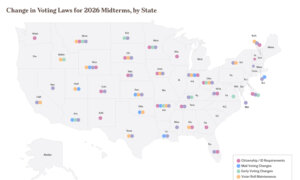
A bill requiring voters to prove their citizenship has stalled in the Senate because of fierce opposition. Most Republicans say it is necessary to ensure election integrity. Most Democrats say it is an attempt at voter suppression. Despite spanning only two dozen pages, the bill is more nuanced than the surface-level debate indicates, analysts say.
The Epoch Times reached out to both left-leaning and conservative think tanks for expert analysis. Two experts, both conservative, responded.
It has been federal law for 100 years that only citizens can vote.
But “there’s no teeth to that law,” said Charles Stimson, former federal prosecutor and senior legal fellow at The Heritage Foundation.
Americans have never been required to prove their citizenship to vote.
“It’s more of an honor system,” Stimson told The Epoch Times.
The bill, dubbed the Safeguard American Voter Eligibility (SAVE) America Act and recently passed by the House of Representatives, would require Americans to present proof of citizenship, such as a REAL ID, passport, or a birth certificate, when registering to vote.
The Senate opened debate on the bill on March 17, but Republicans do not have the 60 votes needed to advance the measure.
The law is necessary, Stimson said, because in some states, noncitizens can apply for a driver’s license and automatically become registered to vote, unless they specifically opt out.
“I guess under some people’s opinion, we’re just going to trust that people are going to follow the law and not take that extra step of voting,” he said.
What If Your Name Changes?
The
bill specifically states that people need to present documents that show their current name. Democrats have zeroed in on that requirement, noting that most married women no longer have the last name that appears on their birth certificate.
The bill does account for such situations, according to Hans von Spakovsky, an election law expert and former member of the Federal Election Commission currently at the Advancing American Freedom think tank.
“If you look at the statute, you'll see that there’s a catch-all provision in it,” he told The Epoch Times. “There’s a provision that says that, in addition to these various documents listed, states have to set up a process for individuals who don’t have the listed documents so that they can both file an affidavit and whatever other documentation they have, to prove they’re a citizen.”
Presenting a marriage certificate, for example, resolves the issue with last name changes.
Critics have countered that many people have misplaced their birth certificate or marriage certificate and that new ones need to be paid for. The fee is $15 to $30 per copy, depending on the jurisdiction, according to the National Center for Health Statistics.
The catch-all provision would also mean that different states would set up different rules for proving citizenship. That is inevitable, according to Von Spakovsky.
“You have to leave it in the hands of local officials to make the determination of whether you’ve provided enough evidence,” he said.
What the SAVE America Act’s requirements would look like would also depend on its interpretation by federal regulators, as well as results of any subsequent litigation, Stimson noted.
“This is the way it works in this country for better or worse,” he said.
Only for New Voters
The statute would apply only to new registrations. Current voters would not need to re-register.
“Making it go backwards, you’re just not going to be able to do that from a practical standpoint,” Von Spakovsky said.
However, the law would ensure that issues with noncitizens on voter rolls would be resolved over time, he said.
The bill would require states to set up “a program under which the State identifies individuals who are not United States citizens.”
States could do that by checking voter rolls against the Department of Homeland Security’s Systematic Alien Verification for Entitlements or against the Social Security Administration database, or other databases that provide citizenship confirmation.
Federalization of Elections
Some critics have also pointed out that the law would increase the federal government’s power over elections.
The Constitution’s election clause states that “the Times, Places and Manner of holding Elections for Senators and Representatives, shall be prescribed in each State by the Legislature thereof.”
But it also states that “the Congress may at any time by Law make or alter such Regulations, except as to the Places of choosing Senators.”
The 2002 Help America Vote Act already creates some identification requirements for people registering to vote by mail. The SAVE America Act would thus tighten rules where some already exist, Stimson said.
Not Enough Votes
Although the SAVE America Act has sparked a broad debate about voter ID rules, it is unlikely to become law in the current political climate. Because the bill is universally opposed by Democrats, Republicans lack the votes to overcome Senate filibuster. In addition, several GOP senators have already indicated that they do not support it.
Republicans may try to force Democrats into an endless talking filibuster, but that requires the Senate to maintain a quorum nonstop, Von Spakovsky explained.
“I have my grave doubts that they can actually pull it off,” he said.
However, it is possible that the momentum will transfer to the state level.
“States, particularly red states, who are interested in this, they need to not wait for the feds,” he said, giving the example of Florida, which passed a proof of citizenship requirement for voting.
States are allowed to create such a requirement only for state elections, not federal ones, “but even that would be a big help,” he said.
Correction: A previous version of this article misspelled the name of Advancing American Freedom senior legal fellow Hans von Spakovsky. The Epoch Times regrets the error.