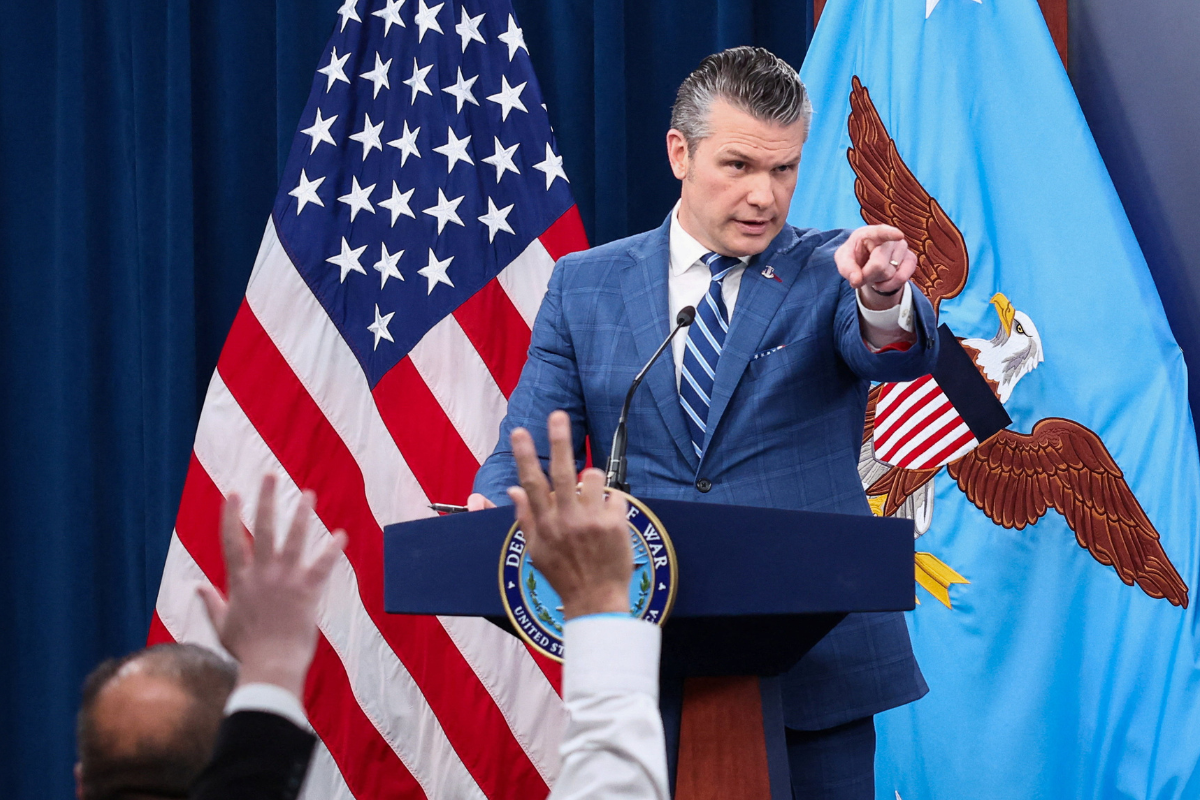

The Pentagon on April 8 stated that the U.S. military has accomplished its objectives in Iran but is ready to “resume combat operations” if needed.
U.S. War Secretary Pete Hegseth told reporters a day after U.S. President Donald Trump announced a two-week cease-fire that Iran’s military capabilities have been decimated, with its missile program being “functionally destroyed.”
“Together with our Israeli partners, America’s military achieved every single objective on plan, on schedule, exactly as laid out from day one,” Hegseth said.
The war secretary called Operation Epic Fury “a historic and overwhelming victory on the battlefield,” noting that the United States, in fewer than 40 days, used less than 10 percent of its total combat power to dismantle “one of the world’s largest militaries.”
“Iran’s Navy is at the bottom of the sea—whether it’s the Soleimani class, their frigate class, their prized drone aircraft carriers, submarines, mine layers—sunk,” Hegseth said.
“Iran’s Air Force has been wiped out. Iran no longer has any sort of a comprehensive air defense system. We own their skies. Their missile program is functionally destroyed. Launchers, production facilities, and existing stockpiles [are] depleted and decimated and almost completely ineffective.”
He said that the Iranian military’s command and control “is so decimated they can’t really talk and coordinate,” meaning that there may be some limited shooting, “but that would be very, very unwise.”
Also present at the press briefing was Gen. Dan Caine, chairman of the Joint Chiefs of Staff, who told reporters that the Pentagon welcomed the cease-fire but that U.S. forces are ready to resume combat missions if necessary.
“We hope that Iran chooses a lasting peace,” Caine said.
“Let us be clear: A cease-fire is a pause, and the joint force remains ready—if ordered or called upon—to resume combat operations with the same speed and precision as we’ve demonstrated over the last 38 days.”
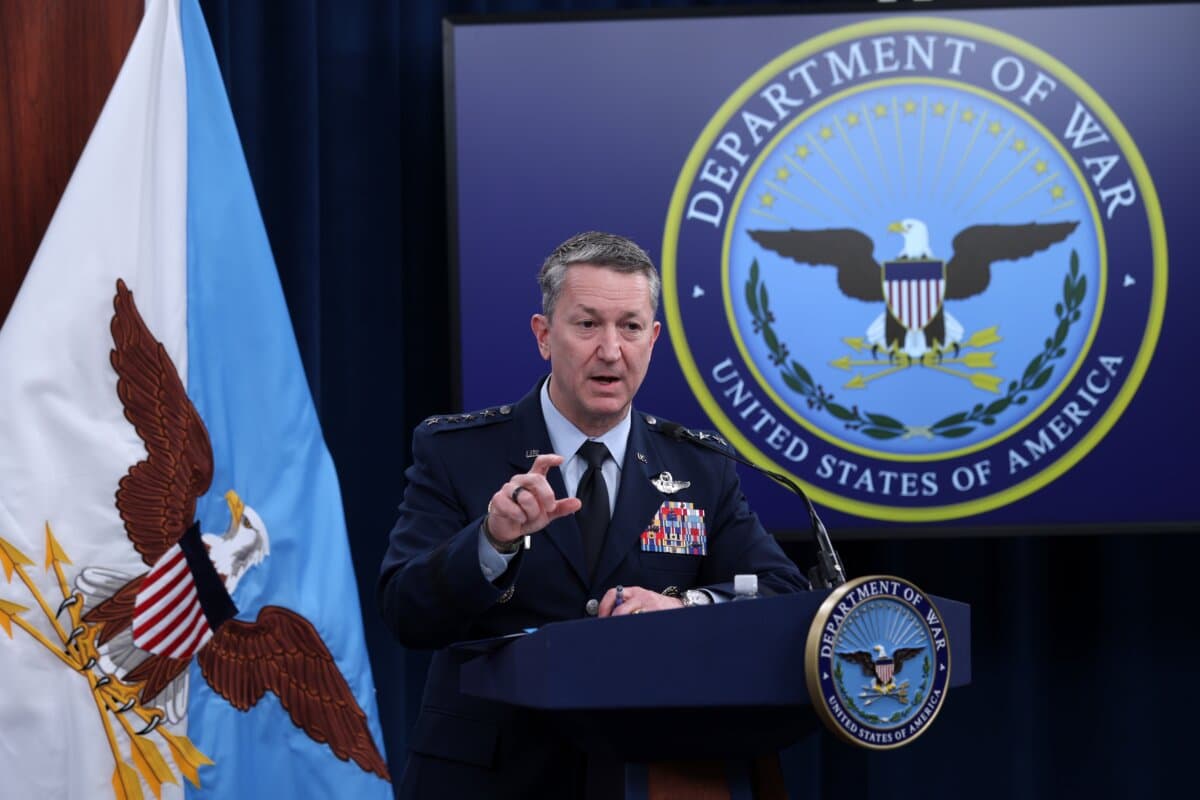
Chairman of the Joint Chiefs of Staff Gen. Dan Caine speaks during a press conference at the Pentagon in Arlington, Va., on March 2, 2026. (Alex Wong/Getty Images)
The remarks came after Trump threatened the bombing of Iran’s power plants and bridges unless Tehran agreed to the complete and immediate reopening of the Strait of Hormuz.
About an hour and a half before the deadline, the president announced in a post on Truth Social a two-week suspension of attacks on Iran, following discussions with Pakistan, which has been a key mediator between the United States and Iran.
“Based on conversations with Prime Minister Shehbaz Sharif and Field Marshal Asim Munir, of Pakistan, and wherein they requested that I hold off the destructive force being sent tonight to Iran, and subject to the Islamic Republic of Iran agreeing to the COMPLETE, IMMEDIATE, and SAFE OPENING of the Strait of Hormuz, I agree to suspend the bombing and attack of Iran for a period of two weeks,” Trump said on the social media platform.
He said in his April 7 Truth Social post that Iran’s 10-point proposal was a “workable basis on which to negotiate.”
“This will be a double sided CEASEFIRE! The reason for doing so is that we have already met and exceeded all Military objectives, and are very far along with a definitive Agreement concerning Longterm PEACE with Iran, and PEACE in the Middle East,” he wrote.
The president said almost all of the points of past contention have been resolved between Washington and Tehran and that the two-week cease-fire will allow an agreement to be finalized.

U.S. President Donald Trump, accompanied by U.S. War Secretary Pete Hegseth and Chairman of the Joint Chiefs of Staff Gen. Dan Caine, at the White House on March 18, 2026. (Andrew Harnik/Getty Images)
The U.S. military will remain in the Strait of Hormuz to ensure that Tehran complies with the cease-fire, according to Hegseth.
He told reporters on April 8 that the U.S. military will be “hanging around.”
“We’re not going anywhere,” Hegseth said. “We’re going to make sure Iran complies with this ceasefire and then, ultimately, comes to the table and makes a deal.”
Acknowledging Caine’s earlier remarks about the military being ready to return to offensive measures if need be, the war secretary said that U.S. forces are “prepared to restart at a moment’s notice with whatever target package would be needed in order to ensure that Iran complies.”