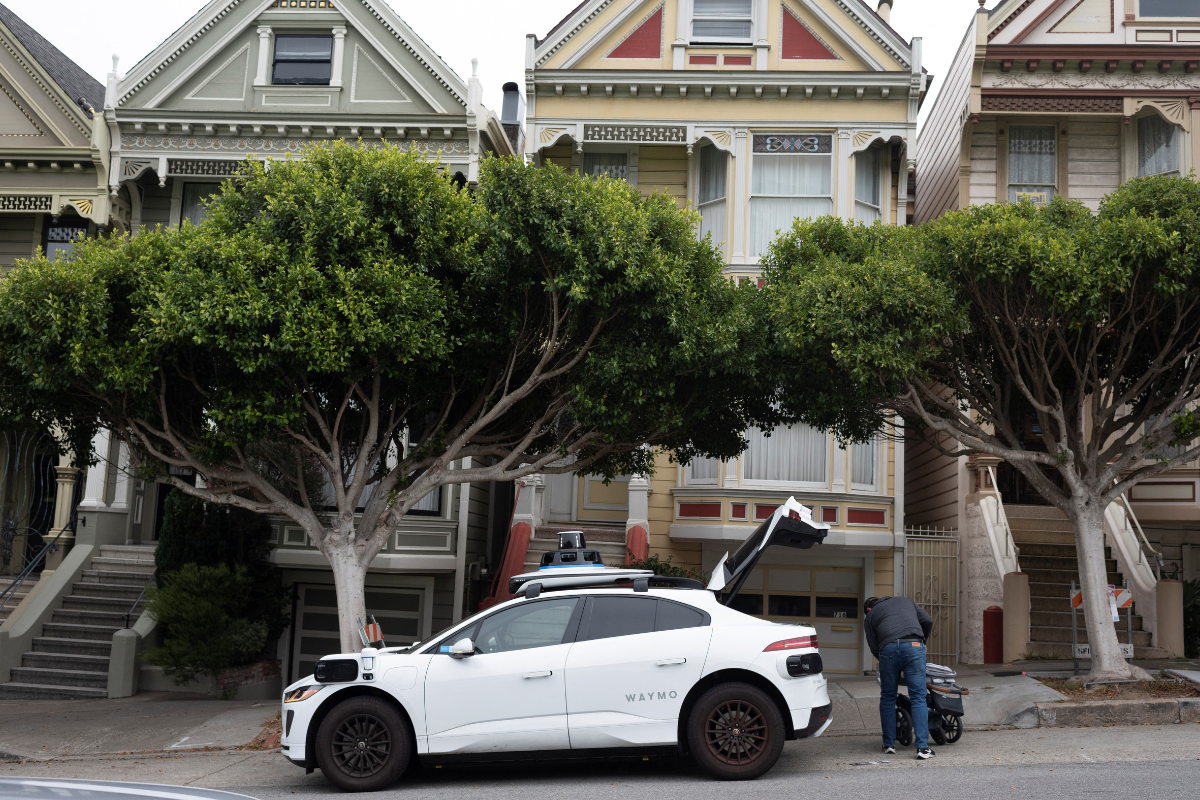

Waymo autonomous vehicles (AVs) stopped and blocked traffic in San Francisco on Dec. 20 after traffic lights stopped working because of an electrical power outage caused by a substation fire, forcing the company to temporarily suspend services.
The robotaxi company said its vehicles are designed to treat nonfunctioning traffic lights as four-way stops but that the scale of the outage had created unusual conditions. Therefore, the company paused services, resuming on the afternoon of Dec. 21.
“While the failure of the utility infrastructure was significant, we are committed to ensuring our technology adjusts to traffic flow during such events,” a spokesperson for Waymo, owned by Google’s parent company, Alphabet, said.
The spokesperson said that throughout the outage, Waymo coordinated closely with city officials. Most journeys were completed before vehicles were either returned to depots or pulled over.
The outage was caused by a fire at a substation at Eighth Street and Mission Street on Dec. 20 and left a large section of the city’s northern part without power, affecting 130,000 homes and businesses.
Power was restored to the bulk of customers by Dec. 21, with Pacific Gas and Electric Co (PG&E) continuing to work in the following days to restore electricity.
PG&E provided an update on X on Dec. 22, saying it was continuing repairs to restore power to the remaining 3,800 customers affected and that power should be fully restored by 6 a.m. local time on Dec. 23.
Concerns Over Autonomous Vehicles
The road-blocking problems have raised questions over the ability of autonomous vehicles to adapt to unpredictable or real-world driving conditions.
Philip Koopman, professor emeritus at Carnegie Mellon University and a specialist on self-driving vehicle safety, said the scale of the disruption was concerning.
“What if this had been an earthquake? You would have thousands of robotaxis blocking the road,” Koopman said.

Waymo robotaxis sit parked at a Waymo facility in San Francisco on Dec. 8, 2025. (Justin Sullivan/Getty Images)
Earlier this month, footage of three Waymos went viral on social media after having a “standoff” on a street in San Francisco.
In the TikTok video posted on Dec. 6, one Waymo AV is facing uphill in a neighborhood and has slightly collided with another Waymo car that was apparently pulling out of a driveway. Both cars had stopped in the street and were blocking a third Waymo car that was trying to go down the road.
In an email to The Epoch Times, a Waymo spokesperson confirmed the incident, saying: “While making a multi-point turn on a congested dead-end street, two unoccupied Waymo vehicles made minor contact at a low speed. ... Our roadside assistance team recovered the vehicles and drove them back to the depot manually.”
San Jose State University professor Ahmed Banafa told The Epoch Times that Waymo’s safety systems worked but that the incident exposed a weakness in how AVs handle complex situations involving other AVs.
Banafa said that self-driving cars “still lack the ‘social instincts’ of human drivers.”
“Humans use subtle cues like eye contact and body language to resolve these moments; AVs rely on rigid rules, which can lead to hesitation or confusion when multiple AVs meet,” he said.
Expanding Self-Driving Cars
Waymo was approved to operate in California in August 2023. It has hundreds of robotaxis in San Francisco and operates in other Californian cities such as Los Angeles and San Jose, as well as in Arizona, Florida, Georgia, and Texas.
The company is expanding its services globally, announcing in October that it will make its robotaxis available in London next year.
Other AV taxi services are entering the UK market. On Dec. 22, Uber and Lyft announced pilot programs for autonomous ride-hailing services in London in 2026, in separate partnerships with Chinese tech giant Baidu.
Several locations around the world are also positioning themselves to test the technology, including Switzerland. WeRide announced in November that it had received a permit to operate in the Furttal region of the Swiss canton of Zurich, expecting to launch a fully driverless passenger service in the first half of 2026.
Other AV brands have obtained licenses or are trialing their services in Abu Dhabi, China, Hong Kong, Japan, and Singapore.
Lear Zhou, The Associated Press, and Reuters contributed to this report.