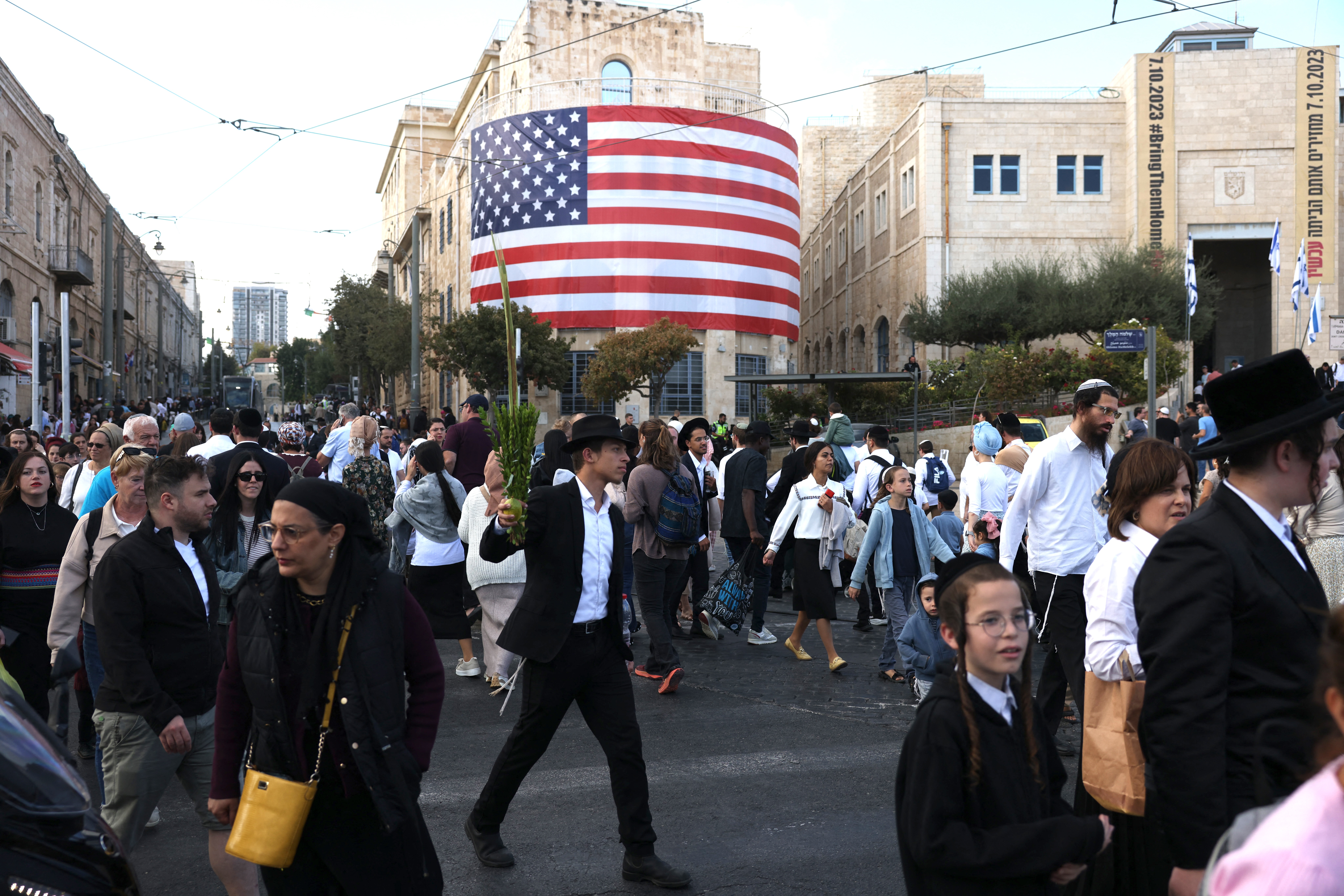

TEL AVIV—The Israeli Ministry of Defense announced that it has completed preparations to receive U.S. President Donald Trump at Ben Gurion Airport early on the morning of Oct. 13. A roughly 160-foot red carpet has been laid out at the center of the ceremonial plaza, alongside a platform for reporters and photographers, and dozens of Israeli and U.S. flags are flying.
At 11 a.m. local time (4 a.m. EDT), a trumpet fanfare will announce the president’s entrance into the Knesset plenum.
Knesset Speaker Amir Ohana, Opposition Leader Yair Lapid, and Prime Minister Benjamin Netanyahu will address the assembly in a special session convened in Trump’s honor. Their speeches will be followed by the U.S. president’s speech.
So far, only three U.S. presidents have addressed the Israeli parliament: President Jimmy Carter in 1979, President Bill Clinton in 1994, and President George W. Bush in 2008.
As part of preparations for the state visit, the Knesset building has been illuminated in the colors of both nations’ flags—blue, white, and red. Interior screens will display messages in both Hebrew and English, featuring a special event logo designed for the occasion. Two viewing areas have been designated for guests inside the building, and the event will be broadcast live via satellite worldwide.
“The visit of the U.S. president, against the backdrop of the framework for the release of our abductees, is accompanied by great emotion and expectation,” said Erez Tsidon, head of the Amun division of the Ministry of Defense, which is responsible for the reception. “Members of the Amun division have been working around the clock in recent days to ensure everything goes according to plan and that the event proceeds successfully and with dignity.”
On Oct. 11, Israel Defense Forces (IDF) Chief of Staff Lt. Gen. Eyal Zamir conducted a field tour in the Gaza Strip with U.S. Middle East envoy Steve Witkoff, Trump’s son-in-law Jared Kushner, and the commander of U.S. Central Command, Admiral Brad Cooper, among other senior commanders. Afterward, they visited the facility at the Re’im base that will receive returning hostages.
Senior Israeli political sources told Epoch Magazine in Israel that the agreement to implement the first phase of the Trump-brokered peace plan is a historic accord, representing the achievement of one of the war’s principal goals—the release of the last of the hostages taken by the Hamas terrorist group on Oct. 7, 2023.
The sources said the agreement is a direct result of Israeli military pressure on Hamas in the Gaza Strip and of the considerable assistance and backing of Trump, who succeeded in assembling an Arab-Islamic coalition to apply pressure on Hamas.
The return of all Israeli hostages, both living and dead, will immediately strip Hamas of its main leverage against Israel.
The next stage of the deal is expected to be the disarmament of Hamas and the demilitarization of the Gaza Strip, and in practice, Hamas will no longer remain a functioning governing body in the Gaza Strip—although it is not yet clear whether Hamas will agree to the U.S. plan for this part.
Israeli Defense Minister Israel Katz wrote in a post on X early on Oct. 12: “Israel’s great challenge after the phase of returning the hostages will be the destruction of all of Hamas’s terror tunnels in Gaza, directly by the IDF and through the international mechanism to be established under the leadership and supervision of the United States.
“This is the primary significance of implementing the agreed-upon principle of demilitarizing Gaza and neutralizing Hamas of its weapons.
“I have instructed the IDF to prepare for carrying out the mission.”
Shifting Battle Lines Inside Gaza
Hamas retains a reduced military leadership in the Gaza Strip led by Izz al-Din al-Haddad, with two other brigade commanders and several battalion commanders.
After the withdrawal of IDF forces in the Gaza Strip to the agreed-upon lines, a Telegram channel associated with Hamas’s military wing reported on Oct. 10 the launch of a wide-ranging operation against local Palestinian militias that collaborated with Israel during the war in the Gaza Strip.
The channel, called The Deterrent—The Force on the Ground, posted a short statement saying: “Across the Gaza Strip our strikes continue from north to south. The Deterrent’s hand is striking now at the lairs of betrayal and collaboration.”
According to reports from the Gaza Strip, on the night between Oct. 10 and Oct. 11, clashes took place in northern Gaza between Hamas forces and militia members whose activity is centered in Beit Lahia. According to reports, Hamas detained 17 of those militiamen. Hamas is also contending with two additional militias in the southern Gaza Strip that oppose it.
Hamas is portraying its mere survival of the organization in the Gaza Strip—despite the severe blow that the IDF inflicted on its military wing—as a “victory.”
Israel’s key challenge will be maintaining security in the West Bank. Senior security officials who spoke with Epoch Magazine in Israel predict that Hamas plans to turn the West Bank into its new theater of operations against Israel, led by Zaher al-Jabarin, head of Hamas’s military wing in the West Bank.
On Oct. 8, the IDF spokesman reported that Israeli forces had intercepted a weapons shipment sent by Iran’s Islamic Revolutionary Guard Corps (IRGC) and its Quds Force special operations unit to terrorists in the West Bank. The shipment reportedly contained asymmetric weapons, including anti-tank rockets, claymore-type charges, drones capable of carrying explosives, hand grenades, and machine guns. The statement noted that this seizure follows the foiling of similar weapons-smuggling attempts uncovered earlier this year.
Senior security officials told Epoch Magazine in Israel that they estimate that the release of hundreds of “heavy” terrorists as part of implementing the first phase of the agreement could strengthen Hamas in the West Bank and ignite a new wave of terror.
One senior security official told Epoch Magazine in Israel that Hamas is on the verge of defeat in the Gaza Strip, but that it will not raise a white flag in its war against Israel. It will concentrate its efforts in the West Bank to build new terror infrastructure, from which it will dispatch terrorists to carry out massacres and suicide attacks against Israelis.