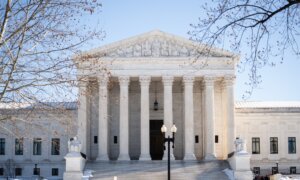

The U.S. Supreme Court late on May 11 cleared the way for Alabama to redraw its congressional election map to comply with the court’s landmark ruling limiting the use of race in redistricting.
The court’s new decision took the form of a brief, unsigned order.
The Supreme Court vacated lower court rulings that required Alabama to use a congressional map that included two majority-black districts out of the state’s seven districts.
The justices waived the usual waiting period and ordered that the new ruling take effect immediately.
Alabama and several other GOP-led states are currently in the process of an unusual mid-decade redistricting they hope will help Republicans retain control of the U.S. House of Representatives in the November elections.
The high court ruled last month in Louisiana v. Callais that race may be only a minor factor in redistricting rationales, not the predominant, overriding reason for how congressional district lines are drawn.
Federal courts had been incorrectly applying the Supreme Court precedents on the federal Voting Rights Act’s Section 2 nondiscrimination provisions “in a way that forces States to engage in the very race-based discrimination that the Constitution forbids,” the high court said in the Callais ruling.
Alabama Attorney General Steve Marshall praised the new ruling, which he said “vindicated the state’s long held position” that the state should not have to draw electoral maps “around race.”
“For too long, unelected federal judges have had more say over Alabama’s elections than Alabama’s voters. That ended today,” Marshall said in a video posted on X.
“My job in this office was to put the legislature in the best possible legal position to draw a congressional map that favors Republicans, seven to zero,” he added.
Election attorney J. Christian Adams, president and general counsel of the Public Interest Legal Foundation, questioned whether Alabama may lawfully draw a map with no black-majority districts.
There is “no way in my view Alabama could have zero without violating the Voting Rights Act,” he told The Epoch Times.
Justice Sonia Sotomayor filed a dissenting opinion, which was joined by two justices, Elena Kagan and Ketanji Brown Jackson.
Sotomayor noted that the majority’s new decision vacates a federal district court ruling that blocked Alabama’s 2023 redistricting plan and sent it back to that court for reconsideration in light of the high court’s new interpretation of the non-discrimination provisions of the federal Voting Rights Act.
“There is no reason to do so,” she said.
In addition to finding that Alabama’s plan violated the Voting Rights Act, the district court held in one of three cases before this court that the state violated the 14th Amendment by deliberately diluting the voter power of black citizens in Alabama, Sotomayor said.
“That constitutional finding of intentional discrimination is independent of, and unaffected by, any of the legal issues discussed in Callais,” so vacating the district court ruling is “inappropriate and will cause only confusion as Alabamians begin to vote in the elections scheduled for next week,” she said.
The Epoch Times reached out to Abha Khanna of Elias Law Group in Seattle for comment. Khanna is the attorney for lead respondent Marcus Caster, who was a Democratic candidate for the Alabama House of Representatives in 2022. No reply was received by publication time.
On May 8, Alabama Gov. Kay Ivey, a Republican, signed legislation authorizing a new primary election in anticipation of a favorable court ruling in the state’s ongoing redistricting litigation.
A May 19 primary will still take place, Ivey said in a statement at that time, but if the court-issued injunctions are lifted in Alabama’s redistricting case, she may call for a special election for certain state Senate and congressional districts where boundary lines would change as a result of a reversion to older district maps.
“With this special session successfully behind us, Alabama now stands ready to quickly act, should the courts issue favorable rulings in our ongoing redistricting cases,” Ivey said.