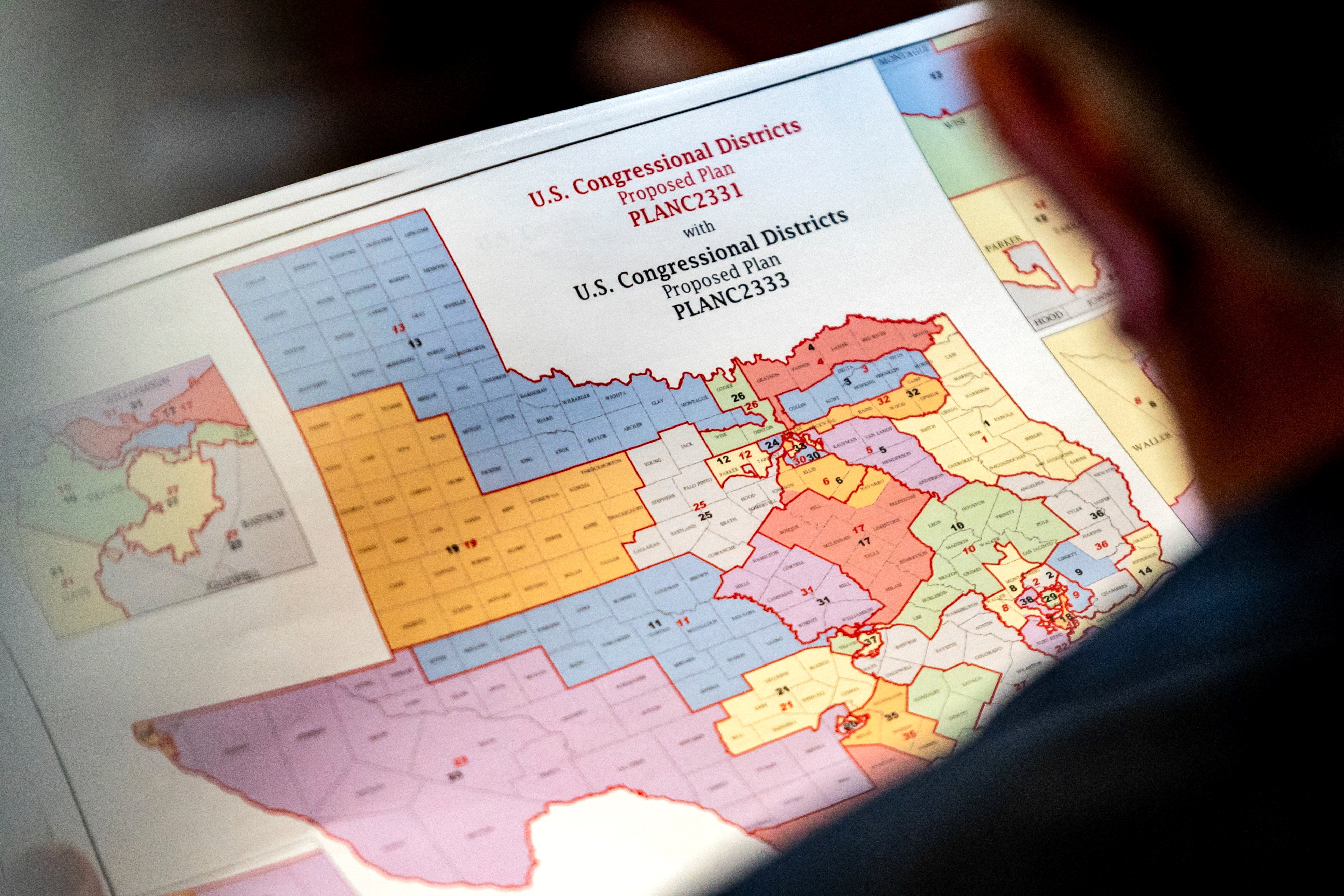

The U.S. Supreme Court ordered late on Dec. 4 that a redrawn election map expected to increase Republican representation in Texas’s U.S. House delegation remain in place.
The court’s new unsigned order in League of United Latin American Citizens v. Abbott was issued over the dissents of Justices Sonia Sotomayor, Elena Kagan, and Ketanji Brown Jackson.
Justice Samuel Alito filed an opinion concurring in the order. Justices Clarence Thomas and Neil Gorsuch joined the concurrence.
On Nov. 21, the Supreme Court took action hours after Texas appealed a federal district court ruling striking down the election map passed earlier this year. Under the federal Voting Rights Act, the state is allowed to file an appeal directly with the Supreme Court, bypassing the U.S. Court of Appeals for the Fifth Circuit.
Alito, who oversees urgent appeals from Texas, issued an administrative stay on that date, halting the lower court ruling. An administrative stay temporarily preserves the status quo while giving justices more time to consider a case.
Republicans currently enjoy a razor-thin majority over Democrats in the House of Representatives, and Texas Republicans currently hold 25 of the state’s U.S. House seats. Democrats hold 12 seats. Congressional elections are scheduled for Nov. 3, 2026.
A three-judge panel of the U.S. District Court for the Western District of Texas held 2–1 on Nov. 18 that the state may not use the new map because “substantial evidence shows that Texas racially gerrymandered the 2025 Map.”
In the federal district court’s majority opinion, Judge Jeffrey V. Brown said that “the Plaintiff Groups are likely to prove at trial that Texas racially gerrymandered the 2025 Map.”
Gerrymandering refers to the manipulation of electoral district boundaries to benefit a particular party or constituency. The Supreme Court has previously ruled that race-based gerrymandering violates the U.S. Constitution but that redrawing district boundaries to boost partisan fortunes passes constitutional muster.
U.S. Circuit Judge Jerry E. Smith, who sat on the panel, filed a strongly worded dissenting opinion, describing the ruling as the “most blatant exercise of judicial activism” he has ever witnessed.
In its new order, the Supreme Court majority wrote, “Based on our preliminary evaluation of this case, Texas satisfies the traditional criteria for interim relief.”
The state is likely to succeed in its claim that the district court “committed at least two serious errors,” the high court said.
First, by “construing ambiguous direct and circumstantial evidence against the legislature,” the district court failed to honor the legal presumption that the Texas Legislature acted in good faith.
Second, the district court “failed to draw a dispositive or near-dispositive adverse inference against [the] respondents even though they did not produce a viable alternative map that met the State’s avowedly partisan goals,” the Supreme Court said.
The high court said Texas also made “a strong showing” that it would suffer irreparable harm if the district court’s ruling were not stayed. The district court “violated” the Supreme Court’s ruling in Republican National Committee v. Democratic National Committee (2020), which held that lower federal courts should avoid altering election rules on the eve of an election.
“The District Court inserted itself into an active primary campaign, causing much confusion and upsetting the delicate federal-state balance in elections,” the Supreme Court majority wrote.
The ruling states that the new order would remain in effect throughout an appeal should the respondents file one with the Supreme Court.
Alito wrote in his opinion that he was concurring because “Texas needs certainty on which map will govern the 2026 midterm elections.”
“[The district court failed] to apply the correct legal standards as set out clearly in our own case law,” the justice said.
Kagan wrote a dissenting opinion that was joined by Sotomayor and Jackson.
After a nine-day hearing and the introduction of thousands of exhibits, the district court issued a 160-page opinion that struck down the map at issue, finding that “Texas largely divided its citizens along racial lines to create its new pro-Republican House map, in violation of the Fourteenth and Fifteenth Amendments,” Kagan said.
“[Yet the Supreme Court reversed that judgment] based on its perusal, over a holiday weekend, of a cold paper record,” she wrote.
“[Today’s order] disrespects the work of a District Court that did everything one could ask to carry out its charge ... [and] disserves the millions of Texans whom the District Court found were assigned to their new districts based on their race,” the dissenting opinion reads.
Kagan also said the kind of urgency described in Republican National Committee v. Democratic National Committee does not exist in this case because Texas is not “on the eve of an election.”
In that precedent, the election was five days after the injunction was granted, she said, but in Texas, the general election is 11 months from now and the primary election is five months away.
“The majority today loses sight of its proper role ... [and in the process] ensures that many Texas citizens, for no good reason, will be placed in electoral districts because of their race,” Kagan wrote.
“And that result, as this Court has pronounced year in and year out, is a violation of the Constitution.”