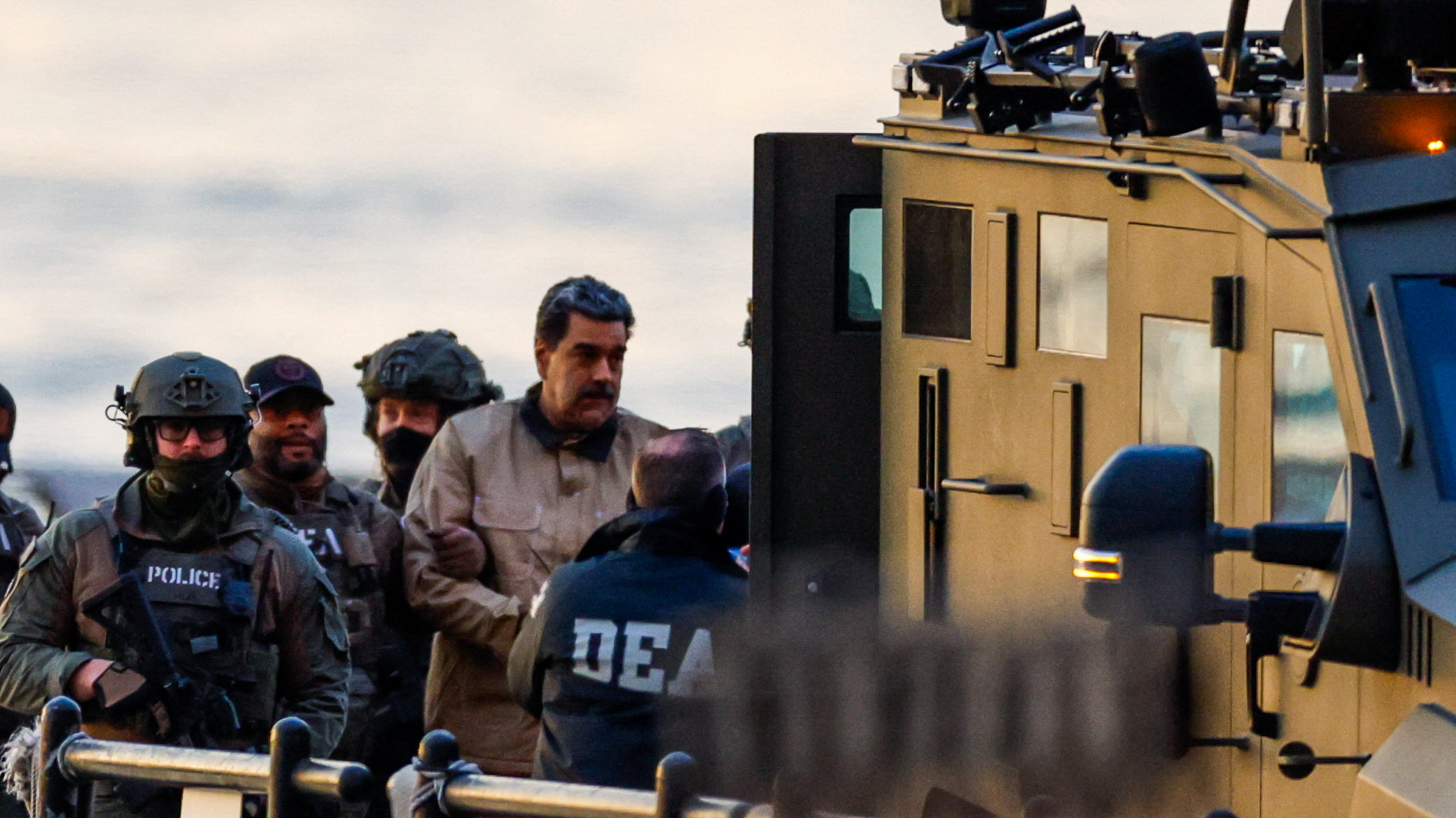
NEW YORK CITY—Deposed Venezuelan leader Nicolás Maduro and his wife, Cilia Flores, made their first court appearance on Jan. 5 after a surprise capture by the United States just days earlier in Caracas.
Both pleaded not guilty while offering some statements on the case. Their brief appearance came after the Justice Department brought a four-count indictment naming Maduro, his wife, and others.
They’re charged with narco-terrorism conspiracy, cocaine importation conspiracy, possession of machine guns and destructive devices, and conspiracy to possess those items.
Here are some of the main takeaways and what to expect from the case.
Maduro and Wife Plead Not Guilty
Maduro, 63, and Flores, 69, maintained their innocence and described themselves as the leaders of their country.
“My name is Nicolas Maduro Moros, president of the Constitutional Bolivarian Republic of Venezuela,” Maduro said in comments interpreted from Spanish. He was wearing a blue prison uniform during the brief hearing.
In Spanish, Flores said, “I am first lady of the Republic of Venezuela.”
Maduro pleaded not guilty, saying: “I am innocent. I am not guilty of anything that is mentioned here.”
Flores said: “Not guilty. Completely innocent.”
During his plea, Maduro began making statements about his apprehension by the United States. The judge interrupted Maduro and stopped him from speaking further.
Their statements came after the Trump administration accused Maduro of partaking in a narco-terrorism scheme.
Multiple countries, including the United States, also do not recognize Maduro as the legitimate winner of Venezuela’s election in 2024.
In a Jan. 3 post to social media, U.S. Secretary of State Marco Rubio said Maduro “is NOT the President of Venezuela and his regime is NOT the legitimate government.” He said that Maduro was “the head of Cartel de Los Soles, a narco-terror organization which has taken possession of a country.”
Back in Venezuela, Maduro’s deputy Delcy Rodríguez has been sworn in as interim leader. The question of Maduro’s status as a foreign leader could impact how the case proceeds.
Attorney Questions Arrest
During the hearing, Maduro’s attorney, Barry Pollack, said that his client was “the head of a sovereign state and entitled to privilege.” Previewing the coming litigation, Pollack said there would be “voluminous” pretrial filings.
Maduro also questioned the legality of the arrest. After the judge asked whether Maduro understood his right to remain silent and other rights, Maduro said, “I did not know of these rights.”
In praising the capture operation, Rubio said on Jan. 4 that Maduro was read his rights.
“The guy lived on a military base,” he said during an appearance on CBS’s “Face the Nation.” “Land within three minutes, kick down his door, grab him, put him in handcuffs, read him his rights, put him in a helicopter, and leave the country without losing any American or any American assets—that’s not an easy mission.”
Neither Maduro nor his wife sought bail but requested the ability to seek it at a future date. Maduro also requested a consular visit.
Wife Seeks Medical Attention
A government attorney said that Maduro and his wife were taken into custody at 11:30 a.m. on Saturday, and their plane landed in New York that same day at 4:31 p.m.
Flores’ attorney Mark Donnelly said that he believed his client suffered “significant injuries” during her capture. Donnelly said that Flores, who could be seen with her eyelid and temple bandaged, had a potentially fractured rib.
U.S. District Judge Alvin Hellerstein, who is overseeing the case, directed prosecutors to ensure Flores received care.
Confrontation With Protester
Maduro’s capture was met with celebration from some and criticism from others. In court, an audience member confronted the former dictator, prompting a brief exchange between the two.
Pedro Rojas, a Venezuelan asylum seeker who came to the United States in 2019, was in the audience and told Maduro, “In the name of the people of Venezuela, you will pay.”
“I am a man of God,” Maduro responded. He added that he was a “kidnapped president.” Rojas was scolded by the U.S. Marshals Service, but was not arrested and exited the courthouse along with others in the audience.
“What we want is for the full weight of the law to fall upon Maduro. ... Maduro is being fed, he is requesting medical treatment, all things that political prisoners in Venezuela have never received,” Rojas, a former political prisoner, said in response to a question from The Epoch Times at a gaggle after the hearing.
He went on to call Maduro a “bloodthirsty tyrant” and apologized “to the U.S. and the U.S. justice system for shouting during the proceedings.”
Alvin Hellerstein Is the Judge
The judge who oversaw the hearing for Maduro is Alvin Hellerstein, the same judge overseeing lingering aspects of the case brought in New York against Trump alleging falsified business records.
Trump has maintained his innocence but was found guilty and sentenced to an unconditional discharge, with no jail time or other punishment, just before beginning his second term of office. He attempted to remove the case to federal court, but that motion was rejected by Hellerstein, who was, in turn, instructed by an appeals court to further review the case.
Hellerstein is a senior judge who has been serving in the Southern District of New York since the 1990s.
More recently, Hellerstein ruled that Trump wrongly invoked the Alien Enemies Act to deport purported members of the Venezuelan gang Tren de Aragua.
The Associated Press and Emel Akan contributed to this report.