

Hospitals that benefit from a government program intended to help safety-net institutions end up spending less on charity care than other hospitals, a new study has found, as federal policymakers move to reform the $244 billion initiative.
The 340B Drug Pricing Program allows certain healthcare providers to buy prescription drugs at a steep discount and sell them to patients at retail prices, keeping the difference to supplement their income.
The program was created more than 30 years ago to give a financial boost to rural hospitals, hospitals serving a disproportionate share of Medicaid patients, and other safety-net healthcare providers.
The Affordable Care Act, also known as Obamacare, allowed many more hospitals to join the program. At the same time, hospitals, physician practices, and other providers were consolidating into large healthcare conglomerates.
Within a few years, the 340B program swelled from a relatively small initiative by federal standards to a major revenue source bringing billions of dollars a year into increasingly larger healthcare systems.
Now, a report from the Pioneer Institute shows that hospitals participating in the program spend less on charity care than do other hospitals.
Income Up
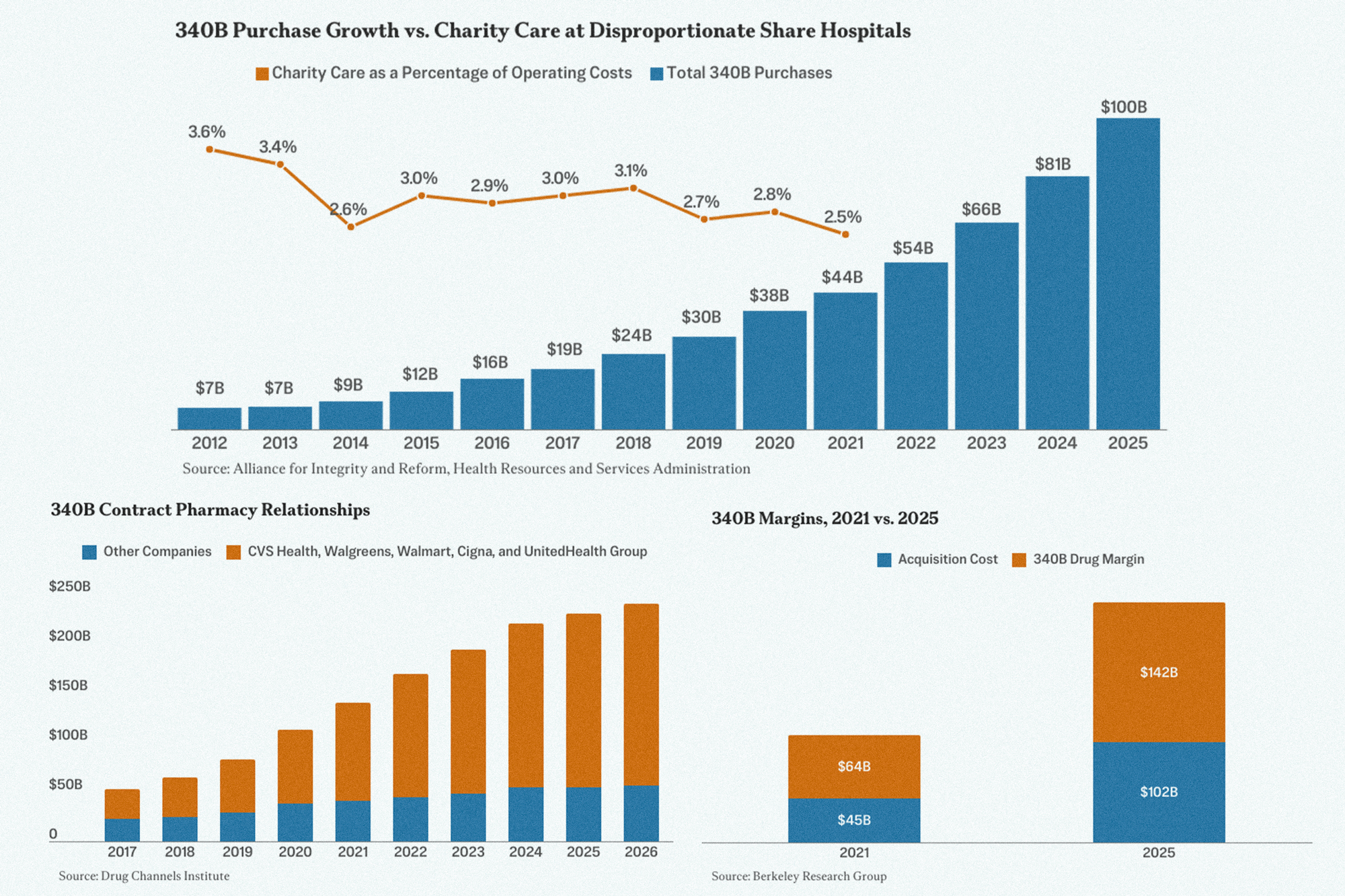
The markup on those drugs netted the covered entities more than $142 billion that year, a margin shared with contract pharmacies and vendors, Berkeley Research Group (BRG) estimated. In some cases, they bought the products for as little as one cent.
That’s possible, in part, because the hospitals don’t have to handle the sales directly. They can sell them through outside contract pharmacies as long as the prescription was written for a patient of the hospital by any physician working at a site the hospital owns.
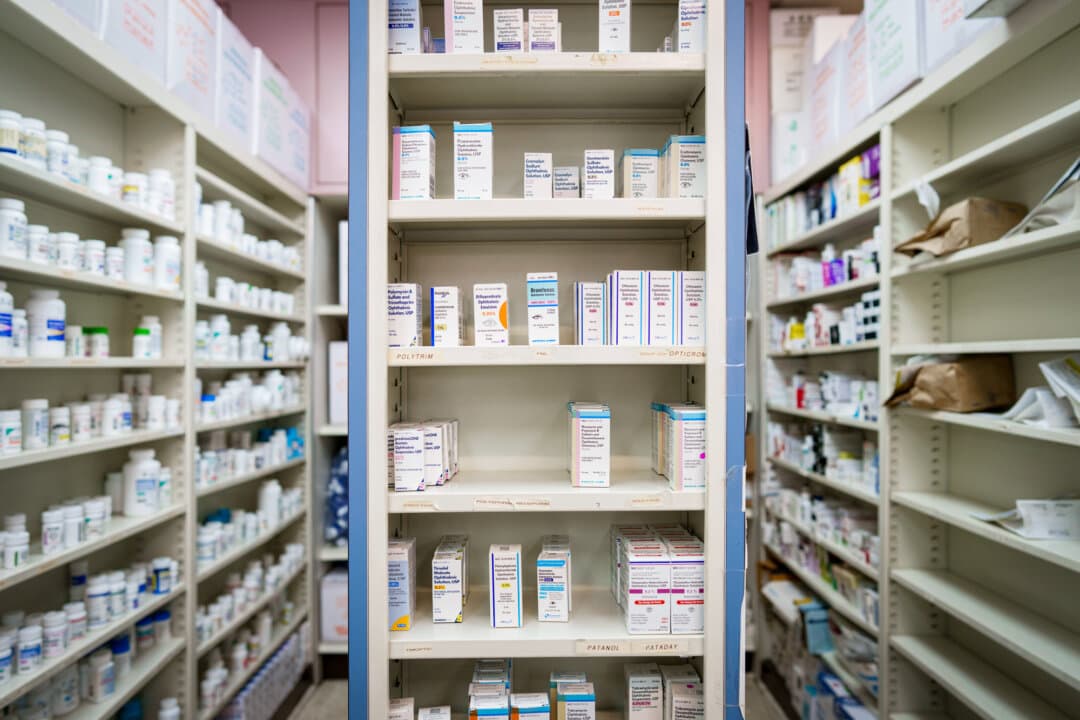
Medications are stored at a pharmacy in Los Angeles on May 12, 2025. The 340B Drug Pricing Program allows certain healthcare providers to buy prescription drugs at a steep discount and sell them to patients at retail prices, keeping the difference to supplement their income. (Eric Thayer/Getty Images)
The 1,150 participating hospitals operated more than 28,000 off-site entities in 2025, including physician practices, outpatient surgery centers, and other freestanding healthcare facilities.
From 2020 to 2025, 340B sales grew by 152 percent, nearly three times the growth of all drug sales in the United States, with margins more than doubling, according to BRG.
Patients and payers spent $244 billion on drugs bought under the program last year, BRG found. These drugs cost covered entities $100 billion, according to data from the Health Resources and Services Administration.
The law does not specify how hospitals and other covered entities must spend the profits.
A report funded by PhRMA, a trade group representing drugmakers that provide the 340B discount, found that 60 percent of the money spent on drugs bought under the program “is retained as profit by hospitals, clinics, and their for-profit partners.”
The American Hospital Association said growth in the program is directly linked to the drug prices pharmaceutical manufacturers set.
“Growth in the program reflects decisions made to expand its reach to underserved populations, including children, cancer patients, and rural communities,” former American Hospital Association CEO Rick Pollack wrote in an op-ed published by The Washington Post earlier this year responding to criticism of the 340B program. “The more drug companies charge for drugs, the greater the discounts and the larger the growth in the program.”
Charity Care Down
Only certain hospitals and clinics are eligible for the 340B program, and all of them are nonprofits.
Nonprofit hospitals receive other benefits, including tax exemption, in exchange for their commitment to provide benefits to their communities. Those benefits include free and discounted services—often called charity care—to patients who cannot afford care.
Yet 340B hospitals spend a smaller share of their operating budgets on charity care: 2.16 percent compared to 2.82 percent at other hospitals, including for-profit hospitals, according to a Pioneer Institute study of 3,999 hospitals.
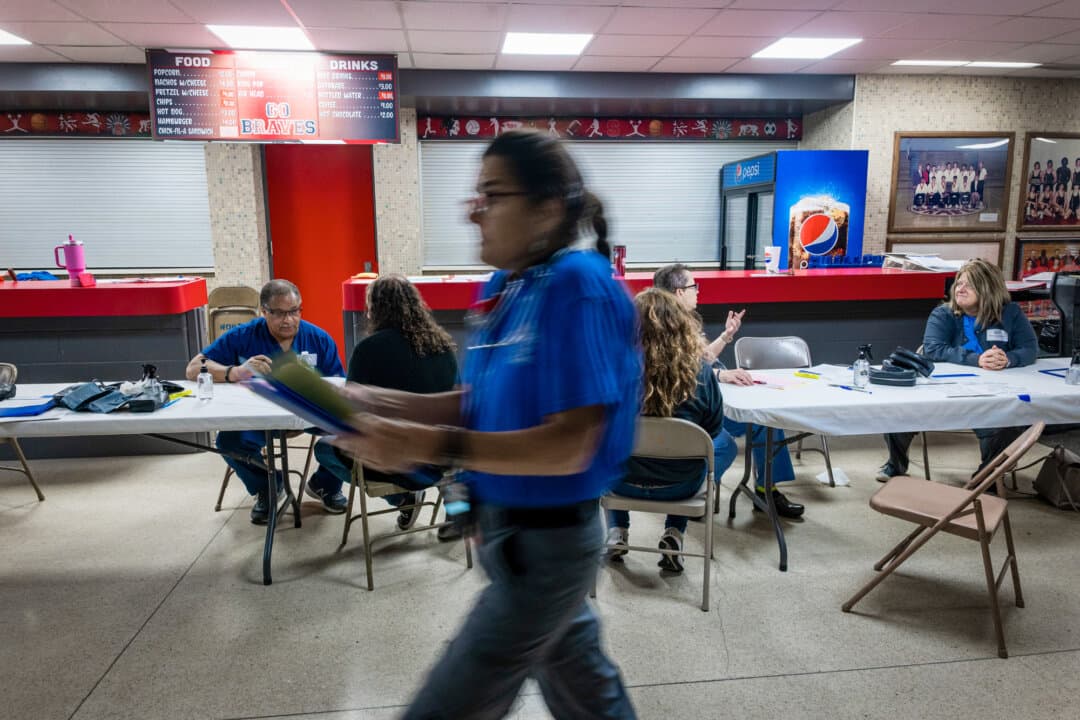
Patients register for care at a mobile dental and medical clinic in Terre Haute, Ind., on Aug. 2, 2025. The 340B program is meant to assist hospitals that serve rural areas, those with a disproportionate share of Medicaid patients, or other safety-net healthcare providers. (Spencer Platt/Getty Images)
“The study does not claim that joining 340B causes hospitals to provide less charity care. It shows that the discount does not reliably translate into more help for patients, and that current reporting rules give the public no way to see how 340B savings are used,” the Pioneer Institute’s web summary of the report states.
The 340B hospitals underperformed across multiple charity care measures. These hospitals spent 29 percent less on care for uninsured patients.
According to a 2023 study from Alliance for Integrity and Reform of 340B, two-thirds of 340B disproportionate share hospitals ranked below the national average of 2.5 percent of operating costs in charity care spending. One-third (36 percent) dedicated less than 1 percent of their resources to charity care.
Bharath Krishnamurthy, director of pharmaceutical policy at the American Hospital Association, told The Epoch Times that “a long line of misleading studies” wrongly singles out charity care as the only way to measure how hospitals provide for their patients and communities.
“340B hospitals use their savings in a multitude of ways to maintain, expand, and improve access to care for patients that address the unique needs of the communities they serve,” Krishnamurthy said.
The American Hospital Association estimated that 340B hospitals provided nearly $100 billion in total benefits to their communities in 2022.
Little Oversight
The 340B program was created for providers on federal grant budgets that had to treat patients whether they could afford the care or not, and Congress included very little oversight into the law that created it.
According to a 1992 House committee report, the goal was to allow these providers to “stretch scarce Federal resources as far as possible, reaching more eligible patients and providing more comprehensive services.”
Currently, no federal rule requires 340B hospitals to report how much they receive through the program or how they use that money.
“Revenue is revenue,” Bon Secours Mercy Health, a nonprofit healthcare system with more than 1,200 sites, said in response to a 2023 congressional request for information on the hospital’s use of the 340B revenue. “All revenue is used to pay for expenses incurred in pursuit of our mission.”
Bon Secours Mercy Health realized more than $270 million in 340B savings and revenue from 2018 to 2023.
The Cleveland Clinic’s 340B benefit totaled $933.7 million between 2020 and 2023, and it applied the benefit “to the health system’s overall operating expenses and revenues” to offset the cost of and invest in community healthcare services.
“There is no dollar-for-dollar ‘pass on’ requirement to patients under the 340B statute,” the Cleveland Clinic wrote to Congress.
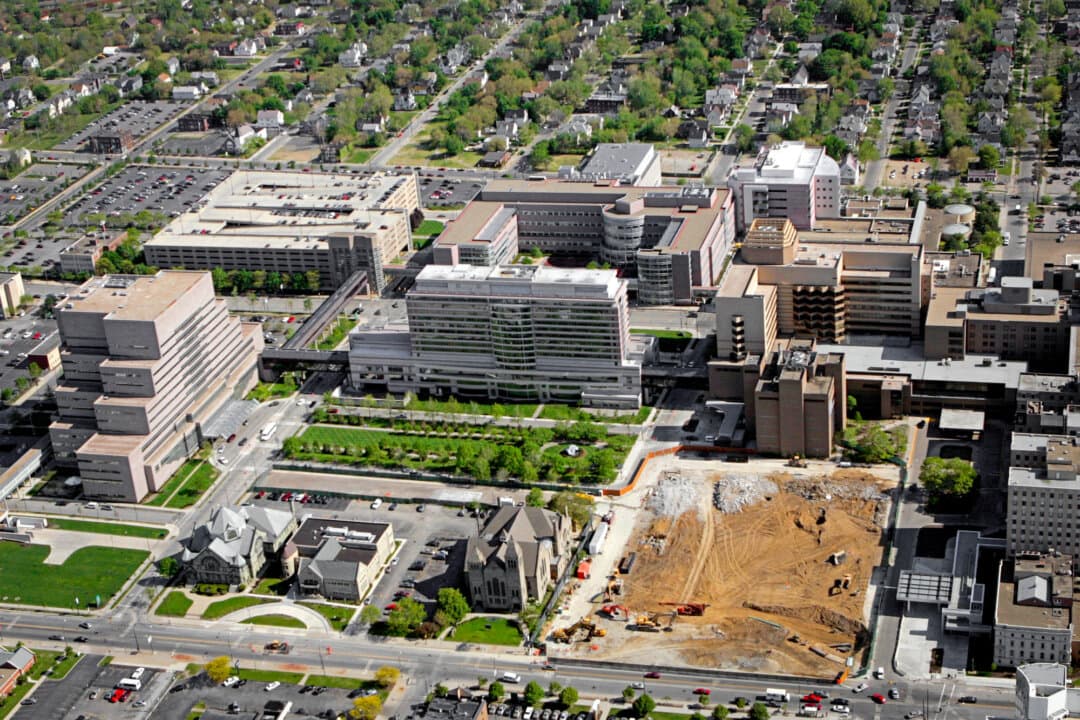
The Cleveland Clinic in Cleveland on May 20, 2005. The clinic's 340B benefit totaled more than $900 million between 2020 and 2023. (Mark Duncan/AP Photo)
William Smith, a senior fellow at the Pioneer Institute, wrote in a summary of the Pioneer Institute study that he thinks that’s a bad idea.
“A discount this big shouldn’t be a mystery,” Smith said. “If it’s reaching the patients in need, that’s the easiest thing for the institutions to prove, but none of those hospitals do, because no one has ever had to.”
Money Flows to For-Profits
Hospitals participating in the 340B program are nonprofits, but they enter business relationships with pharmacies that dispense drugs on their behalf. In Minnesota, these contract pharmacies and third-party administrators capture about 16 percent of the revenue flowing through the program, according to a report from the Minnesota Department of Health.
Contract pharmacies often get flat fees of $6 to $15 per prescription, and some also retain up to 20 percent of the revenue from prescriptions filled for insured patients, according to a sampling of insurance contracts by the Government Accountability Office in 2018.
Five companies account for 77 percent of all 340B pharmacy relationships. They are CVS Health, Walgreens, Walmart, Cigna, and UnitedHealth Group, according to the Drug Channels Institute, a pharmaceutical intelligence company.
“These Fortune 50 companies profit from 340B transactions without directly supporting the program’s safety-net mission,” wrote a team of scholars at the University of Southern California Schaeffer Institute.
For-profit entities reaping financial benefits from the program simply divert more resources away from 340B’s intended purpose, which is to allow safety-net hospitals to stretch scarce resources as far as possible, according to a majority staff report released last year by the Senate Health, Education, Labor, and Pensions Committee under Chair Sen. Bill Cassidy (R-La.).
Proposed Changes
Beginning next year, two federal initiatives could change how 340B discounts are paid and how much Medicaid pays for drugs under the program.
Under a pilot program starting Jan. 1, 2027, providers will pay the list price up front for certain drugs, then submit claims data to receive their 340B discount as a rebate.
The Health Resources and Services Administration said the goal is to get visibility into individual 340B transactions and avoid giving both the 340B discount and the Medicare-negotiated price on the same drug.
Hospital groups are suing to block the pilot. The Maine Hospital Association and four safety-net hospitals filed a lawsuit against the pilot program on Oct. 9. Paying market prices up front and waiting for rebates will cause struggling hospitals to cut back on patient care, the hospitals said.
In July, the Centers for Medicare and Medicaid Services (CMS) proposed a rule that would reduce the markup Medicare pays hospitals on 340B drug sales. Medicare would simply pay hospitals two-thirds of the average sales price for covered drugs, saving beneficiaries and taxpayers an estimated $5.7 billion. The rule, if finalized, would take effect on Jan. 1, 2027.
In a public comment addressed to CMS Administrator Dr. Mehmet Oz, Rep. Mike Lawler (R-N.Y.), joined by five Republican colleagues, asked to reconsider the rate reduction, saying it would result in “a nearly 40 percent reduction in payments to safety net hospitals that utilize the 340B program.”
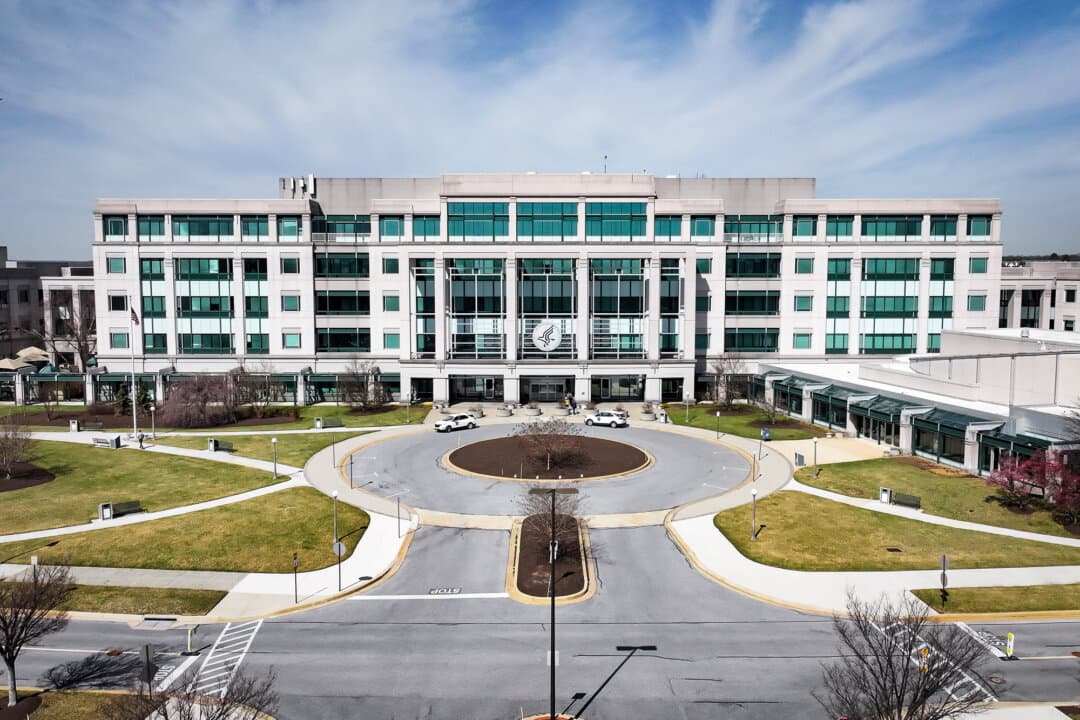
The Centers for Medicare and Medicaid Services (CMS) building in Woodlawn, Md., on March 19, 2025. CMS has proposed a rule that would reduce the markup Medicare pays hospitals on 340B drug sales. (Kayla Bartkowski/Getty Images)