
The Department of Energy (DOE) has identified 11 projects that will receive federal support in advancing “first mover” nuclear energy technologies under the Energy Reactor Pilot Program authorized by President Donald Trump in May.
“President Trump’s Reactor Pilot Program is a call to action,” DOE Deputy Secretary James Danly said in an Aug. 12 announcement. “These companies aim to all safely achieve ‘criticality’ by Independence Day [July 4, 2026], and DOE will do everything we can to support their efforts.”
As defined by the Nuclear Regulatory Commission (NRC), “criticality” is “when each fission event releases a sufficient number of neutrons to sustain an ongoing series of reactions,” a stable consistency that can eventually be used to generate electricity.
The pilot program was established in June in accordance with Trump’s executive order reforming DOE’s nuclear reactor testing program “to expedite the testing of advanced reactor designs ... at sites that are located outside of the national laboratories.”
That action was among four May 23 executive orders issued by the president aimed at quadrupling the nation’s nuclear energy capacity by 2050 with the goal of licensing 10 new reactors by 2030, including three by July 4, 2026.
The United States is the world’s largest generator and consumer of nuclear energy, with 94 nuclear reactors in 55 power plants, which the Energy Information Administration calculates generated 18.6 percent of its electricity in 2023.
However, most were built from 1970 to 1990 and average more than 40 years in service. The only new reactor to come online in the United States since 2016 is Vogtle’s fourth reactor in Georgia, which was $16 billion over budget and six years behind schedule.
Under current regulations posted by the NRC, it takes 10 to 12 years just to license and permit a new nuclear reactor in the United States.
Dramatically accelerating those timelines is among the primary aims of Trump’s May orders seeking to “reinvigorate” the nation’s nuclear energy industry,
The urgency is underscored by the emergence of 60-plus new reactor technologies—such as “plug-in” small nuclear modular reactors (SMRs), natrium-cooled reactors, “fast fission” reactors, and fusion reactors—reaching a point of potential commercial viability.
The diversity of new reactor types is reflected in the 11 projects selected to advance under relaxed regulatory oversight. Five are based in California.
Companies involved in the chosen projects are responsible for all costs associated with designing, manufacturing, constructing, operating, and decommissioning their test reactors.
However, the relaxed permitting is expected to spur private investment from a wider variety of interests.
Spreading the “risk” among investors in advancing “first mover” technologies, not just in nuclear reactor development, is a key to shepherding breakthroughs to commercial viability, which can often take years.
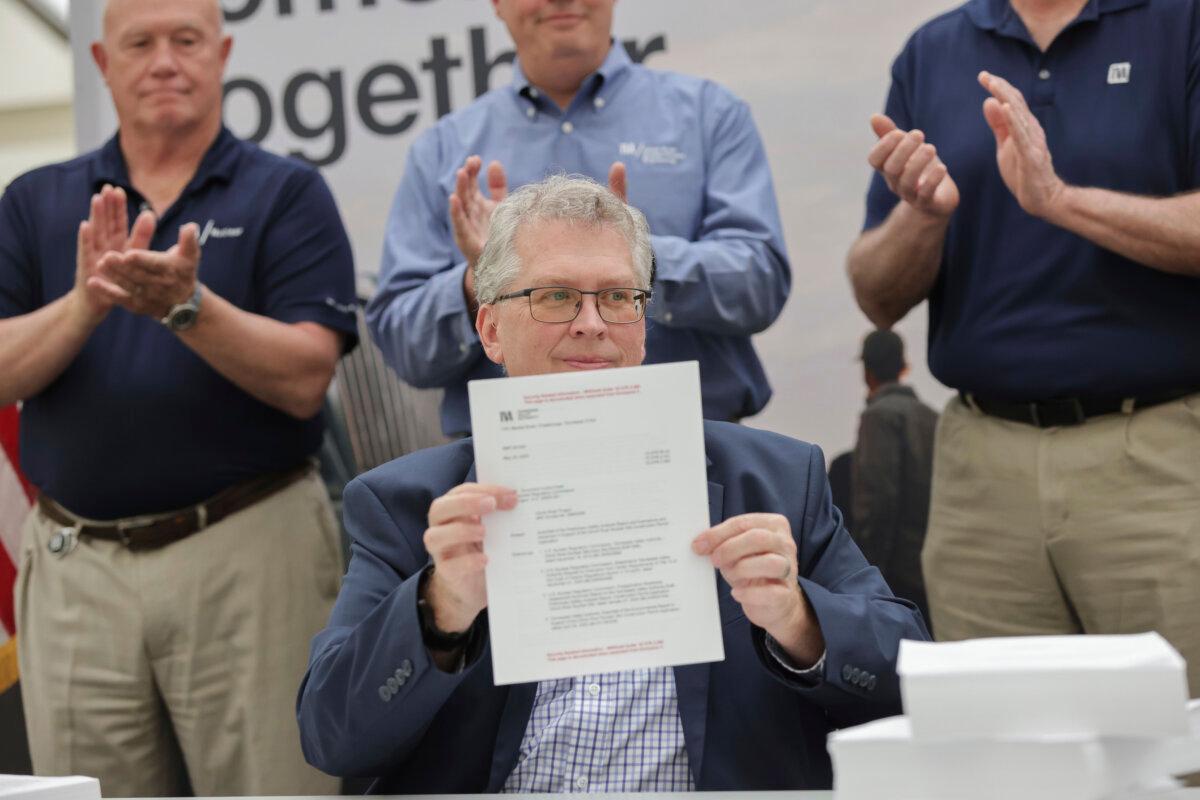
Tennessee Valley Authority New Nuclear Program Vice President Scott Hunnewell signs the construction permit application to build a GE Vernova Hitachi BWRX-300 small modular reactor in Clinch River, Tenn., on May 19, 2025, the first licensed and commissioned in the United States. (Tennessee Valley Authority via AP)
The Elite 11
The 11 projects selected by DOE are the following:
Last Energy, based in Washington, is proposing to build 20-megawatt electric pressurized water reactors in its Texas factory that can be shipped on flatbed trucks to users.
Last Energy, along with the states of Utah and Texas, on Dec. 30, 2024, filed a joint lawsuit against the NRC in U.S. District Court in the Eastern District of Texas claiming that the commission does not have jurisdiction over reactors in this size class and that its “incredibly costly” licensing and “overburdensome” regulations are hindering domestic implementation of technologies being pioneered in—but exported from—the United States.
“Building a new commercial reactor of any size in the United States has become virtually impossible,” the six-year-old company stated in the suit.
Aalo Atomics, based in Austin, Texas, is developing a 30-megawatt thermal reactor, cooled by sodium and using uranium enriched to less than 10 percent, that “prioritizes fuel chain availability, inherent safety, and manufacturability.”
Aalo in May also signed a memorandum of understanding with DOE’s Idaho National Lab for “the deployment of an experimental Aalo reactor.”
Oklo, headquartered in Santa Clara, Calif., has designed a reactor cooled by liquid metal and is among global leaders in advancing ways to recycle nuclear waste as fuel.
The company has ambitious plans for powering data centers, but its first license application to the NRC was rejected by the staff as having insufficient information. Oklo plans to submit an application for a different design later this year.
During a June 12 hearing before the House Science, Space, and Technology Committee’s Energy Subcommittee, Oklo Chief Technology Officer Pat Schweiger testified that unless the United States “modernizes regulations” and invests in “next-generation research,” China will “achieve AI supremacy.”
Antares Nuclear, headquartered in Redondo Beach, California, is developing a kilowatt-scale reactor designed to be used in space and for “energy resilience for mission-critical facilities.”
Atomic Alchemy, of Idaho Falls, Idaho, has a proprietary reactor design for generating isotopes and an advanced recycling system for used nuclear fuel.
Deep Fission, based in Berkeley, California, plans to frack a mile deep to install a 15-megawatt reactor that will pipe steam to the surface for electricity.
Natura Resources, headquartered in Abilene, Texas, has an NRC construction permit for a molten salt reactor design it wants to build at its research center at Abilene Christian University meant to host the project.
Radiant Industries, of Segundo, California, has designed a portable reactor to replace diesel generators of up to 1 megawatt. It recently signed a contract to provide these reactors for the Air Force.
Terrestrial Energy, based in Charlotte, North Carolina, has a high-temperature molten salt design it says is ready to build and demonstrate.
Valar Atomics, headquartered in Hawthorne, California, has designed a high-temperature gas reactor to produce industrial-scale heat or electricity. It is a party with Last Energy in its lawsuit against the NRC.