
The Pentagon published on Tuesday its annual report to Congress on the trajectory of China’s military build-up.
Since 2000, the Pentagon has provided yearly updates to lawmakers, assessing various aspects of China’s forces and how they may be employed in future conflict scenarios. These annual reports have tracked the growth of communist China’s navy and nuclear forces, its posture toward Taiwan, and more recent advances in space and information technology.
At 100 pages, this year’s report reiterated assessments that China is preparing to assert control over Taiwan through military force as early as 2027. Looking further down the road, U.S. analysts anticipate that China will continue to modernize its military to become a world-class force by 2049.
Here are five key findings from the new report.
9 Aircraft Carriers by 2035
The Chinese People’s Liberation Army Navy currently operates three aircraft carriers.
China’s first aircraft carrier, Liaoning, was based on a partially completed Russian Kuznetsov-class ship with a ski-jump style aircraft launch and a conventional steam-engine turbine propulsion system.
China’s second carrier, Shandong, was a fully domestically produced derivative of the Liaoning, again built with a ski-jump launch and a conventional propulsion system.
For its third aircraft carrier, Fujian, China built its first flat-deck ship, complete with an advanced electromagnetic catapult.
The Pentagon report assessed that the Chinese People’s Liberation Army Navy has plans for six more aircraft carriers by 2035, bringing their total to nine within the next decade.
By comparison, the U.S. Navy is bound by law to operate at least 11 aircraft carriers at a given time. The sea service is currently replacing its aging Nimitz-class carriers with newer Ford-class carriers.
The U.S. Navy is also legally required to maintain at least 10 more amphibious assault ships, which can serve as miniature carriers suitable for helicopters and specialized fixed-wing aircraft.
Nuclear Forces Readying for Rapid Response
Following early access to the annual Pentagon publication, Reuters was first to report the Pentagon’s assessment that China had likely loaded at least 100 nuclear-capable intercontinental ballistic missiles (ICBMs) into silos in three recently constructed silo fields near its border with Mongolia.
The Pentagon’s report further spells out U.S. assessments that China’s nuclear forces are developing the capabilities required to detect and launch a retaliatory nuclear strike before an adversary’s nuclear first strike lands.
“In 2024, China probably made progress on its attempts to achieve an early warning counterstrike (EWCS) capability, similar to launch on warning (LOW), where warning of a missile strike enables a counterstrike launch before an enemy first strike can detonate,” the Pentagon report states. “China likely will continue to refine and train on this capability throughout the rest of the decade.”
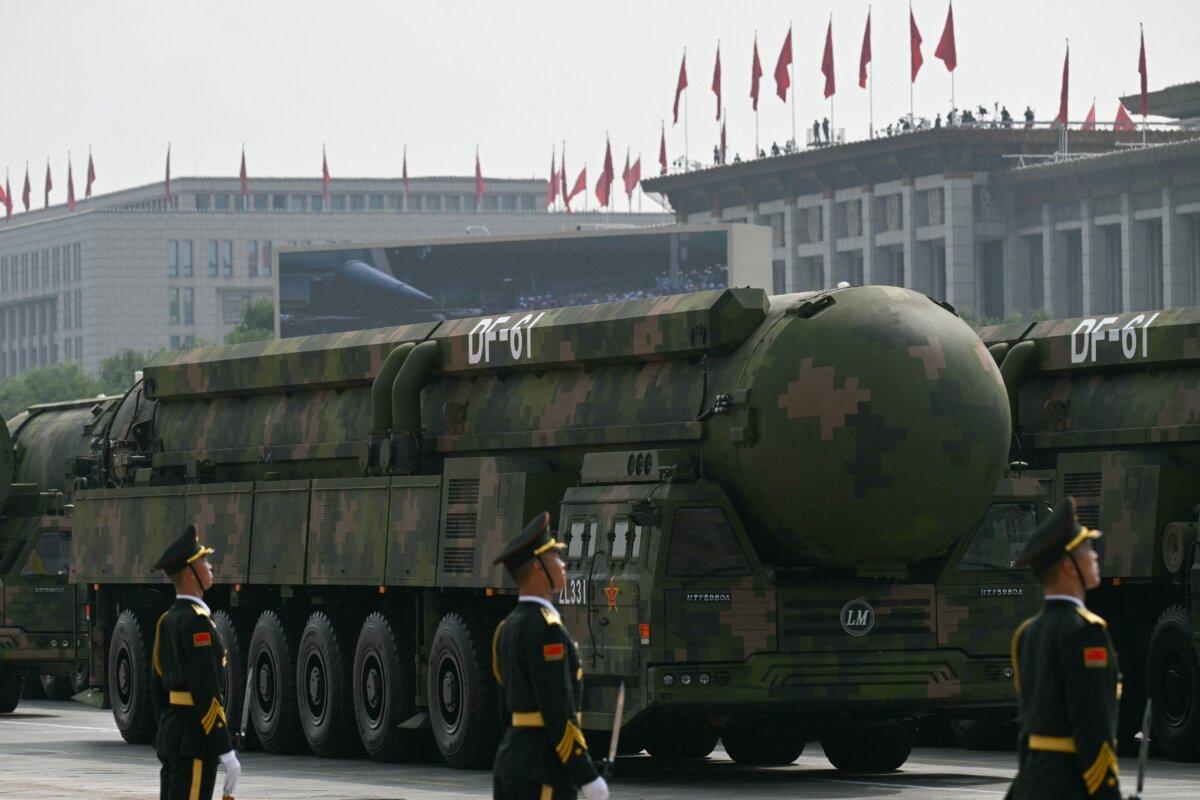
The DF-61 intercontinental ballistic missile is seen during a military parade marking the end of World War II, in Beijing's Tiananmen Square on Sept. 3, 2025. (Greg Baker/AFP via Getty Images)
In particular, the report noted China’s launch of satellites believed to be able to detect a nuclear launch within 90 seconds. The report also noted China’s employment of multiple ground-based large phased-array radars that can detect launches from thousands of miles away.
Pentagon analysts also noted drills in late 2024, in which Chinese nuclear forces practiced launching multiple ICBMs in rapid succession; a capability critical for proving a credible retaliatory nuclear launch posture.
Elsewhere, the Pentagon report reiterated doubts about China’s willingness to enter into nuclear arms control frameworks with the United States.
Shortly after taking office, President Donald Trump expressed hopes that he could bring both Russia and China to the negotiating table to agree on mutual reductions in their respective military forces, including their nuclear arsenals. In August, Chinese Foreign Ministry spokesman Guo Jiakun signaled Beijing’s rejection of a proposed set of nuclear arms reduction talks.
Artificial Intelligence, Other Emerging Technology
The Chinese military looks to dominate by integrating artificial intelligence and other information technologies into its doctrine, the Pentagon assessed.
“China believes the next revolution in military affairs will occur when militaries transition to ‘intelligentized’ warfare and fully integrate artificial intelligence, big data, advanced computing, and other technologies into the joint force,” the report states.
Pentagon analysts assess that China is still developing the concepts and capabilities it would need to realize this “intelligentized warfare” doctrine, but is actively studying the Russia–Ukraine conflict to identify useful practices for AI and unmanned systems.
“Throughout 2024, China continued to invest in AI technologies for a range of military applications including unmanned systems, [intelligence, surveillance, and reconnaissance] collection and analysis, decision-making assistance, cyber operations, and information campaigns,” the Pentagon report added.
The report said the Chinese AI platform Deepseek and the telecommunications company Huawei both took steps to stockpile various computer chips and graphics processing units before export control laws limited China’s access to such products. Pentagon analysts said China’s AI industry has also established shell companies and found other intermediaries as a way to bypass export control efforts.

The DeepSeek logo is displayed alongside its AI assistant app on a mobile phone, in this illustration photo taken on Jan. 28, 2025. (Florence Lo/Illustration/Reuters File Photo)
The United States is taking steps to keep pace with China’s embrace of AI and other emerging technologies.
Last month, the Pentagon announced it would focus research and funding on AI, quantum computing, biomanufacturing, directed energy weapons, hypersonic weapons, and innovations for conducting logistical operations in contested spaces.
This month, the Pentagon launched GenAI.mil as a platform for integrating AI models into the U.S. military’s various workflows.
Long Range Ship-Killers
This year’s Pentagon report provided some new context about China’s DF-27 ballistic missile.
In last year’s report, the Pentagon offered multiple passages of analysis about the potential capabilities and purposes of the DF-27, including as a system for launching hypersonic glide vehicles, delivering nuclear warheads, and carrying out conventional strike capabilities.
By contrast, this year’s report only references the DF-27 in a single chart, describing it as an ICBM built for conventional strike missions, including land attack and anti-ship roles.
The chart indicated the DF-27 has a range of between 3,000 and 5,000 miles, enabling missile forces in China to hit targets in parts of the contiguous United States.
Such a weapon system may prove valuable for Chinese forces in a conflict scenario where they seek to seize Taiwan or assert other territorial claims throughout the Indo-Pacific region.
For years, U.S. analysts have assessed the Chinese military to be building out the capabilities for what they’ve referred to as an “anti-access/area denial” strategy in which they may assert expansionist territorial claims and then deter outside forces from being able to intervene. Long-range anti-ship weapons like the DF-27 could serve that overall strategy by extending the zone in which outside forces are at risk of being hit if they try to contest China’s territorial ambitions.
Corruption, Mishaps, Vulnerabilities
While policymakers, military planners, and analysts have referred to China as the “pacing threat” for the United States, the new Pentagon report indicates the Chinese military is not impervious to mistakes and institutional challenges.
This year’s report noted several Chinese military leaders were either investigated, replaced, or otherwise punished amid persistent corruption concerns within its ranks. These corruption concerns have stretched to the upper leadership levels in China’s Central Military Commission (CMC).
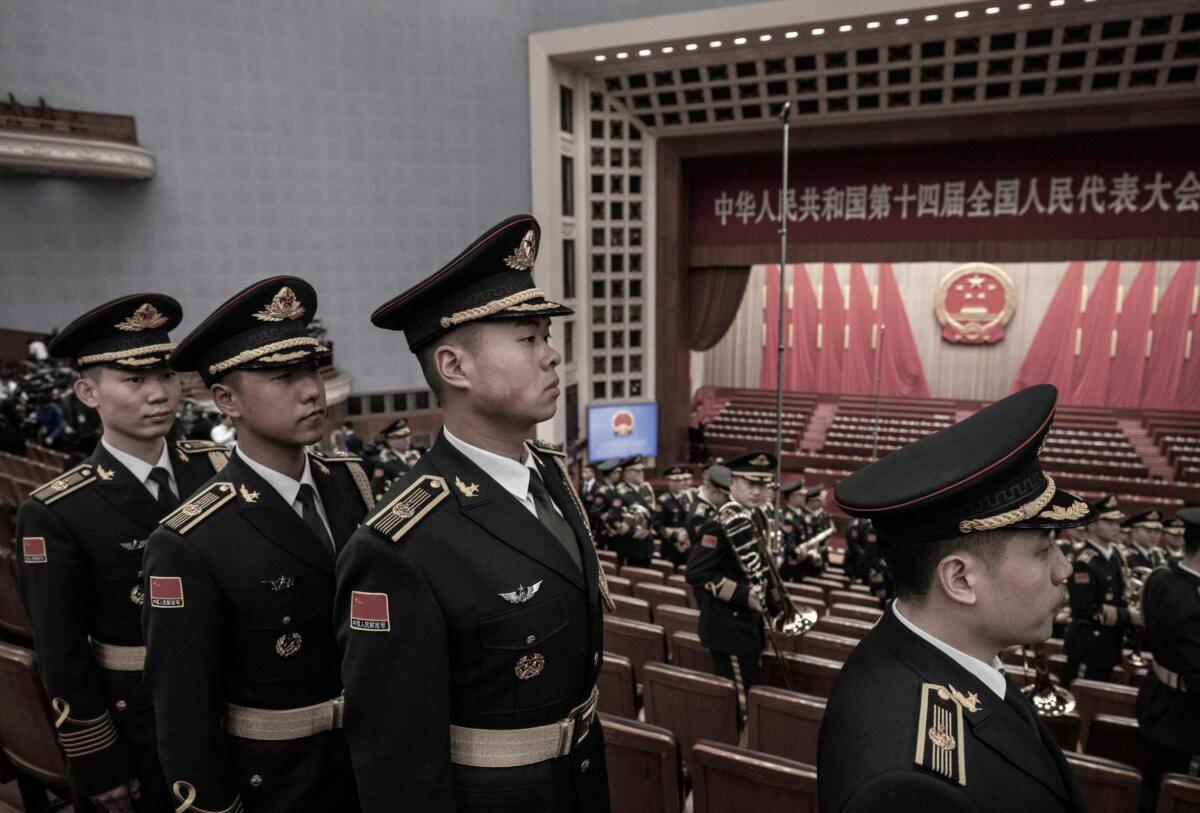
People's Liberation Army Band members leave after the opening of the NPC, or National People's Congress, at the Great Hall of the People in Beijing on March 5, 2024. (Kevin Frayer/Getty Images)
“The PLA has continued to experience corruption-related investigations in every service, which have led to the removal of dozens of general officers. By late 2024, corruption issues had again reached the level of the CMC,” the Pentagon report noted.
Pentagon analysts reported that corruption within China’s military procurement components has contributed to failures in new weapons and equipment, such as malfunctioning lids on Chinese missile silos. The Pentagon analysts said corruption may have also played a role in equipment flaws that led to the 2024 pierside sinking of China’s first Zhou-class submarine.
The report also stated that China’s political leadership appears willing to purge military leaders it deems to be disloyal, regardless of the disruption it may cause to Chinese military forces.