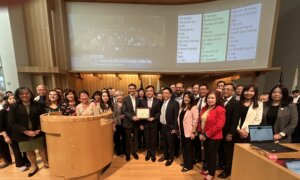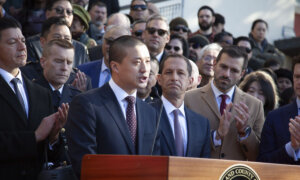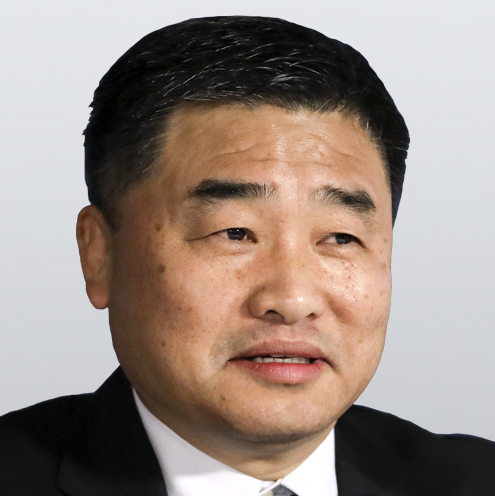
Dozens of Taiwanese individuals from various sectors gathered in front of the San Francisco War Memorial Opera House on July 14 to commemorate the 74th anniversary of the signing of the Treaty of San Francisco.
Speakers at the gathering said the treaty was the legal starting point for Taiwan’s existence as an independent nation.
Completed in 1932, the War Memorial Opera House was originally built to honor all those who served in World War I. Designed in classical Roman Doric style, it is located across from the west side of San Francisco’s City Hall.
On Sept. 8, 1951, 48 Allied nations and defeated Japan signed the Treaty of San Francisco at this opera house, formally ending the war with Japan.
One of the main organizers of this week’s visit, the 908 Taiwan Republic Campaign, holds celebrations each year in Taiwan on Sept. 8 to mark the anniversary of the treaty. The event in San Francisco at the opera house was held earlier in the summer to allow for more attendance.
Akio Yaita, executive director of the Indo-Pacific Strategy Thinktank (IPST), hosted the July 14 event.
He said in a speech that six treaties are crucial in Taiwan’s modern history: the Treaty of Shimonoseki (1895), the Cairo Declaration (1943), the Potsdam Proclamation (1945), the Treaty of San Francisco (1951), the Treaty of Taipei (1952), and U.N. Resolution 2758 (1971).
“For decades, Taiwan has been bound by these treaties, becoming a strange entity—like a country, but not officially one,” he said.
The IPST is a Taiwan-based think tank dedicated to enhancing Taiwan’s global recognition and defending its democratic way of life.
Chilly Chen, chair of the Taiwan Republic, a nongovernmental organization dedicated to Taiwanese independence and nation-building, said at the event that although the Qing Dynasty ceded Taiwan to Japan through the Treaty of Shimonoseki in 1895, the Treaty of San Francisco in 1951 marked the formal renunciation of Taiwan by Japan—without specifying to whom sovereignty was transferred.
Article 2 of the Treaty of San Francisco states: “Japan renounces all right, title and claim to Formosa and the Pescadores [names for Taiwan’s islands].”
However, due to the geopolitical conflict at the time between Taiwan and the Chinese communist regime, the treaty left Taiwan’s sovereignty status unresolved.
Chen said that despite Taiwan’s democratization and its people electing their own presidents, “Taiwanese have waited over 100 years, and we still haven’t received the right to self-determination as granted under Articles 76 and 77 of the United Nations Charter.”
Article 77 of the U.N. Charter allows for the placement of territories separated from enemy states due to World War II under the U.N. trusteeship system. Article 76 states that such trusteeships should aim to promote “progressive development towards self-government or independence,” in accordance with circumstances and the wishes of the local population.
Yaita believes that since the Treaty of San Francisco did not assign Taiwan’s sovereignty to any country, “Taiwanese themselves should claim it.”
“The origin of Taiwan’s independence lies right here—at the San Francisco War Memorial Opera House,” he said.
He said that the modern international community stands on two fundamental principles: “sovereignty resides with the people” and “national self-determination.” However, he said that Taiwanese people were not present at any of the six treaty negotiations and signings.
“The treaty that Taiwanese people should truly support is one signed by themselves, deciding their own future,” he said.
Michael Tsai, former Taiwanese minister of national defense and current chair of the Institute for Taiwan Defense and Strategic Studies, said at the event that after the Treaty of San Francisco was signed, the U.S. government also held the position that Taiwan’s sovereignty was undetermined.
When the Korean War broke out in 1950, U.S. President Harry S. Truman dispatched the U.S. Seventh Fleet to defend Taiwan and declared, “The determination of the future status of Formosa must await the restoration of security in the Pacific, a peace settlement with Japan, or consideration by the United Nations.”
This statement is widely viewed as the origin of the idea that Taiwan’s sovereignty is undecided.
In 1952, Japan and Taiwan signed a peace treaty reaffirming that “Japan has renounced all right, title, and claim to Taiwan (Formosa) and Penghu (the Pescadores) as well as the Spratley Islands and the Paracel Islands.” However, the treaty again did not specify to whom Taiwan’s sovereignty belonged.
Tsai said that both the U.N. Charter and the International Covenant on Civil and Political Rights state that people have the right to self-determination. Thus, Tsai thinks Taiwan’s future should be decided by its people.
Chen Nai-yu, a councilmember from New Taipei City, said at the event that the Treaty of San Francisco is critically important to Taiwan. She said that Taiwan already possesses the four fundamental elements of statehood: people, territory, government, and sovereignty.
“Taiwan is already an existing independent country,” she said. “We must let the world know that the human rights of the Taiwanese people and Taiwan’s national sovereignty cannot be ignored.”
Wu Jia-long, a consultant at the IPST, said that national borders are essential for statehood. He said that Northern Ireland remains part of the United Kingdom, and Quebec remains in Canada, because of mixed populations that make borders difficult to draw.
“China and Taiwan are separated by the Taiwan Strait, so their borders can be clearly delineated,” he said.
He said that beyond having government, territory, and people, “Taiwan urgently needs to build a strong national defense to protect its sovereignty through strength.”
Hsieh Chen-kuan, chair of the Love of Taiwan Association in the San Francisco Bay Area, told The Epoch Times that he visits the San Francisco War Memorial Opera House every year around Sept. 8 to commemorate the signing of the Treaty of San Francisco. He called on all Taiwanese people to unite and work toward Taiwan’s reentry into the United Nations.