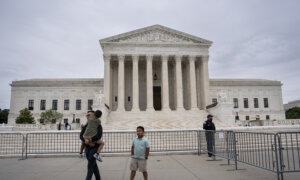

A panel of federal appeals court judges on May 19 grappled with the Trump administration’s efforts to procure unredacted voter registration records from California and Oregon.
The hearing came as the Department of Justice (DOJ) has been reaching out to states by seeking voter rolls with complete personal information, mainly driver’s license numbers or the last four digits of Social Security numbers. About a dozen states have provided the data voluntarily.
The department said the information is necessary to determine whether states are complying with federal voter roll maintenance laws.
Democratic states have largely refused to provide the data. Some Republican states also have been wary of handing over the records, usually referring the DOJ to the public versions of their voter lists with sensitive information redacted.
The DOJ filed a series of lawsuits in September 2025 against six states, alleging that they violated federal law by refusing to provide voting records the department said were necessary to prevent inclusion of ineligible voters.
Judge David Carter of the U.S. District Court for the Central District of California issued a Jan. 15 decision dismissing the department’s request to access California’s voter registration databases. Carter ruled that the demand for voter data from California Secretary of State Shirley Weber was “unprecedented and illegal.”
Carter said the DOJ cannot use civil rights legislation “as a tool to forsake the privacy rights of millions of Americans,” noting that such authority rests solely with Congress.
On Feb. 5, Judge Mustafa Kasubhai of the U.S. District Court for the District of Oregon tossed out the DOJ’s lawsuit aimed at obtaining Oregon’s records, finding that statutes upon which the federal government relies “simply fail [to] provide a legal basis for the requested relief.”
Although the Constitution allows Congress to override states’ authority in elections, the judge said the DOJ’s “claims here represent an overreach and misuse of those limited constitutional exceptions designed to ensure decentralized election regulation.”
The department’s claims “disturb the framework of federalism envisioned and enshrined in [the] Constitution,” Kasubhai said.
In oral arguments in two cases before three judges in a Pasadena, California, courtroom of the U.S. Court of Appeals for the Ninth Circuit, DOJ attorneys said on May 19 that the agency should prevail in its appeals of adverse lower court rulings in election records litigation.
DOJ attorney Andrew Braniff said that last summer the department asked Oregon for its statewide voter registration list “based on the plain authority of the Civil Rights Act of 1960 in order to enforce the language of the National Voter Registration Act and the Help America Vote Act.”
Judge Lucy Koh repeatedly interrupted Braniff, asking why the DOJ failed to mention the 1960 Civil Rights Act in its initial demand letter if its authority under that law was “so plain.”
That statute empowers the department to demand that states hand over voting records if the DOJ explains why it needs them.
Braniff said that “the plain authority to have the state maintain their voter registration list is listed clearly in the [National Voter Registration Act].”
Braniff said the first letter was meant to give Oregon an opportunity to cooperate with the DOJ “in maintaining a clean and accurate voter roll of eligible voters as they are required to do” under both the National Voter Registration Act and the Help America Vote Act.
The subsequent letter laid out the statutory requirements for that demand under the Civil Rights Act, he said.
Oregon attorney Robert Koch said that in this case the DOJ “seeks to reimagine a 66-year-old civil rights statute to force Oregon to create and disclose an unredacted version of its statewide voter list—and not just Oregon’s, but every state in this country, to amass a national federal database of every registered voter in America.”
That “shocking demand” is not permitted under the Civil Rights Act, the Privacy Act, or the E-Government Act, he said.
Koh raised President Donald Trump’s executive order 14248 on election integrity and the legal opinion issued on May 12 by the DOJ’s Office of Legal Counsel, which states that “section 303 of the Civil Rights Act authorizes the [DOJ’s Civil Rights] Division to seek statewide voter registration lists from states.”
The opinion states that the Privacy Act, Driver’s Privacy Protection Act, and E-Government Act “do not limit that authority.”
Koh told Koch that the executive order only states that “the Department of Homeland Security shall review each state’s publicly available voter registration list—it doesn’t say unredacted.”
“So if you are basically trying to implement this executive order, why are you now seeking the unredacted voter rolls?” she said.
In the California case, DOJ attorney David Goldman said the Office of Legal Counsel opinion was “really unremarkable.”
“What we did as a law enforcement agency is get guidance as to what to do if we find evidence of voter fraud in our investigation of [state voter rolls],” he said.
“It does not belie some sort of hidden motive that we’ve been keeping from the courts this whole time ... and I stand by it today.”
It is unclear when the Ninth Circuit panel will rule on the California and Oregon cases.
Peter Svab and Aldgra Fredly contributed to this report.