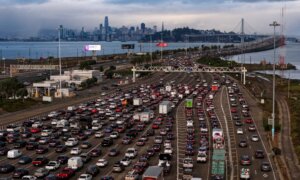
The California Assembly on Jan. 29 advanced a bill that would expand a state study on replacing the gas tax with a mileage-based fee for road maintenance, drawing sharp criticism from Republicans who called it a step toward imposing costly new taxes on drivers already facing high fuel costs.
Assembly Bill 1421, authored by Assembly Member Lori Wilson, a Democrat from Suisun City, passed the chamber’s Transportation Committee on a mostly party-line vote. The measure would direct the California Transportation Commission to consolidate research and submit recommendations to lawmakers by 2027, including ways to address equity for low-income drivers with long commutes.
Supporters argue that the research is necessary as California’s shift to electric vehicles (EVs) threatens to slash gas tax revenues, which fund highways, transit, and infrastructure.
The state collected about $14 billion from fuel taxes and vehicle fees in the 2023–2024 fiscal year. The 57.9-cent-per-gallon gasoline excise tax alone generated $7.8 billion. But because more than 1 million EVs have been sold in the past four years and there is a mandate for all new car sales to be zero-emission by 2035, projections show that revenues could drop by $2 billion annually by 2030 and up to $4 billion by 2035, according to the Legislative Analyst’s Office.
“The benefit of a road use charge is that it could be structured to provide gas tax relief to low-income drivers,” the bill’s findings state, noting ongoing analysis of effects on supercommuters and tribal nations.
Republicans opposed the bill, offering amendments to bar local governments from implementing mileage fees and prevent “double taxation” on top of existing gas taxes.
Democrats rejected the changes, prompting GOP leaders to accuse them of paving the way for invasive tracking and higher costs.
“The bill advances efforts to impose a new mileage-based tax on top of the more than 60-cent gas tax,” Assembly Republicans said in a statement. “Assembly Democrats rejected the amendments, making it clear they intend to impose a new tax increase on Californians that could punish everyday commuters.”
Assembly Member Carl DeMaio (R-San Diego) warned that the proposal could charge drivers 6 to 9 cents per mile, equivalent to a gas tax hike of $0.87 to $1.15 per gallon.
“The typical California driver with an average drive of 15,000 miles a year will be forced to pay $900-$1200 a year in higher taxes just to drive on poorly maintained freeways they already paid for with the original gas and sales taxes!” DeMaio said in a campaign against the bill.
Other states are grappling with similar shortfalls.
In Oregon, lawmakers are moving toward mandating pay-per-mile fees for EV owners, charging about 2.3 cents per mile or a $340 annual flat fee to offset lost gas taxes. In Hawaii, the state began implementing a road usage charge program in 2023.
A 2017 California pilot program under prior legislation enrolled more than 5,000 vehicles, logging 37 million miles to test mileage tracking without actual payments. The new bill’s backers, including transportation advocacy group Transform, have said that further study could lead to an equitable system that funds transit while reducing emissions, potentially replacing the gas tax entirely.
Opponents, including DeMaio’s Reform California group, have started petitions to block it, labeling it the “Commuter Punishment Act.”
The measure now heads to the state Senate for consideration.