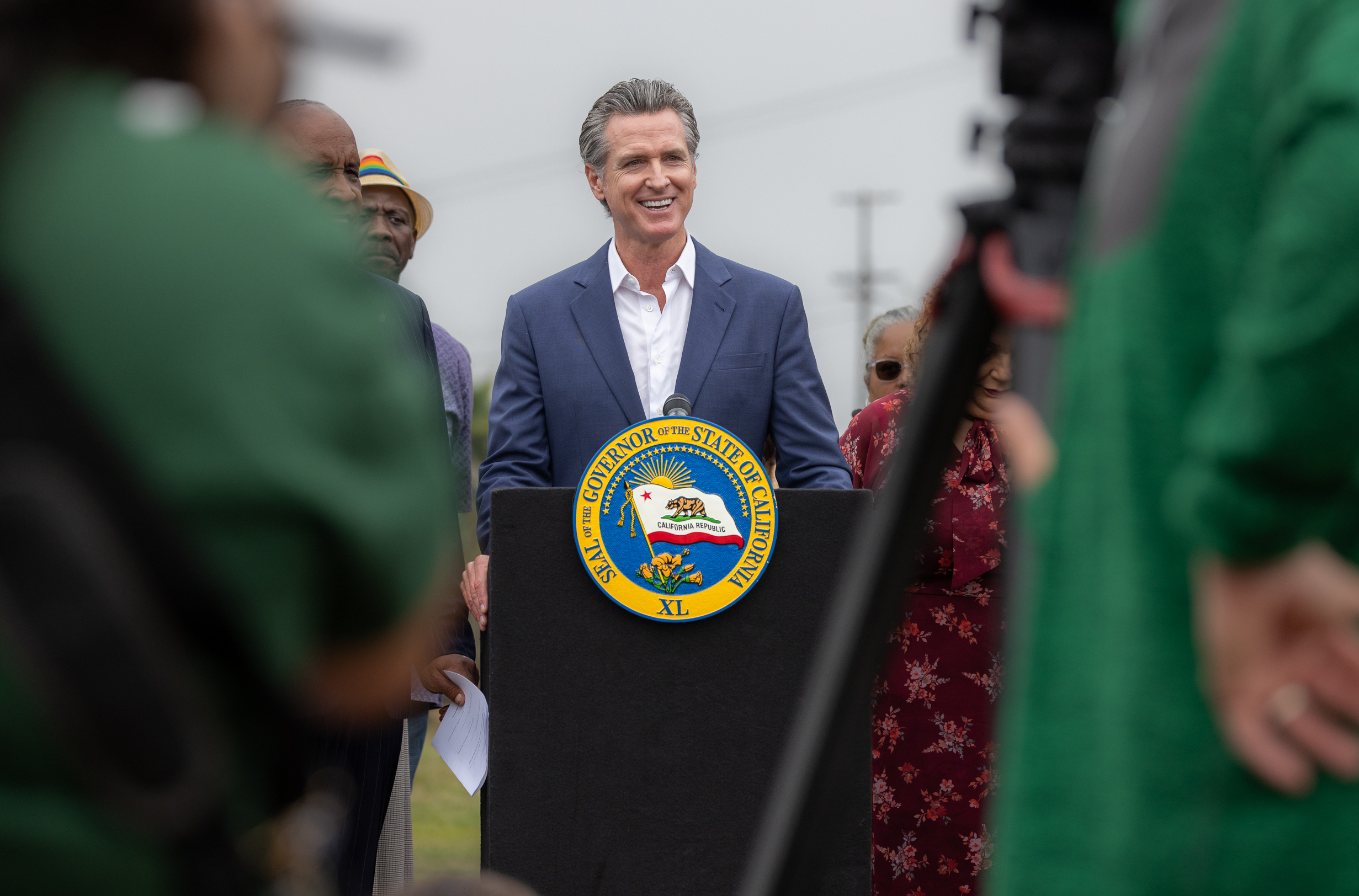

California Gov. Gavin Newsom signed 21 bills on Sept. 29 aimed at limiting federal immigration enforcement in the state, including a ban on officers using shock gloves and a new 25 percent tax on private detention centers.
“California is taking action to strengthen transparency, accountability, and oversight around immigration enforcement in our state,” Newsom said in a statement.
“This is about stepping up where the federal government has failed our communities,” the Democratic governor said. “We will continue protecting our people, upholding the rule of law, and making clear that if the federal government operates in California, we will hold them accountable.”
The shock glove ban applies to all officers in California, including federal immigration agents. It takes effect next year, expires Jan. 1, 2030, and requires the state Department of Justice to complete a safety study on the devices by Jan. 1, 2029.
“Sanctuary politicians attempting to ban our federal law enforcement from any safety equipment is despicable and a deliberate attempt to undermine and endanger our officers,” the agency said in a statement at the time, responding to a group of Democratic lawmakers who urged the agency to abandon the plan.
California law enforcement groups broadly opposed the shock glove ban, including Sacramento Sheriff Jim Cooper, a Democrat and former state lawmaker.
“When the federal government does something, the state Legislature wants to ban it,” Cooper said at a news conference in August.
“For me, use of force is so important. We talk about it all the time. De-escalating [to] a lower level of force. What they’re doing by trying to ban this glove, and it conducts electricity—a much lower voltage than a taser—they’re making our job harder.”
Newsom also signed a revised ban on officers wearing masks. A federal judge blocked the state’s first mask ban in February, ruling that it unfairly targeted local and federal officers because it exempted state officers. The new law applies to all officers.
Another law protects people traveling to and from courthouses from civil arrest, and another bars ICE officers who have committed serious misconduct from becoming police officers or public employees in California.
A fifth law requires rental vehicles that law enforcers use for arrests or transport to display a decal identifying the agency, with limited exceptions.
Detention center taxes will go to state immigration-related services. A separate bill ends a property tax exemption claimed by some detention facilities.
Newsom’s office acknowledged in its announcement that California “cannot dictate federal immigration policy.” It said the state can set requirements for state property, state resources, detention facilities, public records, and law enforcement practices where federal enforcement operates in California.
Courts have mostly sided with the Justice Department in challenges to state limits on federal agents. In April, an appeals court blocked California’s separate law requiring officers to wear identification, ruling that it violates the Supremacy Clause of the Constitution. Federal judges have since blocked mask bans in Virginia on June 30, Philadelphia on July 2, and New York on Aug. 3.
States have fared better on other measures. On Sept. 4, a federal judge dismissed a Justice Department lawsuit challenging an executive order by New Jersey Gov. Mikie Sherrill, a Democrat, that bars federal immigration officers from using state property for enforcement. California’s package includes a similar ban on state-owned property.
“To be crystal clear: we will not abide by unconstitutional mask bans,” a Department of Homeland Security spokesperson said in an emailed response to an inquiry from The Epoch Times on Sept. 29.
“The Supremacy Clause makes it clear that California’s sanctuary politicians do not control federal law enforcement. No tax will stop ICE from deporting criminal illegal aliens to make California safe again. We need California to cooperate with our officers and stop releasing criminals from their jails into California’s neighborhoods. Seven of the 10 safest cities in America cooperate with ICE.”
The spokesperson said that enforcing immigration law is a federal responsibility under the Constitution. Concerning the shock gloves, the spokesperson said that ICE reviews its equipment to make sure it is “consistent with all applicable law enforcement policies and standards,” and that officers are “highly trained in de-escalation tactics and regularly receive ongoing use of force training.”
Lauren Bis, a White House spokeswoman, responded to Newsom’s move in an emailed statement to The Epoch Times.
“Gavin Newsom has no authority over federal law enforcement,” she said. “The Trump administration will not abide by his unconstitutional legislation. Our law enforcement officers will continue arresting and removing criminal illegal aliens from American communities while radical Democrats in California refuse to cooperate and instead choose to release criminal illegal aliens from their jails into communities to terrorize innocent Americans.”
A Department of Justice spokesperson said in an emailed statement to The Epoch Times, “The Department of Justice will continue to challenge illegal sanctuary policies designed to thwart federal immigration enforcement or impede lawful federal operations.”
California is one of 17 states with Democratic-controlled legislatures that have passed more than 100 bills this year aimed at limiting immigration law enforcement, according to an Associated Press analysis.
The most common goal of those bills has been to bar local authorities from cooperating with federal immigration agents.