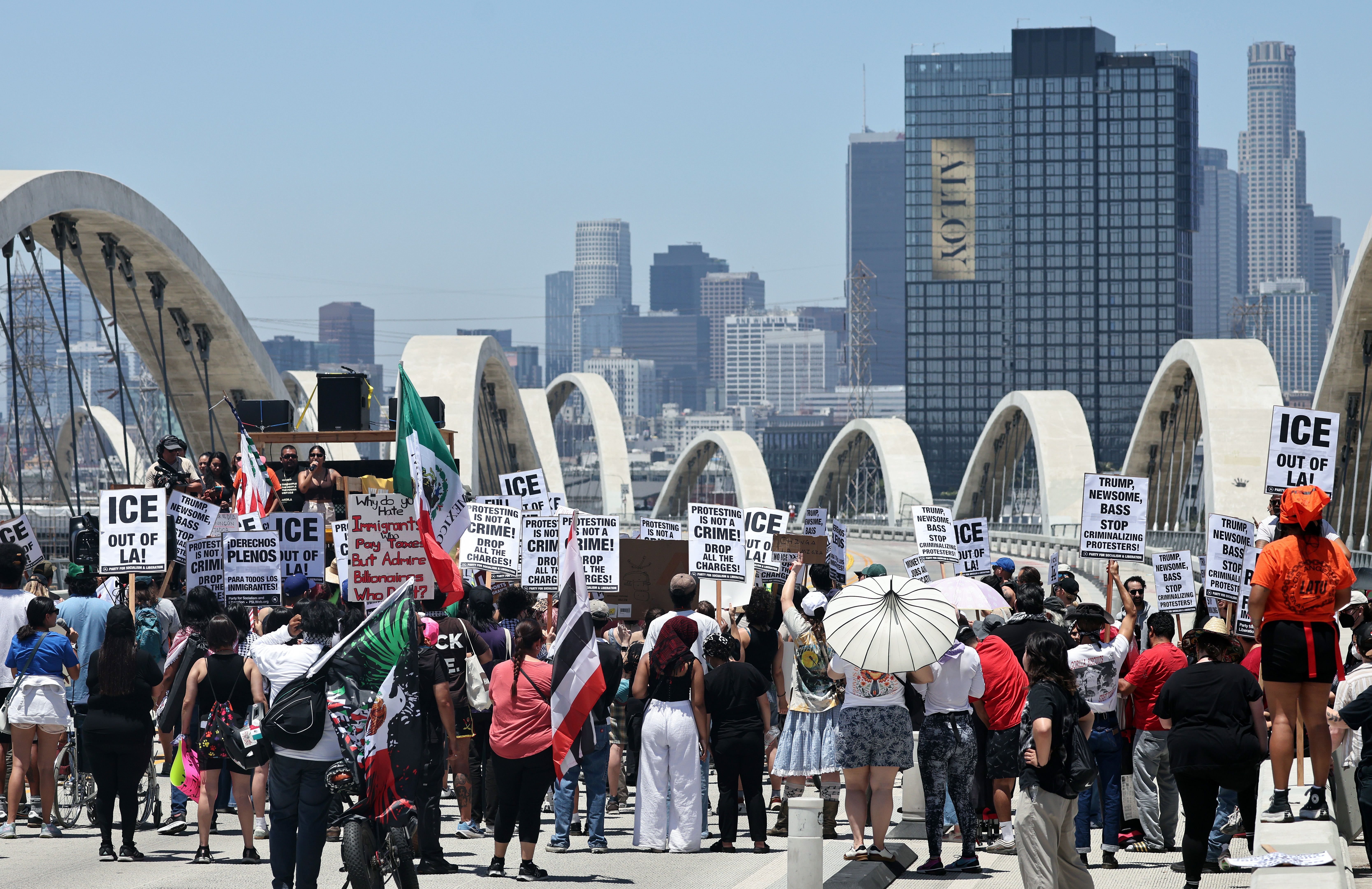

The Los Angeles County Board of Supervisors will consider declaring a local emergency in response to federal immigration enforcement that officials say has sown fear among the illegal immigrant populations in the city.
In a 4–1 vote during a meeting on Oct. 7, the board directed staff to prepare a formal declaration for consideration at the next meeting on Oct. 14.
The declaration would allow the board to unlock an eviction moratorium for illegal immigrants in Los Angeles affected by enforcement operations.
“Families are now afraid to go to work, to attend school, or even to buy groceries,” Supervisor Lindsey Horvath, who coauthored the motion, said at the board meeting.
“As this fear spreads, so does economic hardship, and with it, the very real risk of eviction and homelessness.”
Horvath described the federal enforcement operations as involving agents in unmarked cars and without apparent regard for standard procedures, creating an atmosphere where illegal immigrants in the county are reluctant to leave their homes to go to work, school, or church.
A report from county legal experts outlined how an emergency declaration could enable a temporary pause on evictions, provided it includes provisions for eventual rent recovery.
County staff told supervisors that implementing such a moratorium could create challenges for both property owners and renters. They noted it might force renters to reveal their immigration status in public filings, lead to substantial financial losses for landlords, and expose tenants to potential lawsuits from landlords seeking to collect unpaid rent.
“I do worry about the self-attestation and what vulnerable position we’re going to be putting our immigrant tenants in as it relates to verifying that they need the help,” Supervisor Janice Hahn, the motion’s co-author, said.
Supervisor Kathryn Barger, who voted against the measure, said it was unfair to landlords.
“I’m sure we’re going to be challenged legally,” she said, adding that “landlords are going to be held financially responsible [for unpaid rent] when it’s no fault of theirs, and they still have to pay bills and provide for their families.”
If approved, the proclamation would not automatically impose an eviction moratorium, which would require a separate vote. However, it would empower the county to seek extra funding and implement measures to help stabilize and support impacted residents.
Daniel Yukelson, executive director and CEO of the Apartment Association of Greater Los Angeles, said eviction protections hurt landlords, who are still obligated to pay the mortgage on the property.
“When you’re looking at small mom-and-pop landlords, many of them are still struggling from several years ago under the COVID moratoriums,” Yukelson told The Epoch Times in September.
“Many of them still have uncollected rent that was a huge financial hit.”
Immigration and Customs Enforcement (ICE) agents have conducted large-scale operations in Southern California workplaces and neighborhoods since early this year, detaining hundreds of illegal immigrants and sparking protests.
A U.S. Supreme Court ruling on Sept. 8 cleared the way for ICE to proceed with enforcement, rejecting claims of racial bias in the detentions.
Researchers at the University of California–Merced documented an immediate 3.1 percent dip in statewide employment following the initial sweeps, attributing it partly to absenteeism driven by fear of apprehension.