One of the challenges I face in my daily life is the amount of sitting I’m required to do. Although I still get in a great deal of steps, when I take stock of how much time I spend sitting, I’m frankly rather disappointed. I spend more time looking at a computer screen—working my brain hard, but not my body. Unfortunately, most of us are in the same boat.
The health problems associated with sedentary behavior are well-understood, and we need to address our lack of movement if we’re going to preserve our health.
5 Effective Exercises Easily Performed at Chair Level
Over the years, I’ve learned that the best way to address the health risks of sitting too much is to sneak in some exercise at the same time. If you can’t break away from sitting, I find that the following exercises work very well for getting you moving where you are.
I frequently introduce these exercises to my patients, who generally tolerate them well and find them easy to integrate into their days. However, I do suggest that you consult with your physician before trying these exercises to ensure that they are appropriate for you.
1. Sit-Stands
Sits-stands are the most accessible exercise of this series, because if you sit in a chair, you’ll need to stand up eventually. Standing up and sitting down is exactly what you do for this exercise, albeit many times. Let’s get up and get started.
Step 1: Sit at the front of a chair with your arms crossed high so that your hands are over your collarbones.
Step 2: Slowly stand up, then slowly sit back down. Be sure to sit down cautiously to avoid placing strain on your spine.
Step 3: Standing up and then sitting back down counts as one repetition. Try to perform three sets of 15 repetitions.
Modifications: If you can’t move all the way up and down, or struggle to do so, feel free to abbreviate how far up and down you move so that you can better control the movement. You should be able to move with greater range as you grow stronger.
Why I Like It: The chair sit-stand exercise is a power move in disguise. It’ll definitely get your muscles tuned and your heart rate up.
2. Seated Marches
The seated march will work your core muscles and carefully target your hip flexors. While seated, marching starts easily enough, but it gets harder fast. However, don’t worry, you’ll do great.
Step 1: Sit slightly forward from the back of your seat, with your back upright, your feet flat on the floor, and your hands resting lightly on the sides of the seat.
Step 2: Slowly lift your right leg off the ground as high as you can, then slowly set it back down. Immediately repeat the movement with your left leg.
Step 3: Lifting your leg and then putting it down counts as one repetition. Try to perform three sets of 20 repetitions per side. You can alternate sides as you go or perform all repetitions in a set on one side before performing them on the other.
Modifications: Only lift your legs as high as you comfortably can. You may very well find that one leg moves up higher than the other, but don’t let that worry you, as that’s not uncommon.
Why I Like It: Strong hip flexors help make a strong stride, which can help prevent trips and falls.
3. Chair Sit-Ups
I have patients perform these modified chair sit-ups quite often, especially at the outset of their rehabilitation courses.
Step 1: Sit at the front of your chair with your back straight and your feet flat on the floor.
Step 2: Slowly lean back in your chair while keeping your back straight. When your shoulders make contact with the chair, slowly move back to the starting position. You should feel your stomach muscles engage solidly as you lean back and forward.
Step 3: Leaning back and then moving forward counts as one repetition. Try to perform three sets of 15 repetitions.
Modifications: If your stomach muscles can’t support leaning back yet, just lean back as far as you can while still being able to return to upright sitting. If your feet try to come off the floor when you move back or forward, feel free to extend your knees and push your feet out in front of you, which can help. You can also hold on to the chair with both hands while moving. Feel free to modify the sets and repetitions to make the exercise work best for you.
Why I Like It: Chair sit-ups become challenging as the repetitions pile up, but remain easy to control. And, hey, if you get tired, you’re already sitting down.
4. Seated Jacks
The seated jack is an excellent compound exercise that works your core, hip flexors, and shoulder muscles at the same time.
Step 1: Start seated slightly away from the back of the chair, with your arms by your sides and your feet flat on the floor. Keep your back upright.
Step 2: Initiate movement by simultaneously moving your legs as far apart as possible while lifting your arms straight up from your sides until you can touch your hands together over your head. When your hands touch over your head, place your feet back down on the floor.
Step 3: Next, move your feet back together as you lower your arms back down toward your sides. Be sure to keep your back upright as you perform the movements.
Step 4: Moving your arms and legs out and then back in counts as one repetition. Try to perform three sets of 20 repetitions.
Modifications: If you can’t bring your arms high over your head, just bring them up as high as you can. If you can’t bring your legs out far, just do what you can.
Why I Like It: Although there is a lot going on in this exercise, you won’t need much space. Don’t underestimate it—you’ll definitely know what areas are being worked on as you progress through the repetitions.
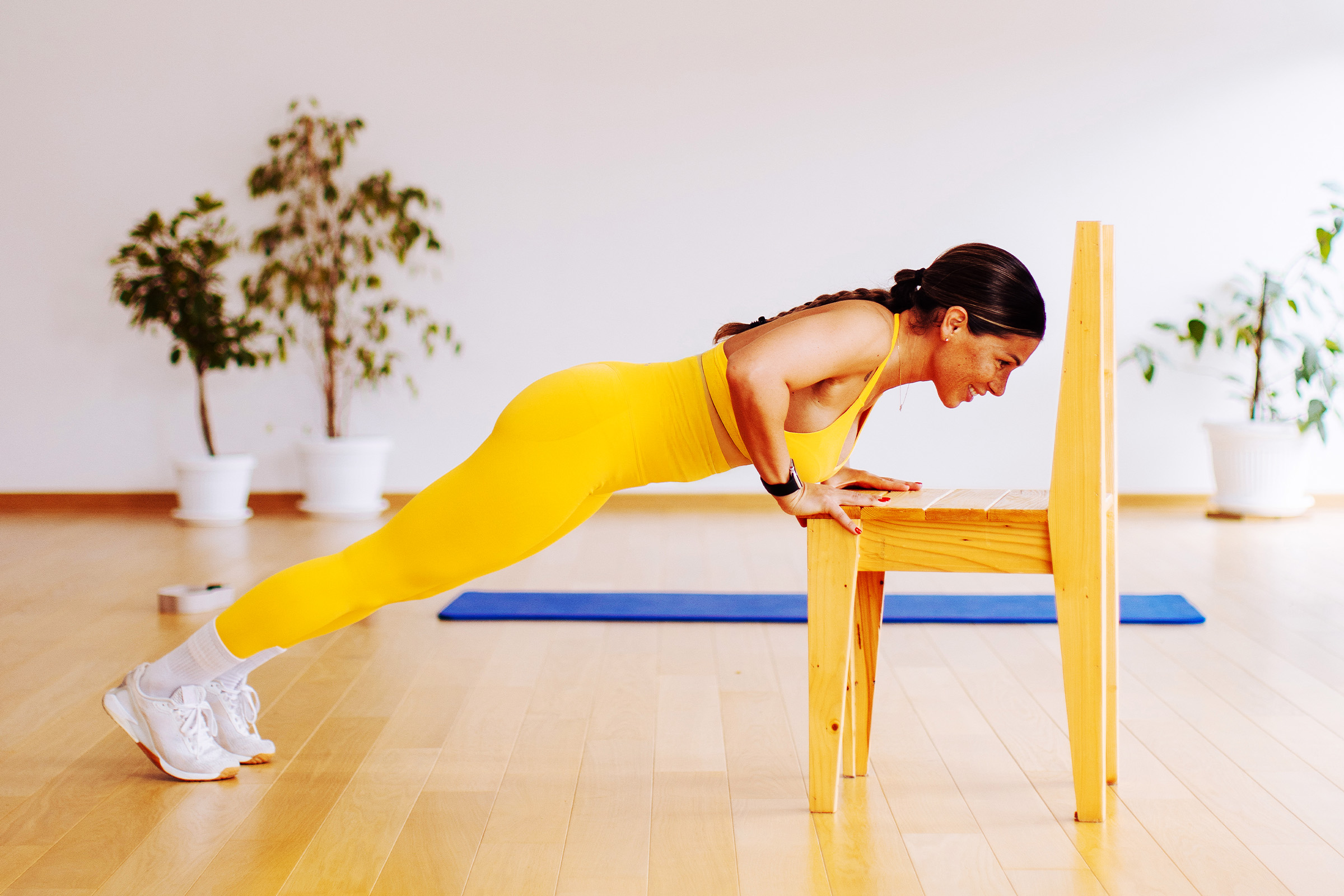
5. Chair Planks
All planking movements are effective, albeit difficult, exercises. The neat thing about this plank is that you can perform it in a more upright position, making it easier than the floor plank, since you don’t have to get down and up from the floor, which can be challenging for some of us.
Step 1: Orient your chair such that it is stable and won’t move unexpectedly. I suggest avoiding the use of rolling chairs for exercise, as they are potential accidents waiting to happen.
Step 2: Facing the chair, place your hands in the middle of the seat and step your legs back so that your body is in a straight line from your shoulders to your feet. Be sure to keep your elbows straight while holding position. You will be on your toes, with your heels off the floor.
Step 3: Try to hold this position for one minute, or as long as you can. Each one-minute hold counts as one set. Try to perform three total sets.
Modifications: If you struggle to keep your elbows straight, you can rest them on the seat, keeping your body straight.
Why I Like It: This exercise is easier to perform than the classic plank movements. It’s a clean, crisp movement that can help power up your core musculature.
These exercises can get you moving, even if you need to stay close to your desk, are hard-pressed for a break, or have difficulty standing. I recommend performing them at least three times per day, or ideally, any time you spend extended time sitting.
Figuratively speaking, working out in your chair today may help your weakness disappear tomorrow. Chair exercises energize and strengthen your body and can help clear your mind to boot. I hope that you enjoy them and that they work well for you.
About the Fitness Model: Aerowenn Hunter is a health editor and fitness model for The Epoch Times. She’s an accredited yoga therapist with three decades of teaching experience.