
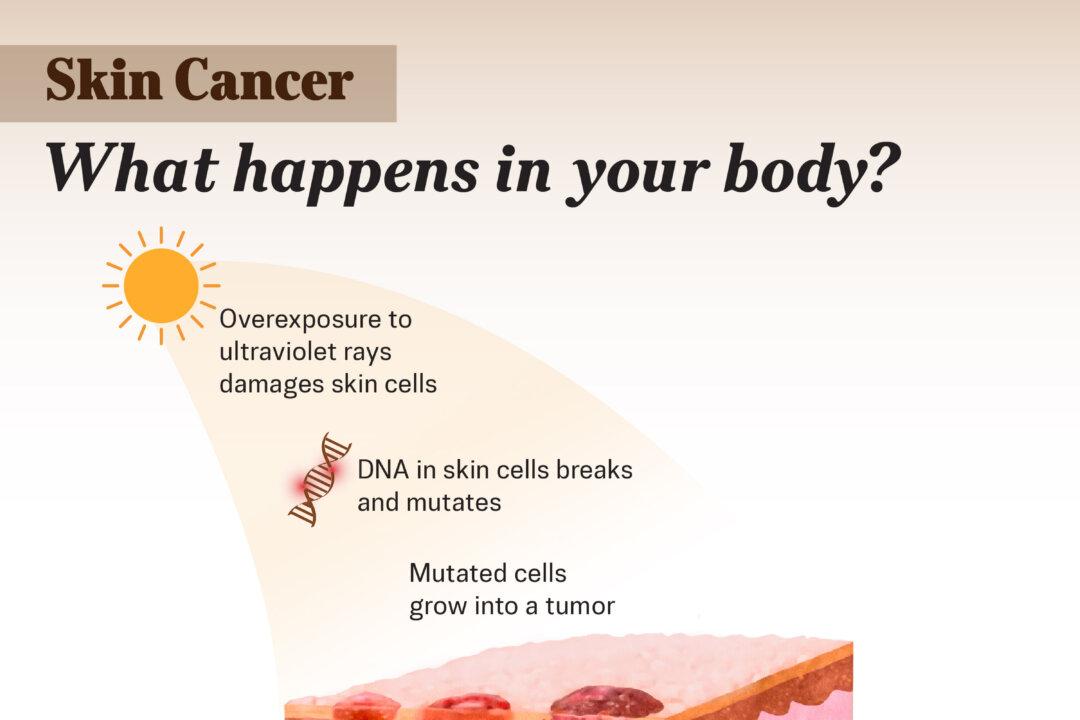
General Symptoms Across All Types
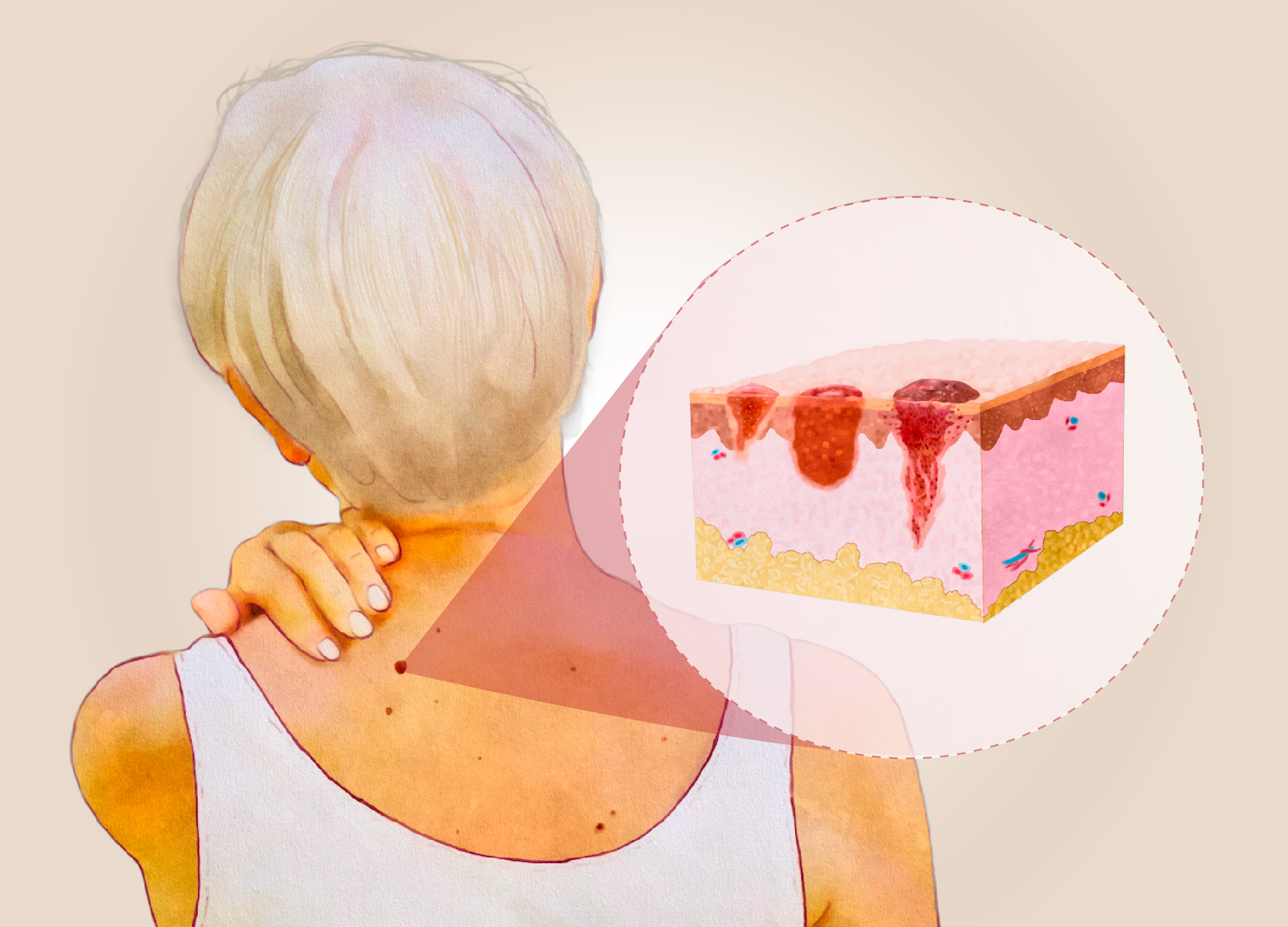
Common symptoms that may indicate any type of skin cancer include:
- New mole or bump
- Change in an existing mole’s size, shape, or color, or bleeding
- Flat or raised patch that is pink, red, or brown
- Sore that does not heal and may bleed or crust
- Itchy, bleeding, or painful area
- Shiny or skin-colored bump
- Rough, scaly red spot
- Growth with irregular or elevated borders
- Growth with an unusual color such as white, black, blue, pink, or red
See a dermatologist immediately if you notice:
- New mole or growth
- Change in an existing mole’s size, shape, color, or texture
- Sore that does not heal within four weeks
- Spot that bleeds, itches, or is painful
- Skin change that concerns you
1. Basal Cell Carcinoma
BCC is the most common form of skin cancer, accounting for approximately 80 percent of all skin cancer cases in the United States. BCC originates in the basal cells—located in the lower part of the epidermis—that continuously divide to replace aging squamous cells on the skin’s surface.
- Persistent, nonhealing sore or ulcer: A sore that appears shiny, translucent, pink, pearly white, or red. It may be tender, rough, have raised edges, and show bleeding, discharge, or crusting. If a sore or ulcer fails to heal within four weeks without a clear reason, it may be a sign of skin cancer.
- Lump or nodule: Small, slow-growing bump that may be shiny pink, white, or red in lighter skin tones, or black or brown in people of color.
- Red patches: Red areas that may itch, cause irritation, or be painful.
- Pink growth with central indentation: Slightly raised pink bump with rolled edge and sunken center, which may crust and develop tiny visible blood vessels.
- Scar-like area: Flat, glossy patch that appears white, yellow, or waxy and lacks clear borders—often a sign of invasive BCC.
Appearance by skin tone: In fair-skinned people, BCCs typically appear as round, flesh-colored nodules, pearly bumps, or pinkish patches. In people with darker skin tones, they may present as raised brown or glossy black lesions.
2. Squamous Cell Carcinoma
Squamous cell carcinoma (SCC) is the second most common type of skin cancer, with more than 1 million cases diagnosed annually in the United States. SCC originates in the squamous cells, which are flat cells located in the outermost layer of the epidermis that are regularly shed and replaced.
- Thick, scaly red patch: Long-lasting, thickened red area with uneven borders that may crust over or bleed.
- Raised growth with central indentation: Elevated lesion with indented center that may itch, bleed, and grow quickly.
- Chronic open sore: Wound that persists for several weeks and often bleeds or forms a crust without healing.
- Wart-like lesion: Growth that resembles a wart and may crust or occasionally bleed.
- Red, firm bump: Solid, raised lesion that may be tender.
- Rough or scaly patch: Textured area that feels different from the surrounding skin.
- Sore that heals and reopens: Wound that appears to heal but repeatedly breaks open again.
Important note: Compared to BCC, SCC tends to grow more rapidly and has a greater potential to metastasize to other parts of the body. However, when detected early, it is highly treatable.
3. Melanoma
Though malignant melanoma accounts for only about 1 percent of all skin cancer cases, it is the most dangerous form due to its high potential to metastasize and its responsibility for the majority of skin cancer-related deaths. Melanoma arises when melanocytes—the pigment-producing cells in the skin—begin to grow uncontrollably.
ABCDE Warning Signs
One of the most reliable ways to spot melanoma early is to follow the ABCDE rule. These simple guidelines can help you recognize the subtle changes that may signal skin cancer.
- Asymmetry: One half of the mole looks different from the other.
- Border: The edges are irregular, jagged, or not clearly defined.
- Color: The mole has multiple colors or uneven color distribution.
- Diameter: The mole is typically larger than 6 millimeters (about the size of a pencil eraser).
- Evolving: The mole changes over time in size, shape, color, or symptoms such as itching, bleeding, or tenderness.
Ugly Duckling Approach
Most normal moles look alike, but melanomas stand out as unusual “ugly ducklings” that look different from your other moles. This method encourages you to look for any spot that doesn’t match the pattern of the others—whether it’s darker, larger, smaller, or simply looks out of place. If a mole catches your eye because it looks different from the rest, it’s worth having it checked by a dermatologist.
- New mole or unusual dark spot that looks different from surrounding skin
- Existing mole that begins to itch, bleed, or become painful
- Spot that becomes raised when it was previously flat
- Spot that develops a rough, scaly, or ulcerated surface
Risk Factors for the 3 Major Types of Skin Cancers
Anyone can develop skin cancer, but some people face a higher risk than others. If you have the following, you may have an increased risk of developing skin cancer—making regular skin checks and sun protection especially important.
- Fair skin that burns easily
- Blue or green eyes
- Blonde or red hair
- History of sunburns, especially during childhood
- Many moles or unusual moles
- Family history or personal history of skin cancer
- Age over 50
- Weakened immune system
- Gorlin syndrome, Bazex-Dupré-Christol syndrome, or Rombo syndrome (genetic conditions that specifically increase the risk of BCC)
- Long-standing burn scars, persistent ulcers or sores, certain types of HPV (all of which specifically increase the risk of SCC)
- History of smoking, especially current smoking or heavy smoking (linked to an increased risk of SCC but not other types of skin cancer)
- History of indoor tanning (people who have tanned indoors have a 67 percent higher chance of developing SCC compared to those who have not)
- Moderate to heavy alcohol use (may increase the risk of melanoma by about 20 percent, with greater risk linked to higher consumption)
- Personal history of breast or thyroid cancer
- Skin exam: A health care provider checks the skin for unusual spots, evaluating their size, color, shape, and texture.
- Skin biopsy: A small sample of skin is removed and examined under a microscope to confirm whether it is cancerous.
- Blood chemistry studies: A blood sample is analyzed to measure levels of specific substances released into the bloodstream by organs and tissues.
- Immunohistochemistry: A laboratory test that uses antibodies to detect antigens or markers in the tissue sample, helping identify cancer cells.
- Magnetic resonance imaging (MRI) scan: MRI may be used to check for cancer cells or tumors that have spread to other parts of the body. It is primarily used for staging rather than for initial detection.
- Gene expression profiling (GEP): GEP extracts ribonucleic acid (RNA) from a tissue sample and uses techniques such as microarray analysis or RNA sequencing to measure the activity levels of thousands of genes at once. This can help determine the cause of the cancer, confirm a diagnosis, and guide treatment decisions.
The 5 Stages of SCCs
SCCs are usually diagnosed early, but in some cases, they can grow deeper or spread to other parts of the body. Staging helps determine how far the cancer has progressed and guides treatment decisions.
- Stage 0: Abnormal cells limited to the top layer of skin
- Stage 1: Cancer has grown deeper into the skin but not spread to lymph nodes or other tissues
- Stage 2: Cancer has invaded deeper skin layers and shows high-risk features but has not spread beyond the skin
- Stage 3: Cancer has spread to nearby lymph nodes or deeper structures such as muscle or bone
- Stage 4: Cancer has spread to distant organs or other areas of the skin
The 5 Stages of Melanoma
Melanoma staging describes how far the cancer has spread, which is critical for choosing the right treatment and understanding prognosis. Early-stage melanomas are often curable, while advanced stages require more aggressive treatment.
- Stage 0: Melanoma limited to the outer skin layer, with no spread
- Stage 1: Melanoma confined to the skin, with no spread to lymph nodes
- Stage 2: Melanoma thicker but not spread to lymph nodes, with a higher risk of spreading
- Stage 3: Melanoma spread to nearby lymph nodes or along the lymphatic system near the original site
- Stage 4: Melanoma spread through the bloodstream to distant skin, lymph nodes, or organs
1. Topical Therapy
Topical therapy involves applying creams or ointments such as imiquimod or fluorouracil directly to the skin to treat precancerous conditions or superficial skin cancers such as BCC or early-stage SCC. These medications are typically used daily for several weeks.
2. Surgery
Several types of surgery may be used to treat skin cancer, including:
3. Radiation Therapy
Radiation therapy, using low-energy X-rays, is often recommended for difficult BCC or SCC cases when surgery is not an option, particularly in older or medically fragile people. Radiation therapy has a cure rate of about 90 percent.
4. Immunotherapy
Immunotherapy uses the body’s immune system to fight cancer by enhancing or restoring its natural defenses. Vaccine therapies that aim to activate the immune system to target tumors are also being explored for late-stage melanoma.
5. Photodynamic Therapy
Photodynamic therapy involves applying a medication to the skin cancer lesion, then activating it with blue light, laser, or controlled sunlight to destroy cancer cells. This treatment is used for some superficial BCCs and SCCs.
6. Targeted Therapy
Targeted therapy for advanced melanoma uses drugs or substances to specifically identify and attack cancer cells while minimizing harm to healthy cells.
7. Chemotherapy
Chemotherapy drugs stop metastatic SCC or melanoma cells from growing, either by killing them or preventing their division. These drugs can be given orally, by injection, or directly into specific areas such as the cerebrospinal fluid or organs to target the cancer regionally. While targeted therapies block molecules involved in cancer growth, chemotherapy broadly kills fast-dividing cells, including both cancerous and healthy ones.
8. Traditional Chinese Medicine
Acupuncture may help manage side effects of cancer treatment, such as nausea from chemotherapy.
1. Anti-Inflammatory Diet
A healthy, anti-inflammatory diet rich in whole, colorful, and preferably organic foods can support skin health and may help reduce the risk of skin cancer.
2. Exercise
Physical activity, as tolerated, can help maintain energy levels, improve mood, reduce fatigue, and support overall health during and after treatment. Talk with your health care team about appropriate exercise levels.
3. Massage Therapy
Massage therapy can help reduce stress, anxiety, muscle tension, and pain.
4. Sleep
Adequate, restorative sleep is essential for healing, immune function, and overall well-being.
5. Frankincense Essential Oil
Frankincense essential oil, extracted from the Boswellia tree, has shown potential as a melanoma treatment. In laboratory and animal studies, frankincense selectively killed melanoma cells without harming normal skin cells and significantly reduced tumor size in mice. These early findings suggest it may offer a targeted, natural approach to supporting melanoma treatment.
Limit UV Radiation Exposure
Wear UV-protective clothing such as long sleeves, sunglasses, hats, and apply broad-spectrum sunscreen with a sun protection factor of at least 30. Zinc oxide and titanium dioxide are currently recognized as safe and effective active ingredients in sunscreens, according to the FDA.
Consider Nicotinamide
A 2015 study found that taking 500 milligrams of nicotinamide—the active, water-soluble form of vitamin B3—twice daily for one year reduced the risk of developing new nonmelanoma skin cancers by nearly 25 percent, with no significant side effects reported.
Explore Polypodium Leucotomos Extract
Polypodium leucotomos, a tropical fern, may help protect the skin from UV damage by increasing resistance to sunburn. Small clinical studies have shown reduced UVB-related skin effects and redness in people who took the extract before sun exposure. However, larger studies are needed to confirm its safety and effectiveness.
Avoid Drinking and Smoking
Both alcohol and smoking can raise the risk of skin cancer. Limiting or avoiding alcohol and quitting smoking are strongly recommended to reduce cancer risk and improve recovery outcomes.