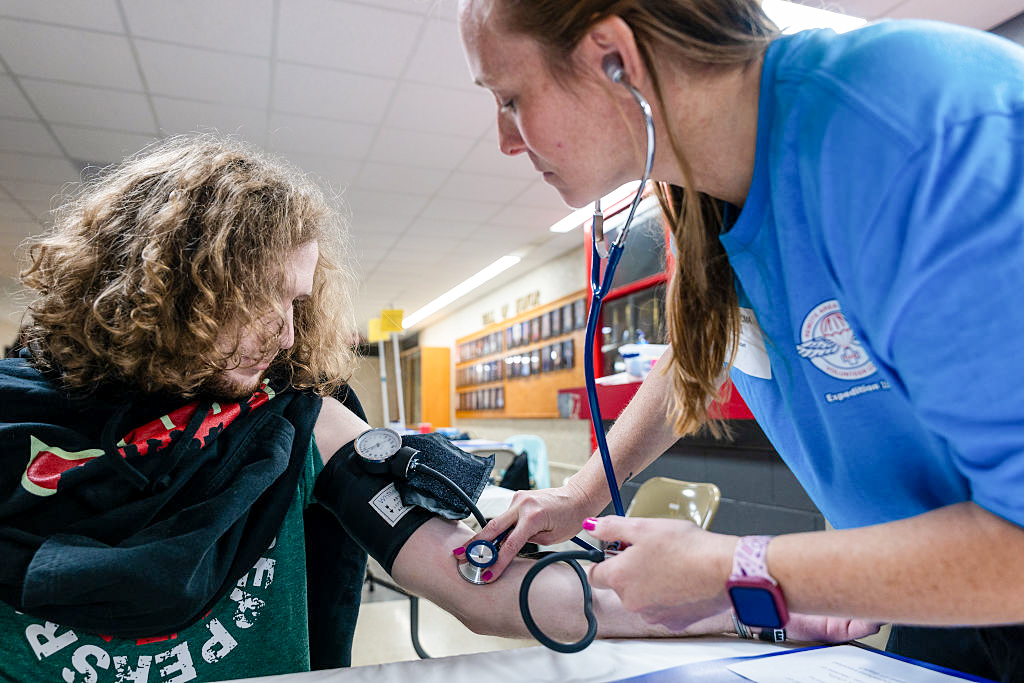

Rates of high blood pressure in children have almost doubled since the turn of the century amid rising levels of childhood obesity, a global study has found.
More than one in 20 children and teenagers, 6.2 percent, were believed to have high blood pressure in 2020—up from 3.2 percent in 2000.
This means high blood pressure now affects 114 million children around the world, according to an international team of academics including researchers from the University of Edinburgh and Zhejiang University in China.
Published in the journal Lancet Child and Adolescent Health, the study was based on data from 443,000 children from 21 countries.
Researchers found that almost 19 percent of children and adolescents classed as obese have high blood pressure, compared with 3 percent of children who are of a healthy weight.
This concurs with the medical opinion that, although it is not the sole factor, obesity is closely related to high blood pressure, also known as hypertension.
‘Major Risk Factor’ in Adults
Other lifestyle factors, including chronic stress, smoking, and drinking excessively, can elevate blood pressure, as can some medications, including anti-depressants and anti-inflammatories, and recreational drug use. Genetics are also believed to be a factor.
High blood pressure, which does not in itself cause symptoms, is a major risk factor for stroke, heart disease, and chronic kidney disease. It is a leading cause of premature death in adults worldwide, putting more than a billion people at risk, according to the World Health Organization.
The near doubling in childhood high blood pressure over 20 years “should raise alarm bells for healthcare providers and caregivers,” said Lancet study author professor Igor Rudan of the University of Edinburgh.
“But the good news is that we can take steps now, such as improving screening and prevention efforts, to help control high blood pressure in children and reduce the risks of additional health complications in the future,” he said.
The findings suggest that an additional 8.2 percent of children and adolescents have prehypertension, meaning blood pressure levels are higher than normal but do not meet the criteria for hypertension.
Prehypertension becomes more prevalent during adolescence than for pre-pubescent children, with rates reaching about 11.8 percent among teenagers, compared with about 7 percent in younger children. Blood pressure levels also tend to increase sharply during early adolescence, peaking at about age 14, especially among boys.

(New Africa/Shutterstock)
Changing Classifications
Pediatric blood-pressure classification and practical diagnostic guidance have changed over the past 20 years, although not uniformly across the world.
In 2017, the United States and some other countries recalculated their reference charts using only normal-weight children, effectively lowering the percentile cut-offs—so a child who might have been classed as “pre-hypertensive” before 2017 could now fall into the “hypertensive” band.
For teenagers, the American Academy of Pediatrics introduced fixed adult-style thresholds instead of height-based percentiles, which also raised prevalence, alongside soaring rates of obesity.
Although there have been concerns over the widespread use of statins to treat high blood pressure in adults—because of the side effects they can cause and debates about cholesterol—these medications are not usually recommended for children.

A child stands next to his father in a checkout aisle that is filled with colorfully packaged junk food marketed at children in a supermarket in Albany, Australia, on Sept. 7, 2024. (Susan Mortimer/The Epoch Times)
‘Bold Government Action’
Bryan Williams, chief scientific and medical officer at the British Heart Foundation, told PA Media that the study’s findings are “deeply concerning.”
“Elevated blood pressure in childhood often persists into adulthood, increasing the risk of heart disease and stroke later in life,” he said.
“While genetics and kidney disease play a role, the sharp rise in childhood hypertension is most likely driven by the growing prevalence of childhood obesity. The good news is that obesity-related high blood pressure can be reversed.”
He called for “bold government action” to tackle childhood obesity rates. In the UK, a ban on the advertising of junk food to children was to come into force in October, but it has been delayed until Jan. 5, 2026.
U.S. Health Secretary Robert Kennedy Jr., as head of the MAHA Commission, is actively pushing for restrictions on junk food marketing to children in the United States, proposing industry guidelines and urging companies to self‑regulate. However, no federal ban is yet in place, and much of the approach remains voluntary and subject to industry pushback.