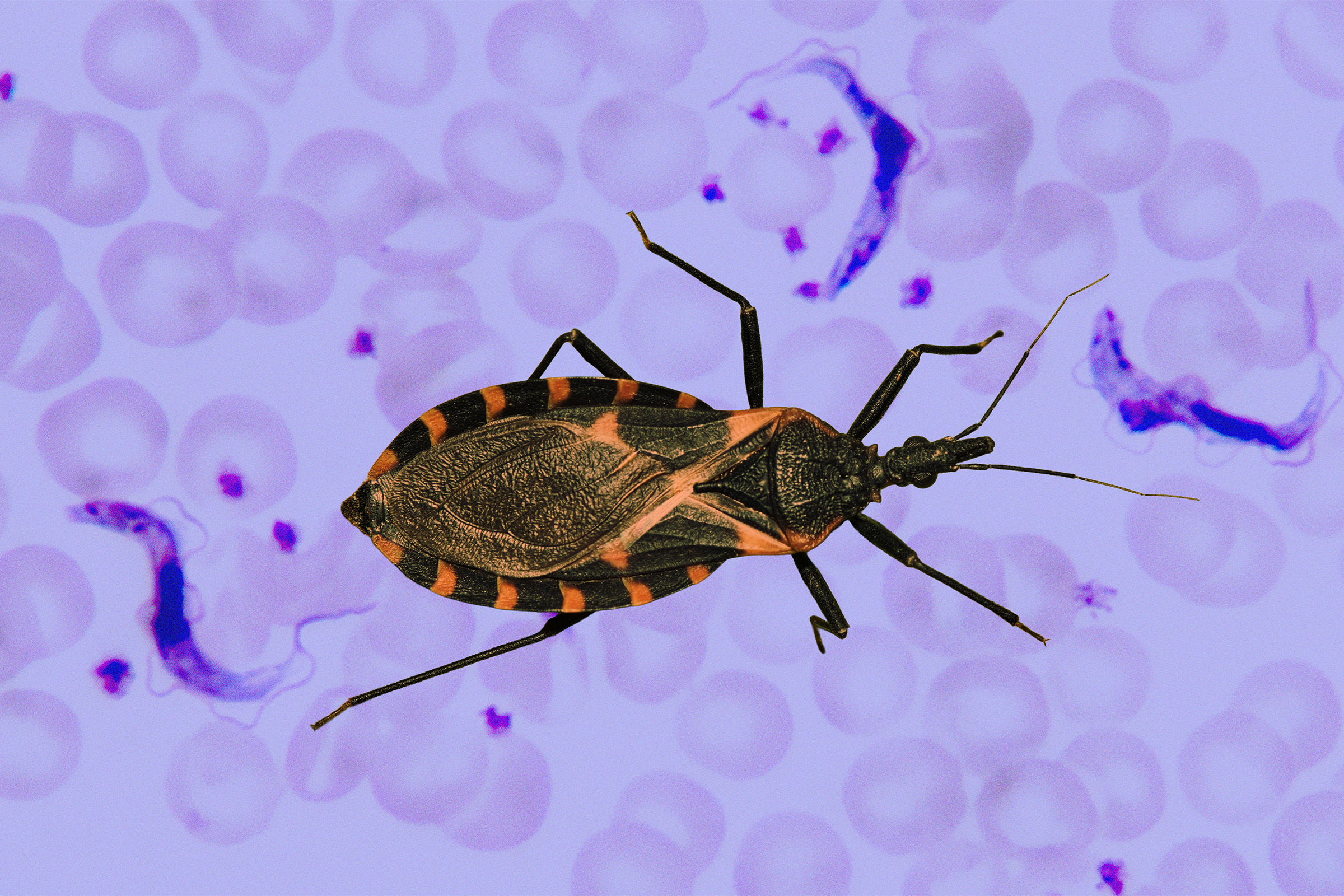
If Chagas disease was news to you until recent headlines, you were not alone. Sometimes called the “kissing bug disease,” it’s caused by the parasite Trypanosoma cruzi (T. cruzi) and is spread by insects that often bite near the mouth or eyes while a person sleeps.
For years, Chagas was considered primarily a rural health issue in Latin America, where thatch roofs and mud walls make it easier for the bugs to colonize homes. In the United States, these insects mostly live outdoors and primarily feed on wild animals. As a result, the parasite circulates mostly in an enzootic cycle—between bugs and wildlife—not in homes. Human infection is relatively rare.
Now, scientists from the University of Florida, Texas A&M University, and other institutions argue, in a recent perspective published by the Centers for Disease Control and Prevention, that Chagas disease should be recognized as endemic—or at least “hypoendemic”—in parts of the United States, especially the Southern states, where the bugs, parasites, and infected wild and domestic animals are well-established.
However, the disease has always been present—just rare—since most Americans do not live in the same rural housing conditions that can lead to infection as do some populations in Latin America.
“Chagas disease and the vectors that transmit it—kissing bugs—are not new to the southern United States,” co-author Bonny Mayes, an epidemiologist in zoonosis control at the Texas Department of State Health Services, told The Epoch Times in an email.
In fact, T. cruzi DNA has been found in 1,000-year-old human remains from Texas—evidence that the disease has a long history on U.S. soil.
What’s the Risk?
While many kissing bugs in the United States carry the parasite, human infection through local transmission is considered rare because of how the infection spreads.
The insects are blood feeders—like mosquitoes or ticks—but with a key difference in how they spread disease, veterinarian and epidemiologist professor Sarah Hamer of Texas A&M, a co-author of the perspective, told The Epoch Times.
“It’s not the bite that’s infectious,” said Hamer, who also has a background in wildlife ecology. “It’s the feces they leave behind during or after feeding.”
Kissing bugs are nocturnal and feed on the blood of various animals, including woodrats, opossums, raccoons, and sometimes humans.
The bugs don’t pass the parasite in their saliva—instead, they leave droppings near the bite, and infection occurs only if that feces enters broken skin, the eye, or a mucous membrane.
“Unlike malaria, it’s an indirect and relatively inefficient transmission route,” Dr. Caryn Bern, a professor of epidemiology and biostatistics at the University of California–San Francisco School of Medicine, who has studied Chagas disease for decades, told The Epoch Times.
Homes with sealed windows, intact screens, and air conditioning typically keep the insects out—unlike some rural housing in Latin America, where mud walls or thatched roofs can allow bugs to colonize inside.
“That’s why we don’t see large outbreaks in the United States the way we do in parts of Latin America,” said Bern, who did not contribute to the perspective.
Mayes said, “Fewer people [in the United States] are exposed to kissing bugs inside their homes.”
As a result, the risk to humans is relatively low but not zero.
A Rare Underreported Disease
An estimated
300,000 people in the United States are currently living with Chagas disease, up from about 100,000 in previous decades.
The vast majority—about 97 percent—were infected years ago in Latin America before immigrating to the United States.
Infections acquired in the United States are rarer, but there’s growing recognition.
From 2000 to 2018, there were 29 confirmed and 47 suspected locally acquired cases, most in states such as Texas, Arizona, Louisiana, and California. However, these cases may be underreported since early symptoms are often mild or nonexistent and because Chagas isn’t nationally reportable.
Left untreated, the disease can become a lifelong chronic infection, with about one in three people eventually developing serious heart complications.
“The heart disease is what we worry about most,” said Bern. “We see conduction disorders, arrhythmias, heart failure, and even sudden cardiac death—often misdiagnosed as something else.”
Because Chagas is still largely seen as a disease that only affects people traveling to Latin America, this assumption tends to filter down into medical and veterinary training—leading to missed opportunities for diagnosis and prevention in the United States, co-author and Texas A&M professor Gabriel Hamer, a medical and veterinary entomologist and wildlife ecologist, told The Epoch Times in an email.
That lack of awareness is part of what prompted him, along with other researchers of the perspective, to call for better surveillance and more research—not only to understand the true scope of the problem but to help find and treat actual cases.
“We know some areas have no transmission, while others—especially in the southern half of the country—have the insect, the parasite, and the wildlife reservoirs in place,” Dr. Norman Beatty, also one of the co-authors and an infectious disease physician and professor at the University of Florida College of Medicine, told The Epoch Times.
People who spend time camping, hunting, working in agriculture, or living in rural areas may be at risk of being infected with Chagas.
However, most Americans aren’t at risk based on their typical environments and behavior, according to Bern.
After Hurricane Katrina, for example, a woman living in a rustic log cabin in Louisiana tested positive for chronic Chagas infection. Flooding may have driven infected insects into her home.
Bern also noted that hunters could theoretically be exposed if they cut themselves while handling infected animals such as raccoons or opossums without gloves. However, she pointed to a large study in Texas that tested nearly 900 hunters and found no infections, suggesting that the real-world risk remains low.
Dogs as Canaries Disease Sentinels
While human cases are rare, dogs are much more vulnerable and can serve as sentinels for the disease’s presence.
Dogs can get infected by grooming themselves or by eating infected bugs,” both Gabriel Hamer and Sarah Hamer said.
Sarah Hamer said, “We’re seeing a lot of sick dogs in the South.”
Gabriel Hamer said, “If your dog tests positive, it may mean there’s a broader risk in your environment—not direct risk from the dog but from the bugs that the dog may have eaten while outdoors.”
Signs and Symptoms
Chagas is often called a “silent” disease—many infected people don’t have symptoms for years or even decades. The disease has two main phases, according to Bern, who runs the U.S. Chagas Network, a resource that helps health care providers learn how to diagnose, manage, and treat patients with Chagas in the United States.
Bern says it’s important for doctors to determine the phase and form of Chagas disease:
- Acute phase: The acute stage occurs within the first one to two months after infection. Some people may experience mild symptoms such as fever, fatigue, body aches, or swelling near the eye, but many feel fine and never realize they’ve been infected.
- Chronic phase: After the acute phase, people enter the chronic phase, which lasts the rest of the person’s life in the absence of treatment. About one-third of infected people eventually develop serious complications, primarily involving the heart.
Diagnosis and Treatment
In the United States, Chagas disease is not routinely screened for in most clinics. Some cases are caught incidentally during blood donation, prenatal testing, or cardiac evaluations.
Diagnosis requires two separate antibody tests, as the parasite is often undetectable in the blood during chronic infection.
“Testing for Chagas disease in humans is complex,” Mayes said, and not all health care providers have experience with the illness.
Treatment involves antiparasitic medications—benznidazole and nifurtimox—which are only Food and Drug Administration-approved for children and are used off-label in adults. Based on trial data, the benefits for children are clearer and the side effects are better tolerated, compared to adults, where the evidence is not as strong and the side effects are more severe.
In many Latin American countries, however, the two medications are routinely used for adults, although some adults can experience adverse effects such as gastrointestinal issues, neuropathy, insomnia, and more serious complications.
“Treatment decisions are individualized, especially in older adults,” Beatty said.
His clinic in Florida, one of the few in the United States actively screening for locally acquired Chagas, has already identified several cases of imported chronic Chagas—and he hopes other providers will follow suit.
Lack of awareness, all experts agree, remains the biggest challenge.
How to Protect Yourself
If you live in rural or wooded areas—or spend time camping, hunting, or working outdoors—it’s wise to take basic precautions beginning with recognizing the insect.
“The adult life stage is pretty big—about an inch long—and usually dark with red or orange markings around the sides of their abdomen,” Sarah Hamer said. “They’re striking if you see them, but most people don’t—bugs are active at night and hide during the day.”
Basic precautions help reduce the risk:
- Seal cracks and gaps at home.
- Use window screens and install door sweeps.
- Keep outdoor lights to a minimum at night.
- Bring pets indoors after dark.
- Avoid letting pets eat insects.
Community science programs, such as the Texas A&M kissing bug community science program, invite public photo submissions to help identify bugs and improve awareness.
“We’re not suggesting people panic,” Sarah Hamer said. “But we do want people who live in areas where kissing bugs are found to recognize them, understand the risks, and know what steps they can take to reduce contact.”