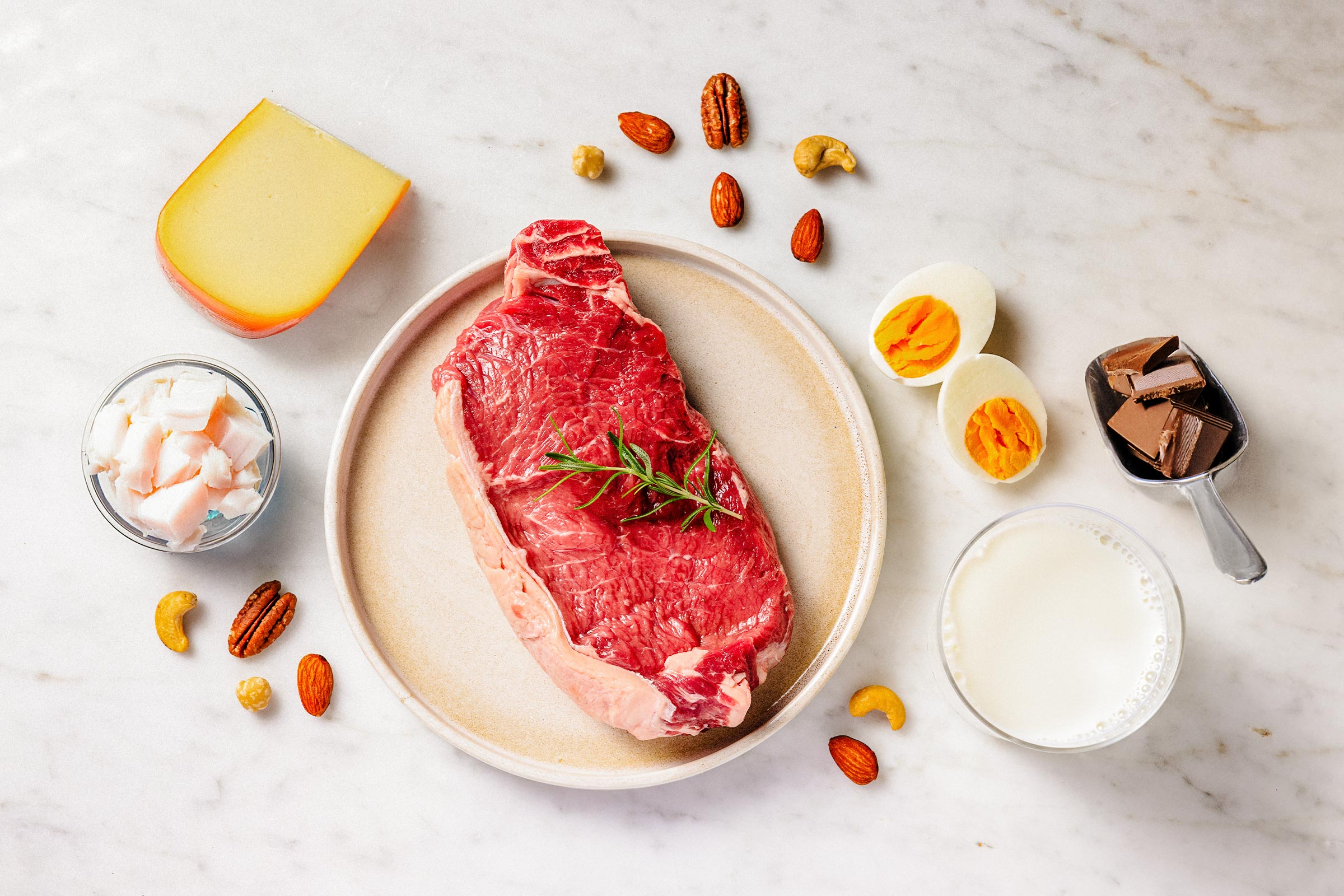
You can enjoy grass-fed beef, whole-fat Greek yogurt, and dark chocolate—all in the same day—while following the 2025 Dietary Guidelines for Americans. With what nutrition experts call “fat budgeting,” you can make the guidelines work for you.
The 2025 to 2030 Dietary Guidelines for Americans made headlines by turning the original 1992 food pyramid upside down, placing protein-rich foods and whole-fat dairy at the top. What most people missed is that the decades-old 10 percent cap on saturated fat as a percentage of total daily calories remains firmly in place.
Saturated fat exists in both plant and animal foods. Although saturated fats are generally solid at room temperature, not all animal fats are solely saturated fats.
Saturated Fats
All fats contain nine calories per gram, whether saturated or unsaturated. The key is choosing wisely.
How to Eat Within the Saturated Fat Cap
For most adults, following a 2,000-calorie diet means eating just 22 grams of saturated fat per day—roughly 2 1/2 tablespoons of butter. Although 22 grams may sound restrictive, with strategic meal planning, you can comfortably fit in steak, eggs, whole-fat dairy, and even dessert while staying under the limit.
Lean: Prioritize sirloin over ribeye and skinless over skin-on poultry. A 6-ounce sirloin has roughly 6 grams of saturated fat, leaving you 16 grams for the rest of the day. Removing the skin from chicken or turkey reduces saturated fat by 50 to 70 percent.
Clean: Focus on whole foods, such as steak and yogurt, rather than processed meats such as bacon and sausage. Processed meats contain sodium and nitrates that compound the cardiovascular risk of the saturated fats they carry.
Green: Use plant-based unsaturated fats such as olive oil and avocado oil to lower the saturated fat intake from your meat.
The ‘Dilution’ Method: Drain fat after browning ground beef and mix meat with plant-based “bulkers” such as lentils or mushrooms to lower the saturated fat density per serving while maintaining a meaty flavor and texture.
Swap the Food Matrix: Research suggests that fermented dairy products, such as yogurt, kefir, and aged cheese, have a neutral or even protective effect on heart health compared with butter, even when their saturated fat content is similar. Swap butter for extra-virgin olive oil when cooking meat.
A Sample Daily Menu
Here, I share a diverse, balanced 2,000-calorie menu that includes animal meat, tofu, nuts, whole-fat dairy, and dark chocolate while staying comfortably under the 10 percent saturated fat cap. It delivers 95 grams of protein and 28 grams of fiber. I like it a lot. Do you think you can eat this?
The Science Behind the 10 Percent Cap
The saturated fat recommendation has deep roots in U.S. nutrition policy. The first modern
Dietary Guidelines for Americans, released by the Department of Health and Human Services and the Department of Agriculture in 1980, recommended reducing total fat to about 30 percent and saturated fat to less than 10 percent of daily calories to reduce the risk of heart disease.
The recommendation stemmed from the 1977 “McGovern Report,” which stated that “saturated fat in the diet is of concern because it has been directly linked to excessive levels of cholesterol in the blood and therefore to an increased risk of heart disease.”
This statement was based largely on the Seven Countries Study, a seminal study that began in 1958 (and continued for more than 50 years) that identified a strong correlation between saturated fat intake and heart disease across seven nations: the United States, Italy, Greece, Yugoslavia, the Netherlands, Finland, and Japan.
Over the decades, the study has been criticized for methodological limitations—particularly for comparing men across countries rather than within the same populations—making it difficult to isolate the effects of saturated fat from other cultural and dietary factors.
Despite ongoing debate, policy change takes time, and the 10 percent cap has remained consistent through multiple guideline revisions.
Nuanced View of ‘Food Matrices’
Research has shifted away from viewing saturated fat as a single chemical entity toward a food-matrix model, highlighting that the health effects of saturated fat depend, in part, on the physical and chemical structure of the food it is in.
For example, saturated fat in fermented whole-fat dairy behaves differently in the body from saturated fat in processed foods. Whole-fat cheese is consistently associated with a lower or neutral risk of cardiovascular disease, despite that it is high in saturated fat and sodium.
Different types of fatty acids in saturated fat also work differently in our bodies. The stearic acid in dark chocolate does not raise low-density lipoprotein cholesterol in the same way that the lauric or myristic acids in other fats might.
Thus, we can enjoy whole-fat dairy and a variety of plant- and animal-sourced foods containing saturated fat while maintaining the saturated fat cap recommended in the new Dietary Guidelines for Americans.
Lidan Du-Skabrin, who has a doctorate in nutrition, contributed to this article.