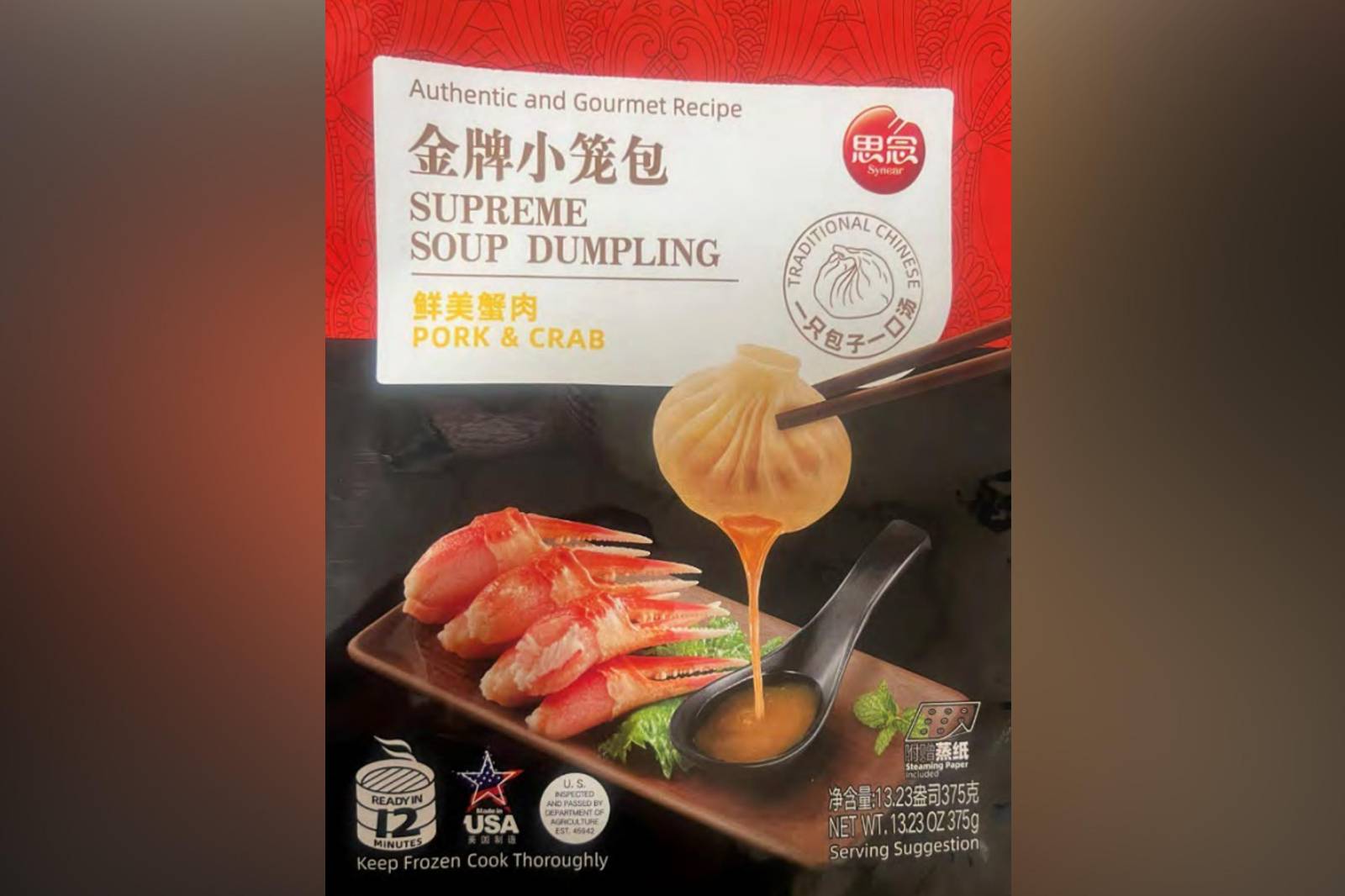

California-based Synear Foods USA LLC recalled roughly 71,603 pounds of not-ready-to-eat frozen pork and crab soup dumpling products from the market, citing misbranding and undeclared allergens.
The allergen in question is peanuts, which were not declared on product labels. The recall is applicable to 13.23-oz. plastic bag packages of “Synear Supreme Soup Dumpling Pork & Crab” and 375-g. plastic bag packages of “Synear Supreme Soup Dumpling Dumplings A La Soupe Supreme Pork & Crab Porc Et Crabe,” the Food Safety and Inspection Service (FSIS) said in a May 31 announcement.
The 13.23-oz products have “Best By” dates of Oct. 15, 2026; Nov. 10, 2026; Dec. 23, 2026; Jan. 26, 2027; and Feb. 23, 2027. The 375-g packages have Best By dates of Oct. 15, 2026, or Jan. 26, 2027. The items were shipped to retail outlets in three U.S. states—California, New Jersey, and Washington. Some were also exported to Canada.
The issue of undeclared peanuts was discovered by FSIS inspection personnel during a routine verification. FSIS personnel identified that the products were formulated with peanut oil, but this was not declared on the product label, the announcement said.
“There have been no confirmed reports of adverse reactions due to consumption of these products. Anyone concerned about a reaction should contact a healthcare provider,” the FSIS said.
When people with a peanut allergy consume the legume, it can trigger an immune reaction that causes severe symptoms, including skin swelling, vomiting, diarrhea, coughing, wheezing, low blood pressure, and shock, according to a March 11 article published in the JAMA Network.
Some people may end up suffering from anaphylaxis, a life-threatening allergic reaction that typically has a death rate of one in 10 million. In the United States, around 2 percent of the population is estimated to be affected by peanut allergy. Most people develop the allergy during early childhood.
In the FSIS announcement, the Synear Foods recall is classified as “High-Class I,” the most severe among the three U.S. Department of Agriculture recall designations. This classification is only issued when there is a “reasonable probability” that consuming the product could result in serious, adverse health impacts or death.
FSIS said it was concerned that some of the recalled products may still remain in consumers’ freezers, and asked people who bought the items not to eat them.
The Epoch Times reached out to Synear Foods for comment but did not receive a response by publication time.
According to a March 11 update from the Food and Drug Administration, nine major food allergens are identified under U.S. law. In addition to peanuts, the other items are milk, fish, eggs, tree nuts, crustacean shellfish, soybeans, sesame, and wheat.
It is legally obligatory that food labels identify the source of all allergens used to make a food product, according to the FDA.
Peanut allergies are triggered by proteins in the legume, according to a post from the nonprofit Food Allergy Research & Education. When a person with a peanut allergy exposes themselves to peanuts, the proteins in the item bind to specific immunoglobulin E antibodies made by the body’s immune system.
If the individual is subsequently exposed to peanut proteins, their immune defenses are triggered, leading to mild or very severe reactions.
Meanwhile, a study from last year found that it may be possible to lower the risk of developing peanut allergy in children by introducing peanuts early in life, according to an Oct. 20 statement from the Children’s Hospital of Philadelphia, which conducted the study.
Researchers analyzed rates of food allergy diagnosis across health records from various states, checking how guidelines on early introduction of peanuts affected children. The prevalence of peanut immunoglobulin E-mediated food allergy decreased from 0.79 percent of the population to 0.45 percent between the pre-guideline and post-guideline periods. During this time, peanuts slipped from the number one food allergen to the second place.
“Future studies could potentially explore specific feeding practices that help us better understand the timing, frequency, and dose of foods that optimize protection against food allergies,” senior study author David Hill said.