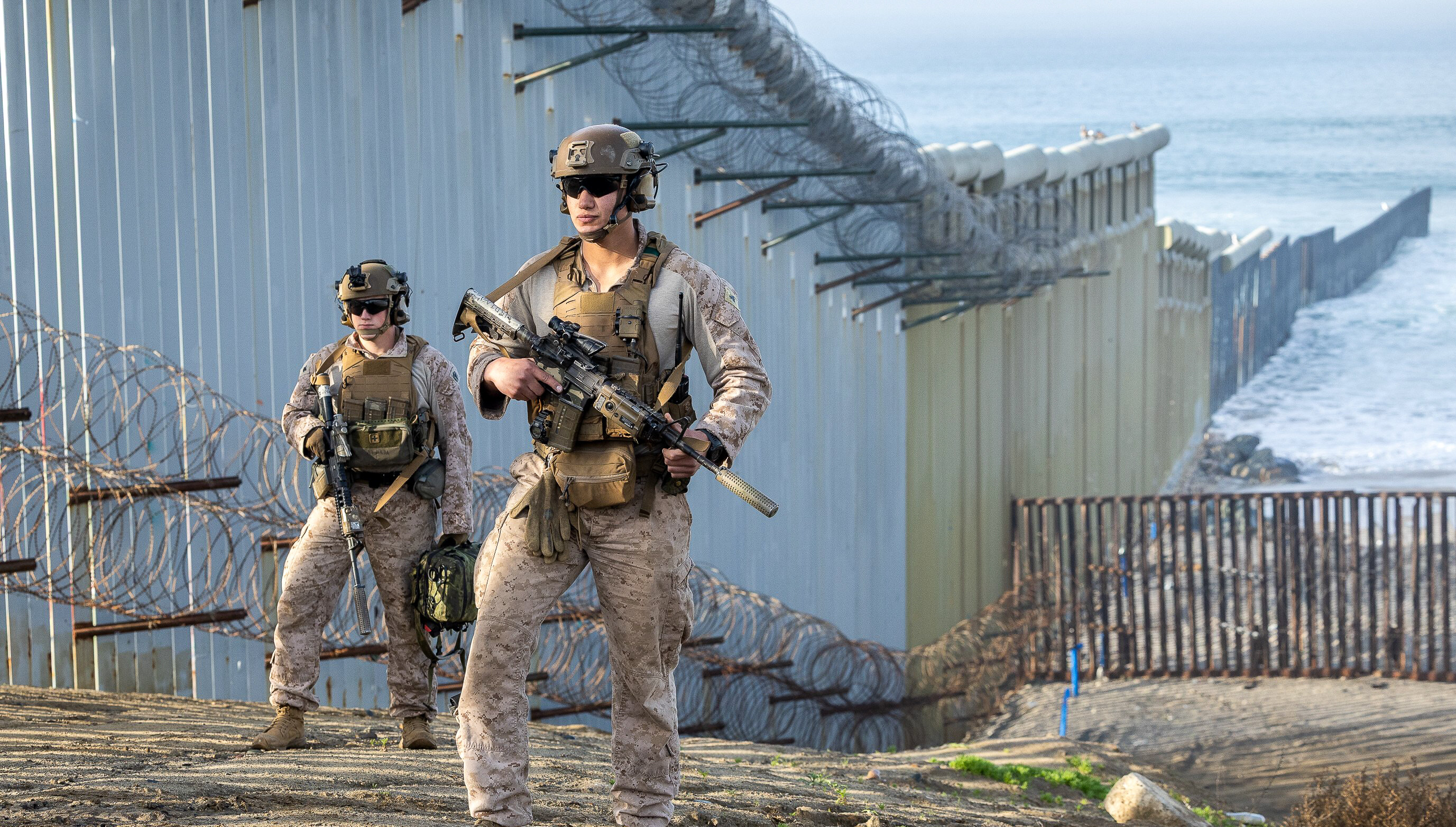

SAN DIEGO—Between the primary and secondary border walls where the U.S.–Mexico border meets the Pacific Ocean, a squad of Marines in full combat uniform and armed with M27s in two civilian trucks approaches the beach at Friendship Park.
Straddling San Diego and Tijuana, Mexico, the park was, until 1993, separated by a small fence so people living on both sides of the border could meet. What has changed in the area since then is a window into U.S. border policy through the decades.
Between 1994 and 1999, during the Clinton administration, fencing was constructed here as part of Operation Gatekeeper. Apprehensions of illegal border crossers plunged as illegal immigrants found alternative routes to the east.
By 2019, during President Donald Trump’s first term, the walls were replaced with 18-foot steel bollard structures.
With Trump’s return to office, the area is now patrolled by the U.S. military as part of a new strategy in which troops cooperate with Border Patrol in newly designated militarized zones. This zone is a 60-foot strip of land running from Friendship Park on the Pacific shore to Sunland Park in New Mexico.
After years of delays, work is progressing to close gaps in the southern border wall, including one as wide as the length of about three football fields near the Otay Mesa Port of Entry east of San Diego on Otay Mountain. Once it’s done, a double border wall will separate Nido de las Águilas (Eagles’ Nest) a low-income neighborhood in east Tijuana from San Diego County. (Brad Jones/The Epoch Times)
One Marine, who was patrolling on Jan. 20, said he had been deployed to the border a few weeks ago.
“We’re just doing some patrolling ops along the border wall, making sure that everything is secure, and just doing our jobs,” said the Marine, who requested anonymity to protect his family from being doxxed.
“The president himself wanted us to come down here, so we took that order, and we took that task, and now we’re going to fulfill it in the best possible way that we can,” he said.
“There’s no saying that we’re going to be here indefinitely. So, while we’re here, we want to make sure that we’re doing as much as we can to ensure the border is secure.”
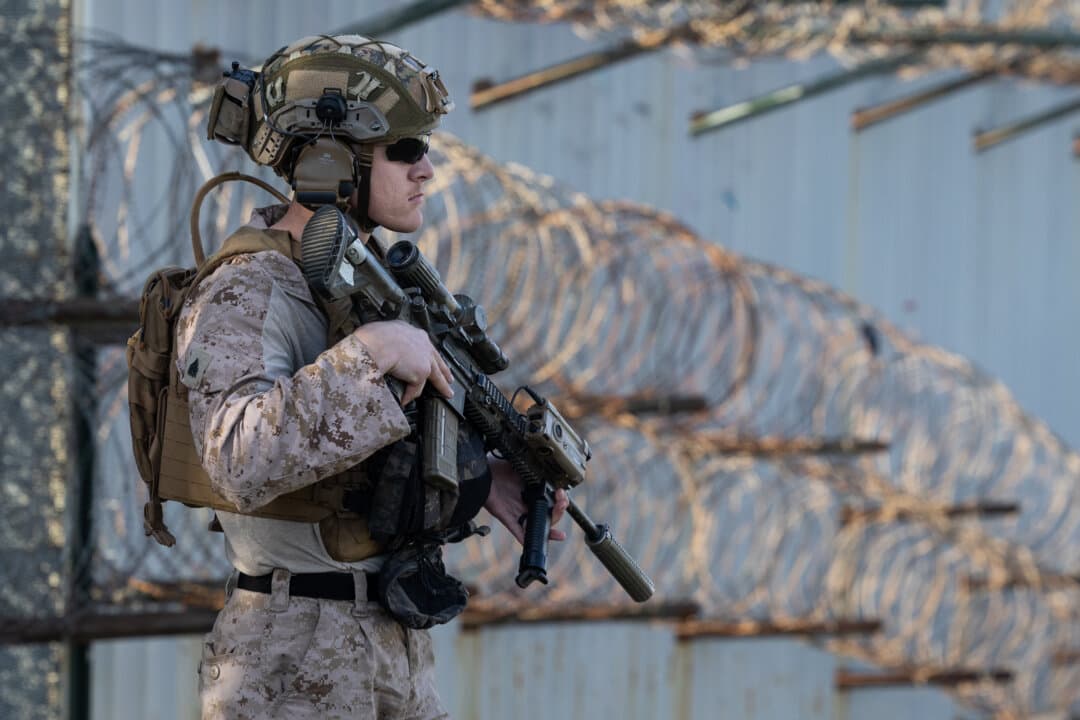
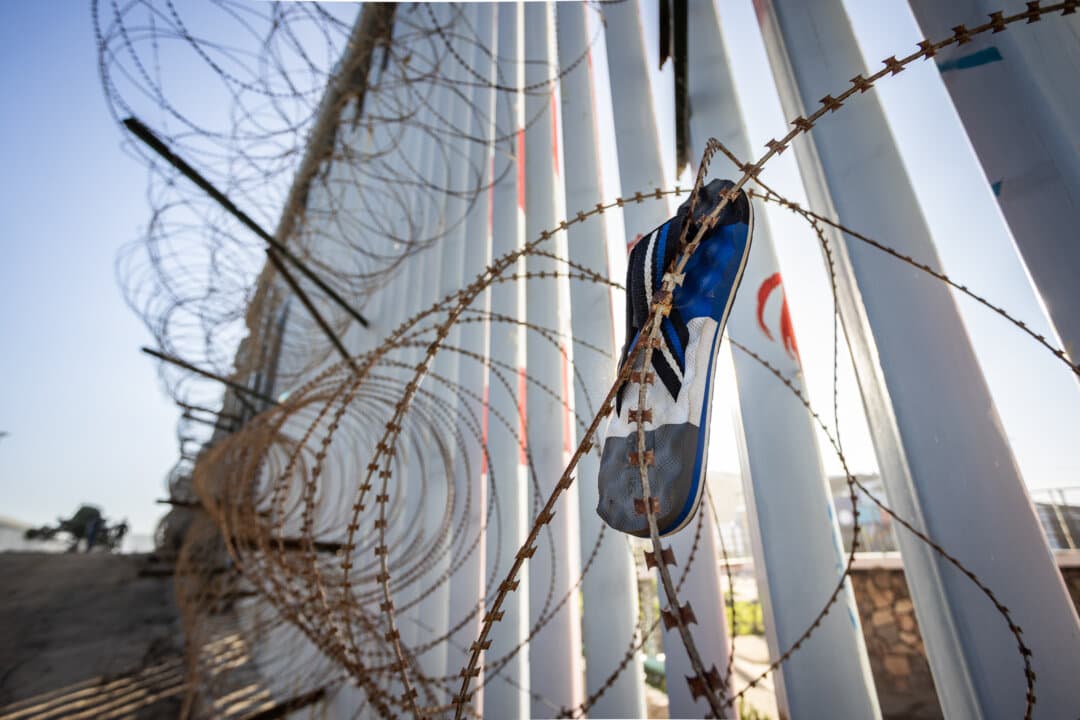
(Left) U.S. Marines patrol the U.S.–Mexico border near San Diego on Jan. 20, 2026. (Right) A sandal caught in barbed wire hangs on the U.S. border wall outside San Diego on Jan. 20, 2026. (John Fredricks/The Epoch Times)
He said the Marines are also pushing farther east to continue work on a previous order to install more razor wire along the wall.
Soon after his inauguration last year, Trump signed a barrage of executive orders on national security and expanded U.S. military presence along the southern border.
The Trump administration has created at least four militarized zones, the latest one from the western boundary of the Otay Mountain Wilderness Area to about one mile west of the California–Arizona state line. The zone spans San Diego and Imperial counties, including California border communities such as Jacumba, Calexico, and Tecate.
More than 7,000 troops have been deployed with helicopters, drones, and surveillance equipment in Texas, Arizona, New Mexico, and California across militarized zones that enable military personnel to enforce strict trespassing laws and detain individuals. About 500 Marines from Camp Pendleton on the California coast were deployed to the Yuma and San Diego sectors to reinforce barriers.
Secretary of the Interior Doug Burgum announced in December 2025 the transfer of about 760 acres of public lands in San Diego and Imperial counties to the Navy for a three-year period to establish a national defense area to support border security operations.
“President Trump has made it clear that securing our border and restoring American sovereignty are top national priorities,” Burgum said at the time. “This action delivers on that commitment.”
Between the Walls
In January, some chatter could be heard on the southern side of the double border walls, but the American side, with its empty picnic tables and benches, was silent—not like it was in summer 1971 when First Lady Pat Nixon inaugurated the park as a binational meeting place symbolizing peace and friendship between the United States and Mexico.
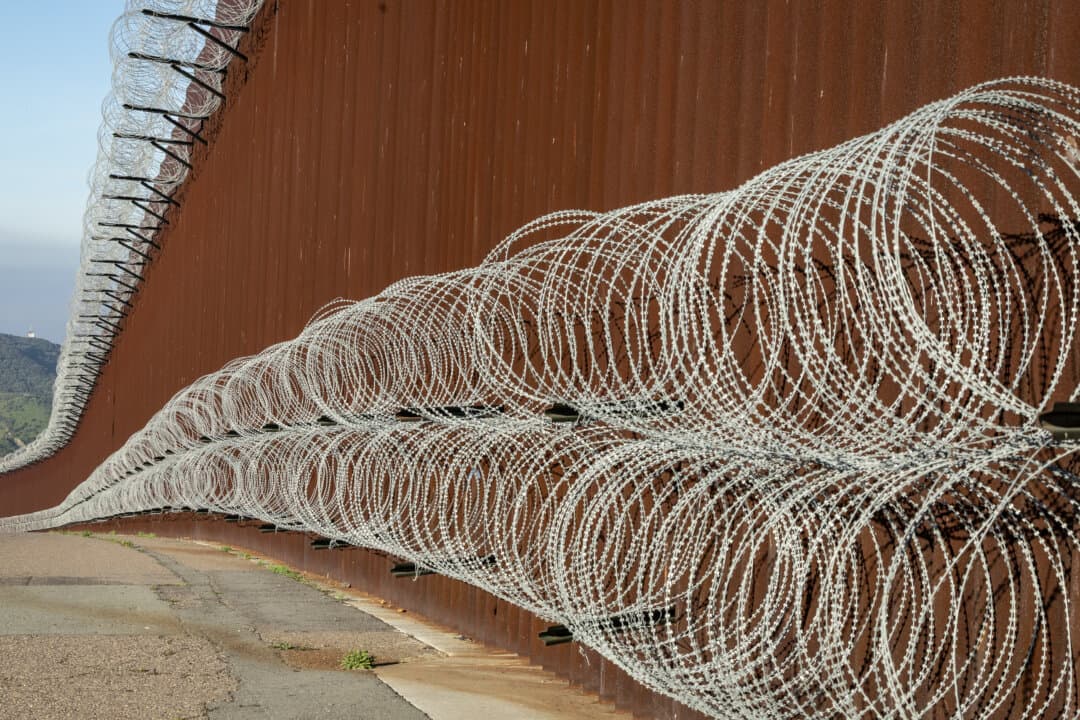
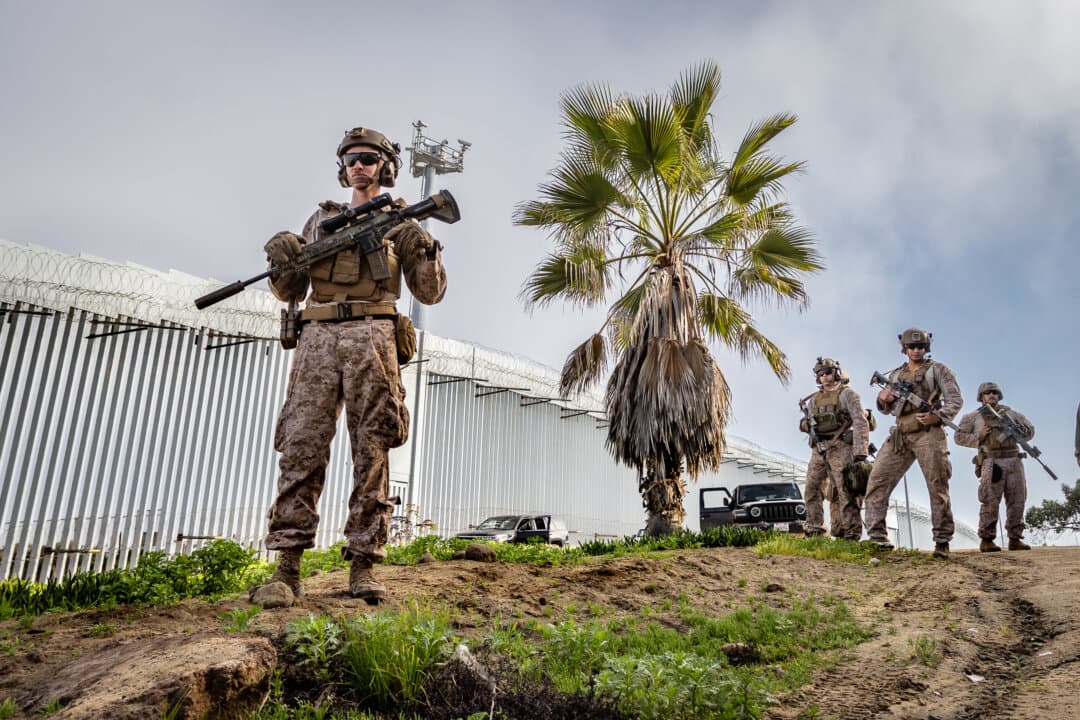
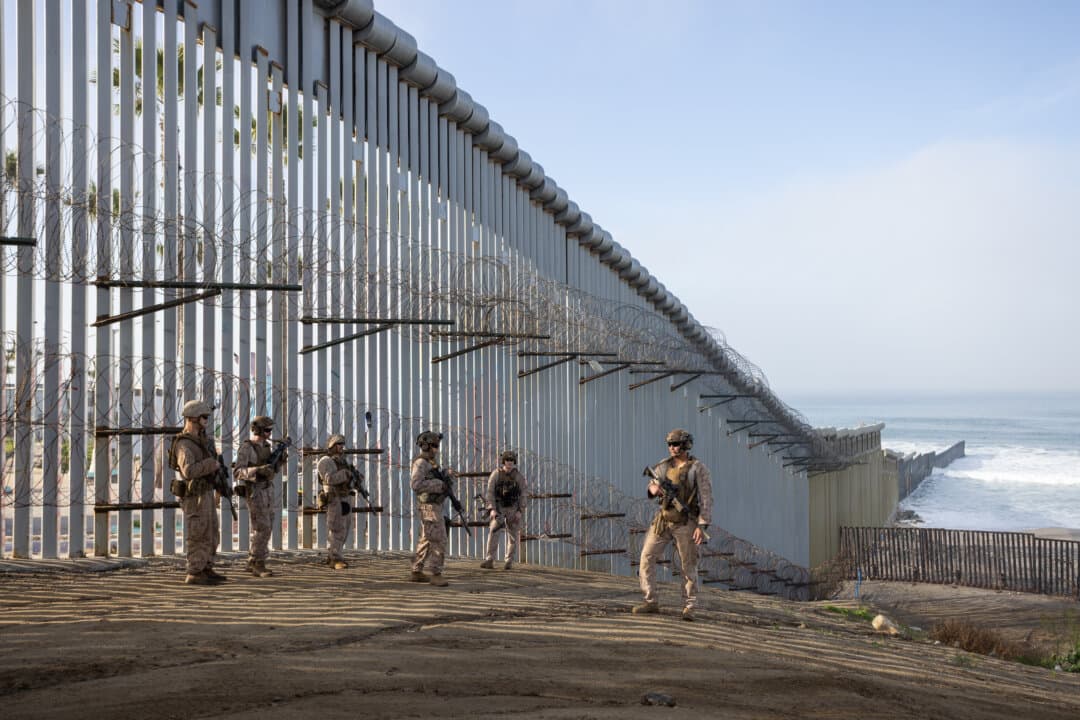
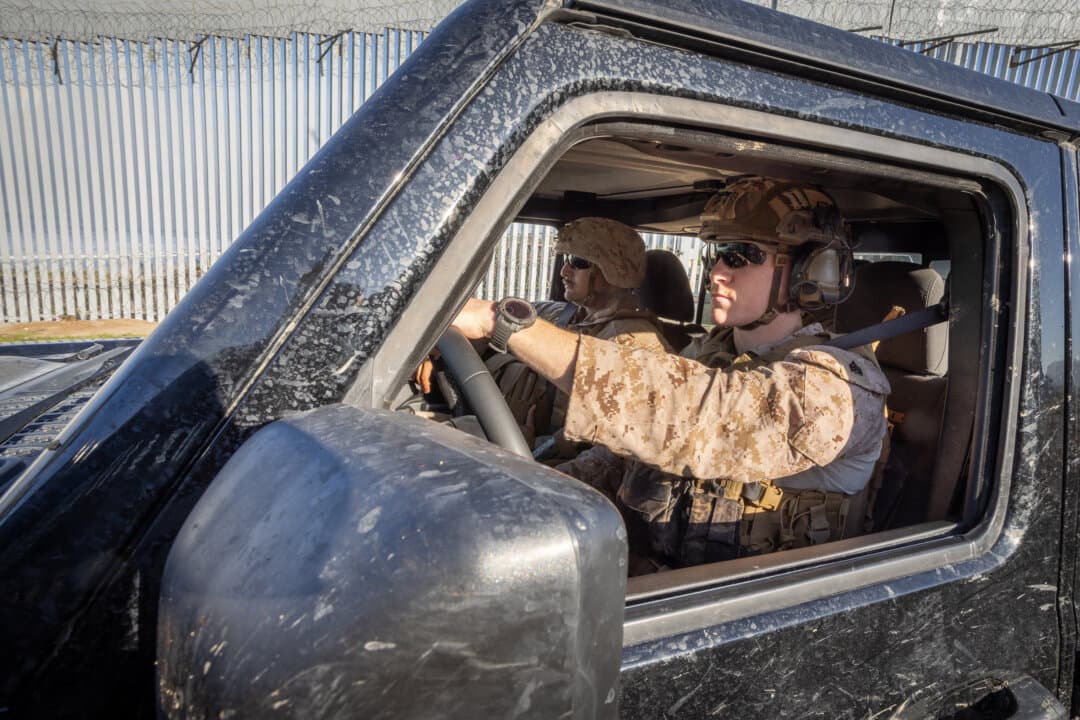
(Top Left) Razor wire installed by U.S. military personnel lines the U.S. border wall outside San Diego on Jan. 20, 2026. (Top Right, Bottom Left-Right) U.S. Marines patrol the U.S.–Mexico border near San Diego on Jan. 20, 2026. About 500 Marines from Camp Pendleton in California were deployed to the Yuma and San Diego sectors to reinforce border barriers. (John Fredricks/The Epoch Times)
Standing between the border walls, both built on American soil, Manny Bayon, San Diego chapter president of the National Border Patrol Council union, told The Epoch Times that the park was built so that Mexicans living in the United States could meet face-to-face with their relatives in Mexico.
“Friendship Park was created for them, the community,” he said.
Originally, the park had a four-foot-high fence that allowed people on both sides to see each other and exchange letters, Bayon said.
But the binational community spirit was short-lived.
“We found that the exchange of letters, also was an exchange of narcotics, primarily heroin,“ he said. ”That’s why they had to limit it. No more passing stuff through the fence.”
Although the Mexican side of the park, known as El Parque de la Amistad, remains open, access to Friendship Park on the American side has been heavily restricted for much of the past 15 years. It was closed from 2009 to 2012 for the construction of the secondary border wall.
Since 2019, the park, part of the larger Border Field State Park, has been essentially shut down since the new 30-foot walls were installed.
Occasionally, people try to swim around the border walls, which reach about 300 yards into the ocean at low tide. Some have drowned or been gravely injured in their attempts, Bayon said; the lucky ones are rescued by lifeguards and then apprehended.
Agents have recovered motorized surfboards that were hollowed out to smuggle drugs in the area, he said. Drones have also been used to carry drugs.
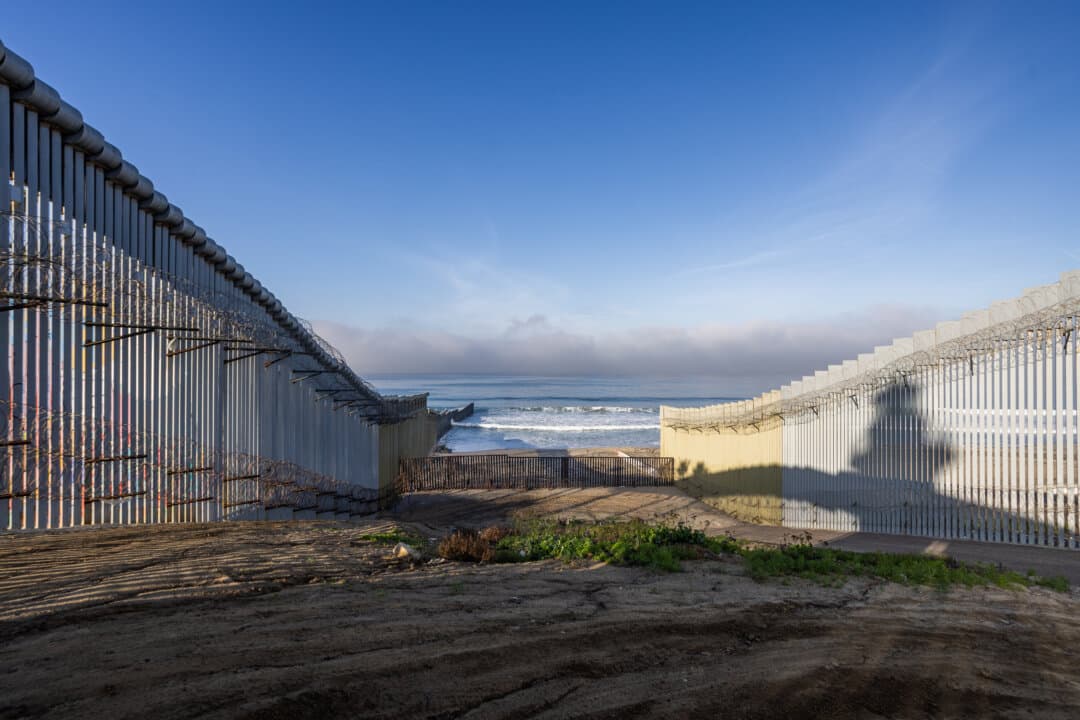
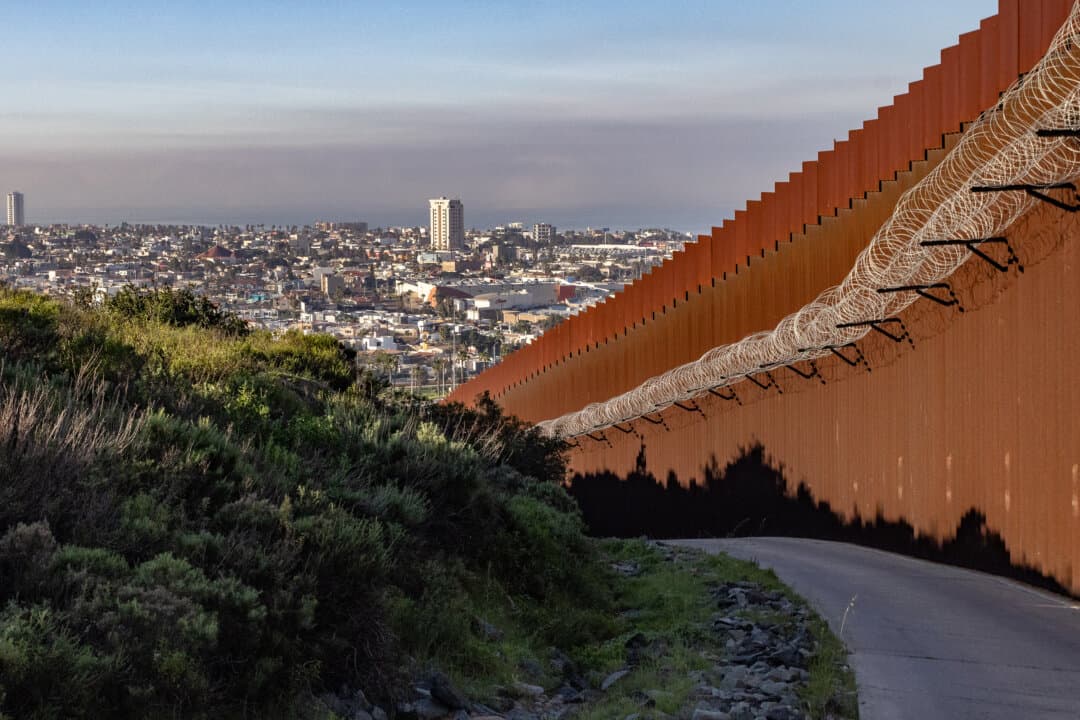
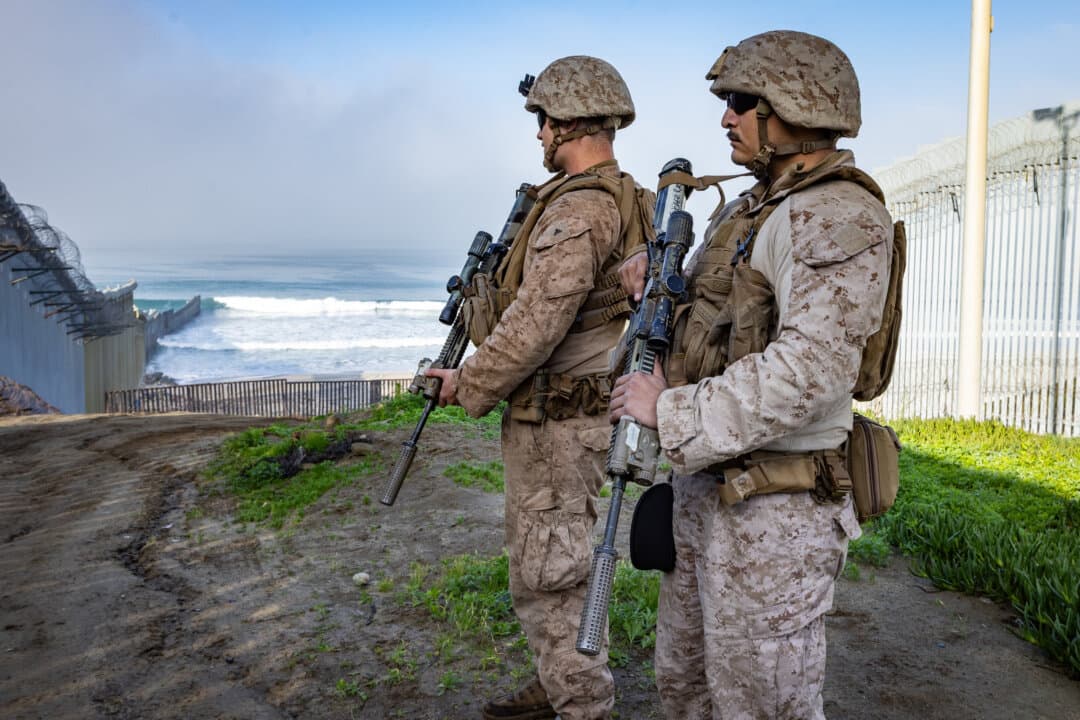
(Top) The Pacific terminus of the U.S. border wall is seen outside San Diego on Jan. 20, 2026. (Bottom Left) The U.S. border wall outside San Diego on Jan. 20, 2026. (Bottom Right) U.S. Marines patrol the U.S.–Mexico border near San Diego on Jan. 20, 2026. (John Fredricks/The Epoch Times)
Customs and Border Protection (CBP) reported nearly 11 million encounters with illegal immigrants nationwide during the Biden administration, not including “gotaways”—illegal immigrants who evaded capture by Border Patrol.
Although illegal border crossings have dropped dramatically since Trump was elected to a second term, they have not stopped. Still, CBP said no illegal immigrants have been released into the country for months.
In fiscal year 2025, which ended on Sept. 30, 2025, CBP reported 691,906 nationwide encounters with illegal immigrants, down from 2.9 million in 2024 and 3.2 million in 2023.