
LOS ANGELES—Explosives and arson experts from the U.S. Bureau of Alcohol, Tobacco, and Firearms this week told a jury in the federal arson case against Jonathan Rinderknecht that fireworks could not have been the culprit.
The 29-year-old Rinderknecht is accused of starting a blaze in the Santa Monica Mountains, which investigators say led to the deadly Palisades Fire of 2025.
“Anyone who was in this area—if there was a firework launched, burning, or landing here—would have seen it. They’re bright, there’s a lot of color, a lot of flame, a lot of stars. And you would definitely hear it,” Kevin Miner, an explosives enforcement officer and unit chief at the agency’s training facility in Huntsville, Alabama, told the court.
“It’s 140 decibels of sound—that’s more than twice what it takes to harm the human ear.”
Miner said he based his findings on video surveillance footage, witness testimony, and analysis of sound profiles, topography, and weather conditions.
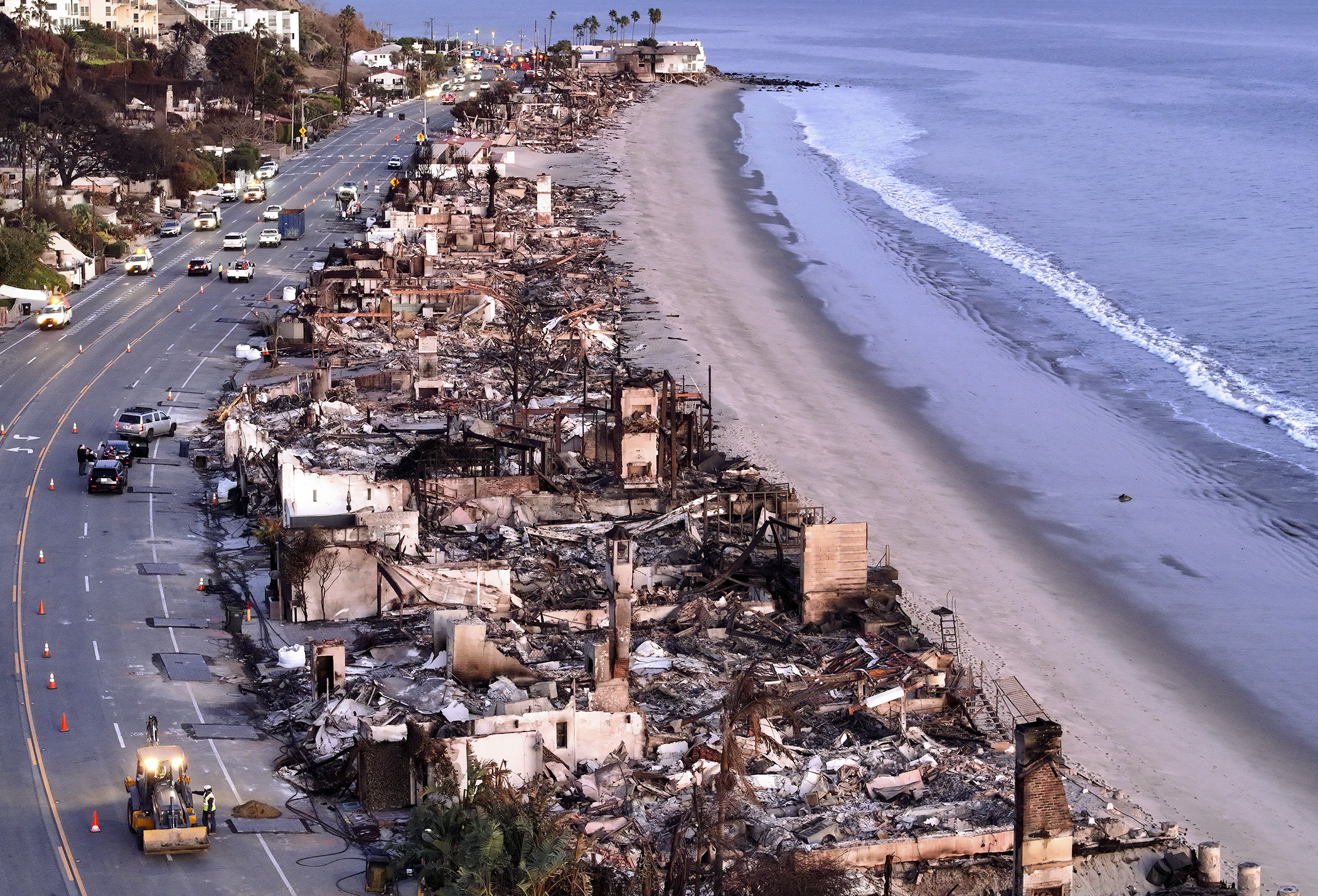
Rinderknecht is on trial for three federal counts of arson related to property damage sustained in the Pacific Palisades Fire, which killed 12 people and incinerated more than 6,000 homes in the eponymous coastal enclave. The state argues the catastrophe was a “holdover” or continuation of the Lachman Fire, which investigators say Rinderknecht allegedly ignited with a Bic lighter just after midnight on New Year’s Eve 2024, driven by a desire for “revenge against society.”
Defense attorneys maintain the government has no “reliable evidence” showing that Rinderknecht started the Lachman Fire on Jan. 1, much less that he was responsible for a separate fire that began a week later on Jan. 7.
Rather, Rinderknecht’s defense team says he encountered a fire and called 911 to report it in good faith—and that a firework was the more likely cause.
ATF agents on Monday and Wednesday dismantled the firework origin theory with a methodical recounting of the evidence.
While in theory, an aerial firework could cause a blaze like the Lachman Fire, Miner acknowledged under cross-examination that the specific conditions in the area and the fact that no witnesses—including, by his own account, the defendant—saw any fireworks, make it extremely unlikely.
Federal fire investigators also ruled out so-called “ground salutes” or ground-based fireworks, a malfunctioning or smoldering firework, or other potential causes like cigarettes, lightning, or powerlines.
Steve Haney, an attorney for Rinderknecht, sought to sow the seeds of reasonable doubt.
“For 10 days, everyone ignored a crime scene, didn’t they?” he asked Miner on cross-examination.
If the Jan. 1 Lachman Fire was an arson, then it was a crime scene—but it wasn’t preserved as such, Haney said, noting the area remained open to the public, planes dropped water and fire retardant on the burn scar, and a subsequent fire razed the area, potentially incinerating physical evidence.
“Isn’t it true that if there were evidence of fireworks, it would have been washed down the hill?” Haney asked. “And for at least nine days, no one went up there to look for fireworks materials?”
Miner ultimately agreed such was theoretically possible, but said the lack of physical evidence in this particular case was not a concern.
“I relied more on the sound profiles, and the video and witness statements. Frequently we have very little physical evidence of the fireworks after suppression, so it’s not uncommon for that to disappear.”
Fireworks
Attorneys for the state preempted the defense’s argument that witnesses, including nearby residents, heard what they thought were fireworks just before midnight that could have emanated from the origin area.
“There are a variety of statements—most in their homes, some said they heard a popping, and a couple people referred to bottle rockets, some to fireworks,” Miner said.
But, he said, any firework sounds they heard more likely than not would have come from below the neighborhood, given the fact that the homes are terraced into the mountainside, and the fire origin area is around 350 feet above it.
“It drops off significantly … Sound has a tendency to travel up,” he said.
Sound emanating from an aerial firework, Miner explained, is omnidirectional—“anything airborne will send sound and blast waves out in all directions.”
In the particular area where investigators believe the fire started, the sound would have traveled everywhere until it hit objects, clouds, hard land, or buildings to absorb or reflect it, Miner said.
“In calm weather like that, there’s nothing to mask the sound. Sound travels very quickly and easily through that medium.”
Something set off in the lower canyons below the homes, he explained, would bounce until it hit objects, clouds, or buildings to absorb it; something set off up higher would be less likely to be heard at all, as the sound energy would “escape into the atmosphere.”
One nearby resident, located around 0.2 miles and around 350 feet below the fire’s area of origin, reported his windows shaking before midnight.
But Miner said it was extremely unlikely he would’ve been the only one to experience this if it came from a firework above him.
“If that were to actually be caused by anything on the mountaintop, you would expect to see evidence in houses adjacent, maybe 200 to 300 feet away—broken glass, cameras askew,” Miner said.
“You can’t rattle a window 0.2 miles away without rattling everyone’s windows.”
A Burning Bush
Investigators determined the fire was incendiary in nature—in this case, ignition of vegetation. They came to this conclusion based on a review of video surveillance, witness testimony, and the defendant’s own statements.
“The defendant admitted having a lighter with him up on Buddha Hill,” said Derek Hill, a fire analyst and recently retired Certified Fire Investigator with the ATF who worked the case, referring to the landing area where investigators believe the Lachman Fire started.
“He said he was alone on the hill. He identified where the fire started correctly—this was information that wasn’t public at the time.
“It gave us pause because he was recognizing the fire from a location we know he was at, but not when that fire would have been visible,” he said.
Investigators tracked Rinderknecht’s movements using geolocation data from nearby cellular towers, constructing a detailed timeline that they overlaid with one constructed from video surveillance footage.
All of this, Hill said, corroborated investigators’ work, including a meticulous mapping of fire pattern indicators, in which they looked at the fire’s impact on the environment to determine how and where it spread, and at what intensity.
Hill helped lead a team that included 11 federal Certified Fire Investigators and five wildland investigators. Arriving on the scene of the Palisades Fire on Jan. 13, they spread across a general area where they believe the blaze originated, and studied the terrain, at times crawling or slithering across the charred ground to find clues.
Ultimately, they were able to narrow a specific area of suspected origin—and then a single bush from where the fire allegedly emerged.
Firefighters had described firebrands or embers that came off the Lachman Fire, which burned from north to south. A detailed analysis, investigators say, confirmed their hypothesis that the Jan. 1 fire had smoldered underground until resurfacing seven days later, when it was picked up by winds and continued as the Palisades Fire.
“We started identifying burned out roots, some exposed and some not,” Hill said. “That was indicative of fire burning underground in the root structure of the shrub. We know the fire came out of this root ball and spread out.”
Compromised Crime Scene
Haney noted—and Hill acknowledged—that investigators could not preclude the existence of an unknown combustible that may have been lost in the fire, or during suppression or cleanup activities.
If the allegation is that Rinderknecht maliciously and willfully started the Lachman Fire, Haney said, the crime scene was compromised.
The fact that people were allowed to walk through a crime scene for nine days was “not ideal,” Hill acknowledged.
Under redirect, the witness said that in nearly 800 fire scenes he’d worked during the course of his career, the majority involved some kind of water suppression before investigators arrived—meaning it was a common condition and one for which agents are trained to take into account.
“Water didn’t wash away the surveillance footage, did it?” Mark Williams, attorney with the Department of Justice, asked.
“It did not,” Hill said, explaining that investigators used the surveillance footage to construct a detailed timeline of when the fire was first visible and how it developed, which they compared with a timeline of the defendant’s movements.
Haney suggested that timeline was incomplete—some videos were taken from miles away and didn’t have audio. And while footage may have depicted when the fire was visible, it didn’t show when it started.
Where Hill said investigators determined the fire ignited between 12:10–12:12 a.m.—when it shows up on surveillance video—Haney noted there was no direct evidence of such.
“You don’t have any cameras that show ignition of when the Lachman Fire occurred, do you?”
“No,” Hill replied.