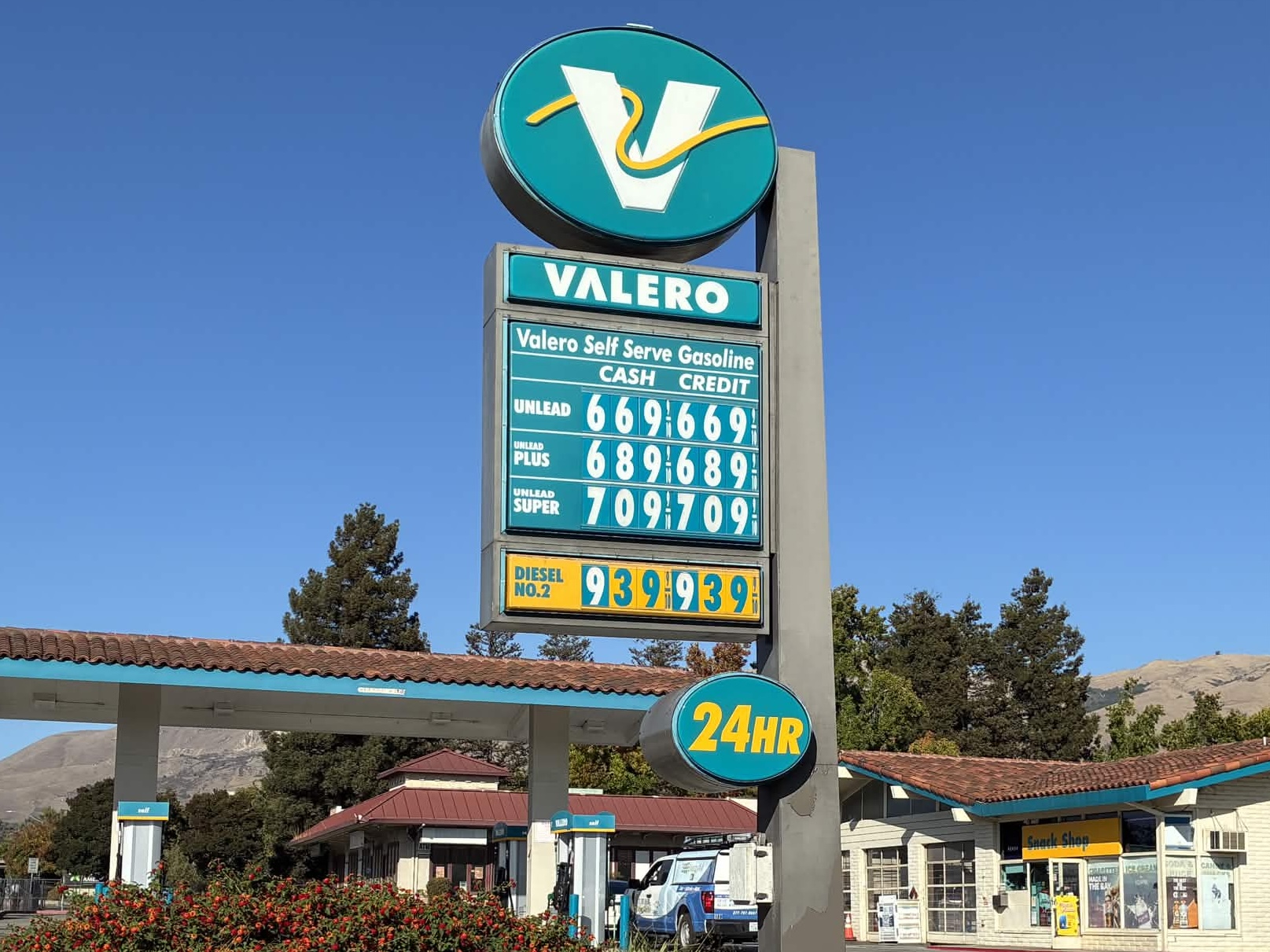

At least several gas stations in the San Francisco Bay Area are pricing diesel at more than $9 a gallon, as an industry analyst says elevated costs reflect local state policies and continued global tensions in the Middle East and between Russia and Ukraine.
Diesel is selling for $9.39 at a Valero station in Fremont, with prices at many other gas stations in the region remaining near or above $9 per gallon in recent days.
According to the American Automobile Association (AAA), the average price for diesel in California was $8.44 per gallon as of Sept. 23. The national average maintained a record $6.52 per gallon.
GasBuddy showed similar California-specific and nationwide average diesel prices on Wednesday, with an upward trend since Labor Day weekend.
The West Coast, in general, has higher dollar-per-gallon prices at the pump compared to the East Coast, according to the GasBuddy gas price map tracker.
“It’s because the West Coast doesn’t have enough refining capacity—a problem that’s exacerbated by the refinery shutdowns that we’ve seen in California over the last couple of years,” GasBuddy analyst Patrick De Haan told The Epoch Times.
“Gasoline taxes tend to be higher in those states as well.”
In California, gas prices include state and local sales taxes, a state excise tax, federal excise tax, low carbon fuel standard fee, and cap-and-trade fee, which make up 26 percent of the price at the pump, according to a cost breakdown from the California Energy Commission.
The state has also grappled with refineries closing and oil companies relocating since 2024, citing high operating costs and a strict regulatory and enforcement environment.
Earlier this year, Valero Energy Corp.’s northern California refinery in Benicia shut down operations.
In late 2025, Phillips 66 ceased operations at its Los Angeles refineries, which supplied fuel to California, Nevada, and Arizona.
California remains home to 11 refineries with a combined processing capacity of 1.3 million barrels (56.2 million U.S. gallons) of crude oil per day.
This produces, on average, 26.1 million gallons of gasoline and 16.1 million gallons of diesel per day.
That’s enough to fulfil about 72 percent of the state’s daily gasoline needs and over 100 percent of diesel needs. The leftover crude oil from each barrel is turned into other petroleum products.
“California and other states on the West Coast generally will have to import fuel,” said De Haan, adding that “environmental programs with the unique rules and regulations” further push prices up at the pump.
California, like Washington state, has a cap-and-trade program, which sets a limit, or cap, on the total carbon emissions allowed in the state.
Businesses are then required to buy credits, which can also be traded, to allow them to emit a set amount of greenhouse gases.
California and Washington say the goal is to push businesses to reduce emissions and encourage low-carbon or renewable alternatives. Businesses that fail to meet their emission allowance or submit enough credits face fines.
The costs for maintaining these environmental programs add roughly 47 cents per gallon when fueling up.
On the national level, a handful of states saw their average diesel prices climb above the national average—such as $7.15 in Hawaii, $6.89 in Michigan, $6.61 in Pennsylvania, $6.91 in Indiana, and $6.83 in Illinois—according to AAA data on Sept. 23.
On social media, photos of a handful of gas stations displaying “Out of Diesel” signs have circulated in recent days, sparking concerns about the national fuel supply.
De Haan, however, said those photos only “represent less than one-tenth of one percent of the total amount of stations nationally,” and do not indicate a nationwide shortage.
He said “Out of Diesel” signs are common, as stations could be facing a temporary delivery delay, choosing not to buy diesel due to prices, or a management, scheduling, or timing issue.
He also noted that the United States is a surplus producer of diesel, exporting millions of gallons of diesel per day.
In an attempt to curb prices at the pump, President Donald Trump on Wednesday called for a temporary ban on diesel exports from the United States.
Global Tensions
The U.S.-Iran conflict is the main driver of increasing gas and diesel prices nationwide, De Haan said.
The fight for control over the Strait of Hormuz has slowed traffic to a trickle and disrupted oil exports from the Middle East.
Shipping data showed three ships passed through on Wednesday. Before the conflict, an average of 130 ships could transit through the strait.
“The second thing worth mentioning is that Ukraine has been carrying out attacks on Russian oil refineries with drones,” he noted.
The drone attacks have caused fuel shortages and disrupted exports that would have generated revenue to fund Russian war efforts, according to the Institute for the Study of War in a July report.
“Prior to the Strait of Hormuz closing, those attacks [on Russian refineries] didn’t amount to as much of an impact, but now they are mounting to more of an impact because the flow of oil and diesel and gasoline from the Middle East is disrupted,” said De Haan.
He added that the outlook on prices is “very contingent on whether or not these political tensions improve.” De-escalation between the United States and Iran and between Ukraine and Russia could lead to some relief at the pump, but continued attacks and a disrupted oil market would continue to push prices up.