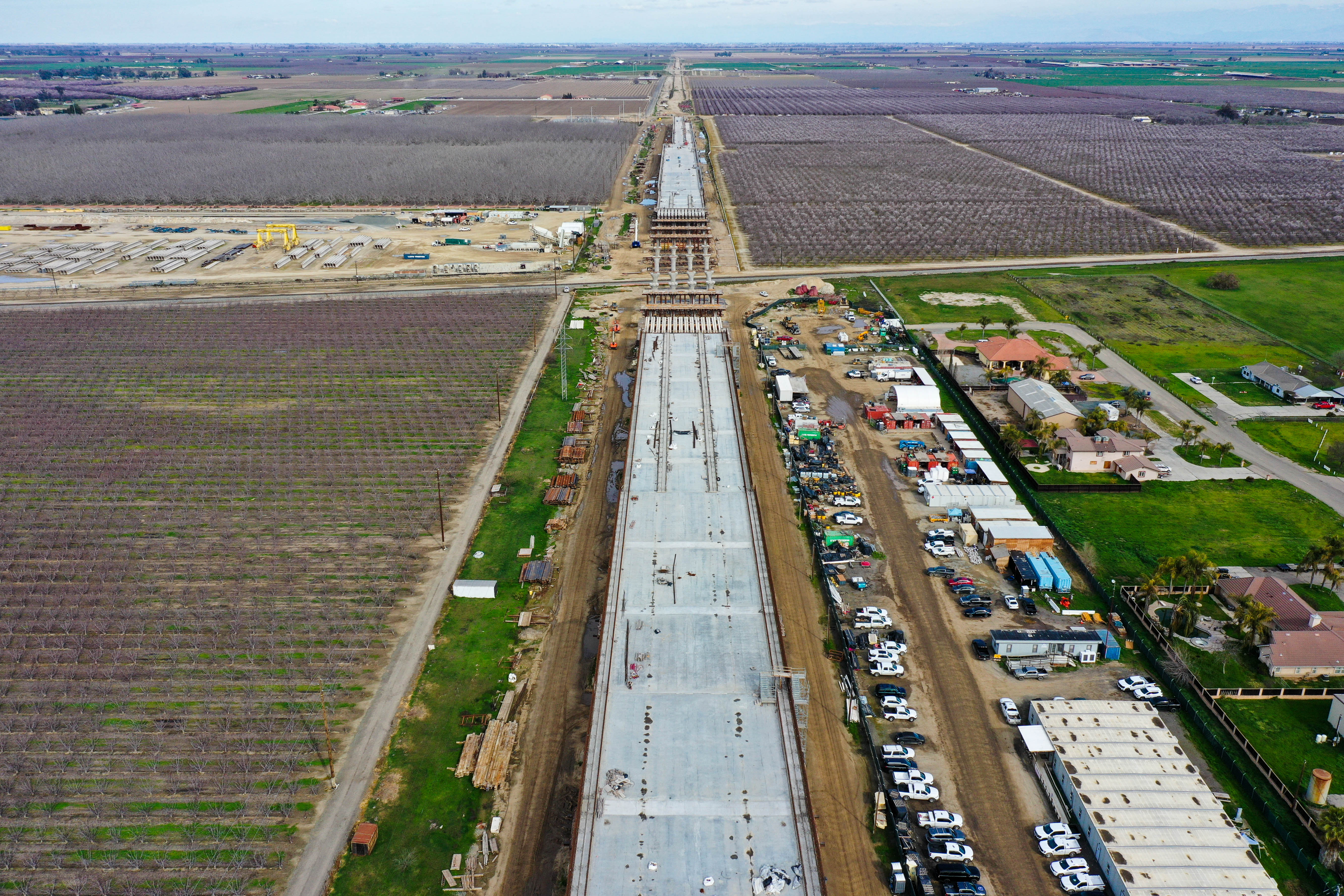

California is scheduled to serve its high-speed rail early segment—a 171-mile line between Bakersfield and Merced—as soon as 2032–2033, with stations not fully functional to their capacity as expected, according to the 2026 Business Plan released on June 1.
“As part of the Authority’s cost-saving strategy, early operating segment prioritizes lower capital costs through streamlined station designs, infrastructure choices, and service levels,” the plan reads.
Stations in Merced, Fresno, Kings/Tulare, and Bakersfield will be designed and built to meet operational needs for initial service of eight daily trains in both directions, according to the plan.
Ten California mayors opposed the Feb. 28 Draft 2026 Business Plan for its local funding plan authorizing the High-Speed Rail Authority (HSRA) to “initiate and lead” enhanced infrastructure financing districts to capture a portion of the future growth around stations for infrastructure.
After the HSRA communicated with local officials, the board of directors approved on June 1 a revised plan, which became the final version.
In 2025, the Federal Railroad Administration terminated the approximately $4 billion fund previously granted to HSRA, citing its overpriced budget and massive delay.
The cost of the whole high-speed rail project that will connect San Francisco and Los Angeles was estimated at $126.08 billion, compared with the $33 billion price tag when the project was approved in 2008.
In the new business plan, HSRA dropped its pay-as-you-go model and replaced it with a new cost-saving strategy “to right-size each stage of project delivery to control costs and initiate service sooner ... then use operating profits to fully build out the system as demand grows.”
“The current High-Speed Rail Authority has injected some life and a sense of urgency to the project, which is much appreciated,” Merced Mayor Matt Serratto told The Epoch Times in a phone interview.
The Merced station was relocated from downtown to the southeast to reduce costs in the final business plan.
“It will save a lot of time and money, a lot of construction expenses, inconveniences from construction, and also save a lot of destruction from having to destroy a lot of key businesses and key city facilities,” Serratto said, noting that others are in favor of having a station downtown and activities that could motivate.
The other end of the early segment, Bakersfield, will have an interim station at Seventh Standard Road and state Route 99, about five miles away from the original location at F Street and Golden State Avenue.
“For more than a decade, the City has engaged in coordinated planning, infrastructure investment, and policy alignment based on the Authority’s commitment to a downtown, world-class station,” Bakersfield Mayor Karen Goh wrote on April 27 to the HSRA in an email obtained by The Epoch Times.
“The abrupt shift to a peripheral, temporary station undermines those efforts and calls into question the credibility of the project’s promised benefits.”
The cost of Merced to Bakersfield was estimated at $34.76 billion in the 2026 Business Plan, approximately $1.9 billion less than last year’s number cited in an Aug. 28, 2025, report by HSRA CEO Ian Choudri.
The $6.6 billion gap left will be filled by financing a fixed $1 billion annually from 2025 to 2045—an appropriation of Cap-and-Invest, formerly known as Cap-and-Trade, a market that allows companies to purchase greenhouse gas emission quotas from the state.
The HSRA plans to advance the 2033–2045 funding to start at the beginning of 2027, using financing tools at the lowest interest rate, according to the 2026 Business Plan.
On page 32 of the HSRA’s 2026 Draft Business Plan, the HSRA noted that it is seeking legislative support for “enabling the Authority to initiate and lead Enhanced Infrastructure Financing Districts.”
In an April 23 email to Choudri, 10 mayors opposed the HSRA’s seeking authority to establish tax increment financing districts within a half-mile radius of proposed station areas for capturing property and potentially sales tax growth, which would then fund high-speed rail construction and related commercialization activities.
Choudri is seeking the same legislative support outlined in his Aug. 28 report.
Tax increment financing tools are used to finance projects using the “anticipation of future tax revenue” resulting from new development, according to a presentation by the Governor’s Office of Business and Economic Development.
“At its core, the proposal contained in the 2026 Draft Business Plan is a direct attempt to divert locally controlled tax revenues, undermine voter-approved constitutional protections, and erode the fiscal stability of California’s cities to backfill a project that continues to face severe financial uncertainty,” the opposing mayors wrote.
Gilroy Mayor Greg Bozzo wrote in an email to The Epoch Times that he was “perplexed” at first, and then became frustrated after he became aware of the impact.
Bozzo said there was no coordination at the local level.
“It was almost as if the HSRA was hoping this would go unnoticed and unopposed,” he said.
An HSRA spokesperson wrote in an email to The Epoch Times: “The Authority is not proposing any policy—particularly not one that would override local land-use or tax authority.
“The discussion is simply about whether there may be future opportunities to reinvest a mutually agreed-upon portion of new incremental value generated by station-area growth and state investment back into supporting infrastructure, similar to existing [enhanced infrastructure financing districts] partnerships between local governments and transit agencies elsewhere in the state.”
Goh wrote in an email to The Epoch Times that she has been communicating with the HSRA about “the scenarios in which the City can support revenue sharing that results in a win-win and leads to a world class station in downtown Bakersfield.”
Other mayors The Epoch Times reached out to, including Hanford Mayor Mark Kairis, Bozzo, and Serratto, said they stand by the joint letter they signed.
“Anything that starts to tap into local tax dollars to pay for a project of this size is just not right,” Serratto said. “This project is so big, it should be paid for at the state and the federal level.”