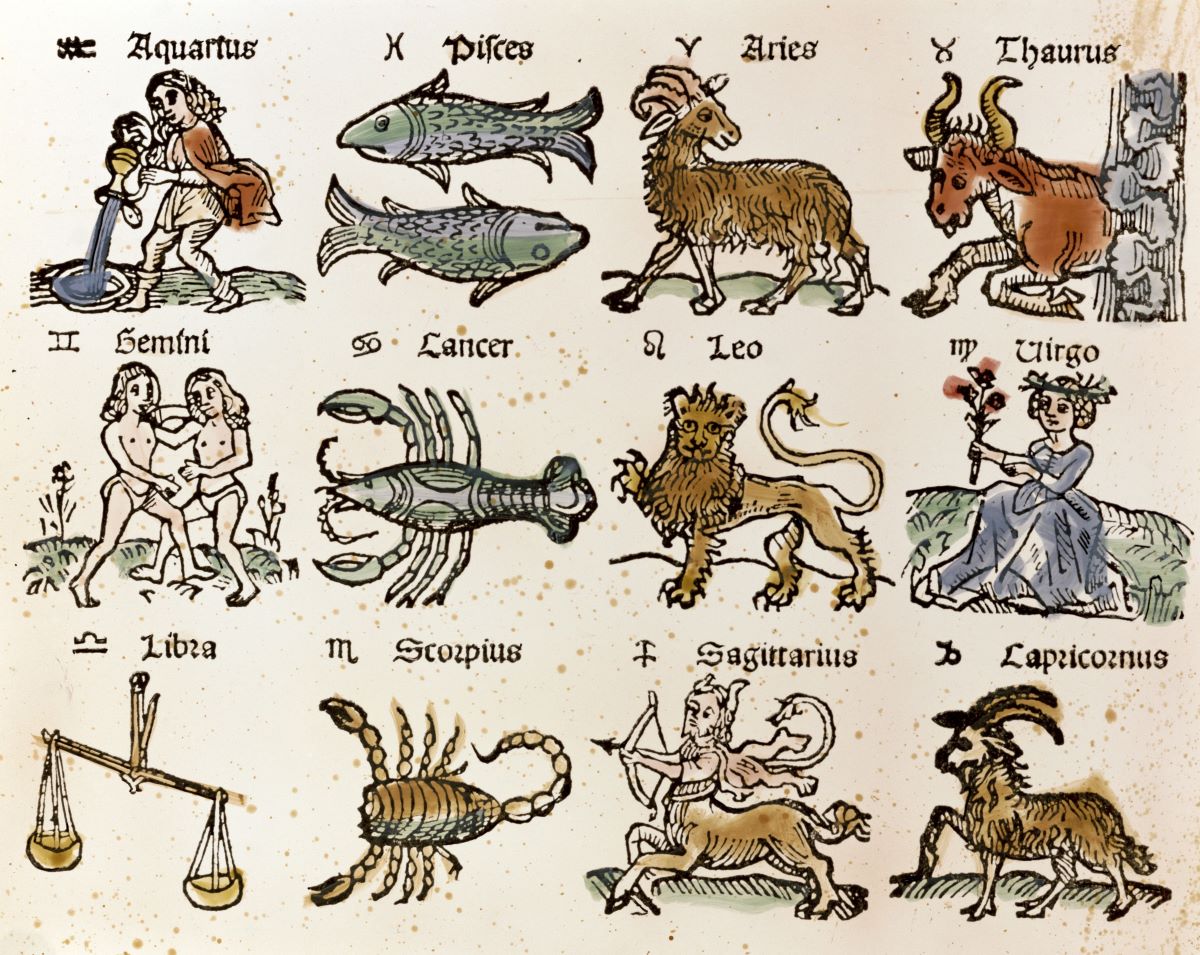
The number 12 has an almost magnetic pull upon the human imagination. Indeed, 12 must rank with 3 as being one of the most culturally enduring and spiritually charged numbers. It crops up across civilizations, religions, and myths, not by accident, but because it symbolizes order, completeness, and the rhythm of human life under the heavens.
Consider first the tribes of Israel. The Old Testament repeatedly stresses that God’s people were gathered, organized, and represented through 12 tribes, each with its own inheritance and destiny. The number is not incidental but covenantal: It embodies the wholeness of Israel as a nation chosen and consecrated.
Later, in the New Testament, Jesus calls 12 apostles, a direct echo of the earlier pattern. The apostles, like the tribes, represent a spiritual totality—the new people of God spread across the earth. It was absolutely necessary with the defection of Judas—leaving only 11—to cast lots to appoint a 12th apostle, Matthias. To the biblical mind, 12 is the number of divine governance and completion.
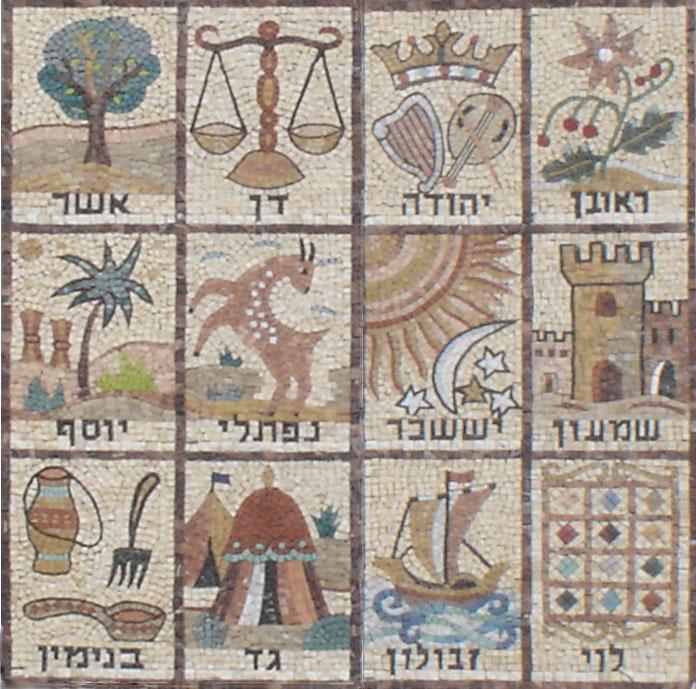
Mosaic depicting the 12 tribes of Israel and their Hebrew names, with symbolic images. (Public Domain)
But this is no mere biblical quirk. The heavens themselves reinforce the sacred resonance of 12. The zodiac, which ordered the sky for Babylonian, Greek, and Roman stargazers, is divided into 12 signs. The 12 months of the year carry us through the full cycle of time, marking out seasons of planting and harvest, light and dark, life and dormancy. To live in a twelvefold world is to live within an order woven into the fabric of the cosmos. Not only that, but the persistence of belief (right up to the present age) in astrology—despite the scientific naysaying—is suggestive that there are 12 types of people, under the rule of 12 star signs.
Greek mythology provides one of the most dramatic expressions of this pattern: the 12 Labors of Heracles. When the great hero is condemned to a period of penance, it is not seven or nine but 12 trials that define his redemption. Each labor is both ordeal and transformation—slaying monsters, cleansing stables, capturing beasts, stealing treasures. Through the 12 tasks, Heracles demonstrates courage, wit, endurance, and, ultimately, a kind of apotheosis. Once again, 12 represents not a random tally but the full measure of a heroic life tested to its limits. The Heracles who begins the labors is not the same man as he who completes them—he has become transformed.
And, in a way, this is a lesson for us all: The key is in the word “labor”—don’t we all do labor? Does our labor transform us into the heroes we could be, or not?
The Symbolism of 12
If 12 appears so often, it is worth asking: Why 12? What makes this number special, beyond mere habit or chance?
Part of the answer lies in its mathematical richness. Twelve is a number of extraordinary balance and versatility. Unlike 11 or 13, which are prime and indivisible, 12 can be divided evenly in multiple ways, but two are especially important:
- two times six (two equals duality, six equals representing humankind, made on the sixth day; so, body-and-soul human beings)
- three times four (three equals heaven, four equals earth; integration)
This makes it a profoundly harmonious and practical number. Ancient merchants and builders valued it because it allowed easy division into halves, thirds, and quarters. A dozen could be split and shared more flexibly than 10, which is why we still count eggs, rolls, and goods in twelves rather than tens. In this sense, 12 reflects the human longing for order that is both useful and beautiful.

Eggs by the dozen. (<a href="https://commons.wikimedia.org/wiki/File:Freerange_eggs.jpg">Fir0002</a>/<a href="https://creativecommons.org/licenses/by-sa/3.0/">CC BY-S.A. 3.0</a>)
But the symbolism goes deeper. Three and four were regarded by many ancient peoples as sacred numbers: three symbolizing the divine, the spiritual, and the heavens; four representing the earthly, the material, and the directions of the compass. Multiply three by four, and you bring heaven and earth together. In this way, 12 becomes the number of cosmic reconciliation, the uniting of the spiritual and the material. No wonder it governs both the tribes of Israel and the signs of the zodiac, the apostles of Christ, and the labors of Heracles.
Other religions also testify to the sacred resonance of 12. In Hinduism, there are the 12 Adityas, solar deities who embody different aspects of the sun’s life-giving power. Hinduism also embraces a 12-petaled lotus as the symbol for the Anahata, or Heart chakra, which represents the center of love, compassion, and emotional balance in the body’s energy system. Each of the 12 petals on this symbolic lotus corresponds to different aspects of the heart’s energy.
In Buddhism, the cycle of existence itself is described through the Twelve Nidanas (or links of dependent origination), which explain how ignorance, craving, and suffering perpetuate the wheel of rebirth. Here, again, 12 represents a full cycle—in this case, the cycle of human bondage to desire, from which enlightenment offers escape.
This astonishing recurrence across cultures suggests that 12 is not a parochial or accidental figure but part of the deep structure of human consciousness or celestial structure. People in different times and places, gazing at the heavens or reflecting on their spiritual experience, found themselves drawn again and again to the same number as a symbol of wholeness.
But the endurance of 12 is not confined to ancient myth or scripture. Even in our modern, supposedly, rational age, we continue to organize our societies and daily lives by this sacred number—often without realizing it.
The Number 12 Today
Take our measurement of time. The clock is divided into 12 hours of day and 12 of night, a division inherited from the Egyptians. The fact that we still structure our existence around these cycles speaks to how natural and enduring the twelvefold division is. It is not arbitrary; it reflects the way humans perceive and experience the passage of time, moving in symmetry and balance.
Or consider the jury system. In many legal traditions, the idea of 12 jurors judging a case is deeply embedded. Why 12? Because it suggests fairness and completeness: not too few to risk arbitrariness, not too many to cloud judgment and make it a mere poll. Twelve citizens, brought together to seek truth, echo the biblical and mythic pattern: a community made whole and entrusted with weighty responsibility. In the 1957 film “12 Angry Men,” there’s a wonderful quotation: “Well, what’s there to talk about? Eleven men in here think he’s guilty. No one had to think about it twice except you,” says Juror 7 (Jack Warden) to Juror 8 (Henry Fonda). It is precisely the dissent of the 12th man that restores balance and leads to justice.
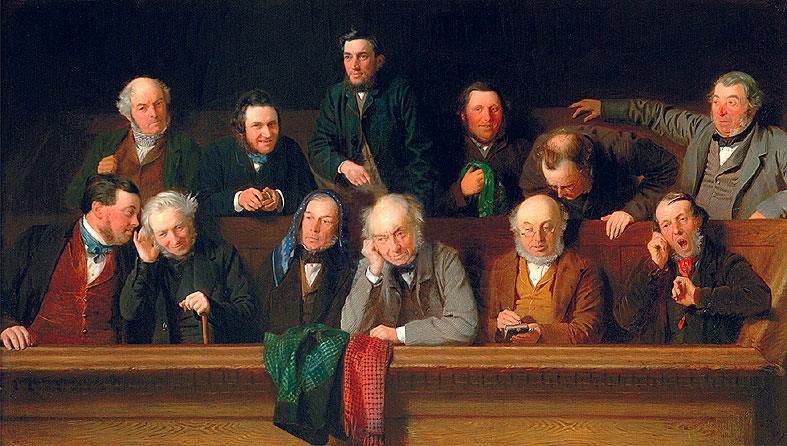
"The Jury," an 1861 painting by John Morgan of a British jury. (Public Domain)
Another striking modern instance is the 12 Steps of Alcoholics Anonymous. When AA was founded in the 20th century, its pioneers instinctively gravitated toward this sacred number to shape a path of redemption and healing. Just as Heracles needed 12 labors to complete his atonement, the recovering addict moves through 12 steps to reach wholeness. The ancient pattern resurfaces to embody order, struggle, and eventual transformation.
Even in more mundane realms, the power of 12 persists. We buy eggs and doughnuts by the dozen, count the months of our year, and celebrate a 12-day season of Christmas. Literature and folklore teem with twelves: the 12 dancing princesses of Grimm’s fairy tale, the 12 days of Yule in Nordic tradition. Again and again, across time and culture, 12 embodies a sense of completeness, harmony, and ritual significance.
Even evil cannot always escape the completion of 12: Hitler’s Third Reich was supposed to last a thousand years, but ended after 12.
Deep Significance
What might this mean for us today? At the very least, it reminds us that the world was not designed haphazardly. A deep order transcends any single culture or religion, an order mirrored in our customs, our calendars, and our stories. When we encounter the number 12, we are being invited to recognize that our lives are part of a larger pattern.
In times of uncertainty, such reminders can be profoundly reassuring. They tell us that even if our politics and culture seem fragmented, and even if personal life feels chaotic, there remains a structure beneath the surface. The ancients intuited this truth, and we still live within it, often unconsciously.
Perhaps, then, the challenge for our age is to become conscious again and look at these seemingly ordinary twelves and see in them not mere convention but the whisper of something greater.
The number 12 suggests that there is a divine arithmetic at work: that our struggles, like Heracles’s, can be brought to completion; that our communities, like Israel’s tribes or Christ’s apostles, can be made whole; and that our daily cycles of time are not monotonous but meaningful. In rediscovering the mystery of 12, we recover not only a number but also a vision of order, destiny, and hope.
What arts and culture topics would you like us to cover? Please email ideas or feedback to features@epochtimes.nyc