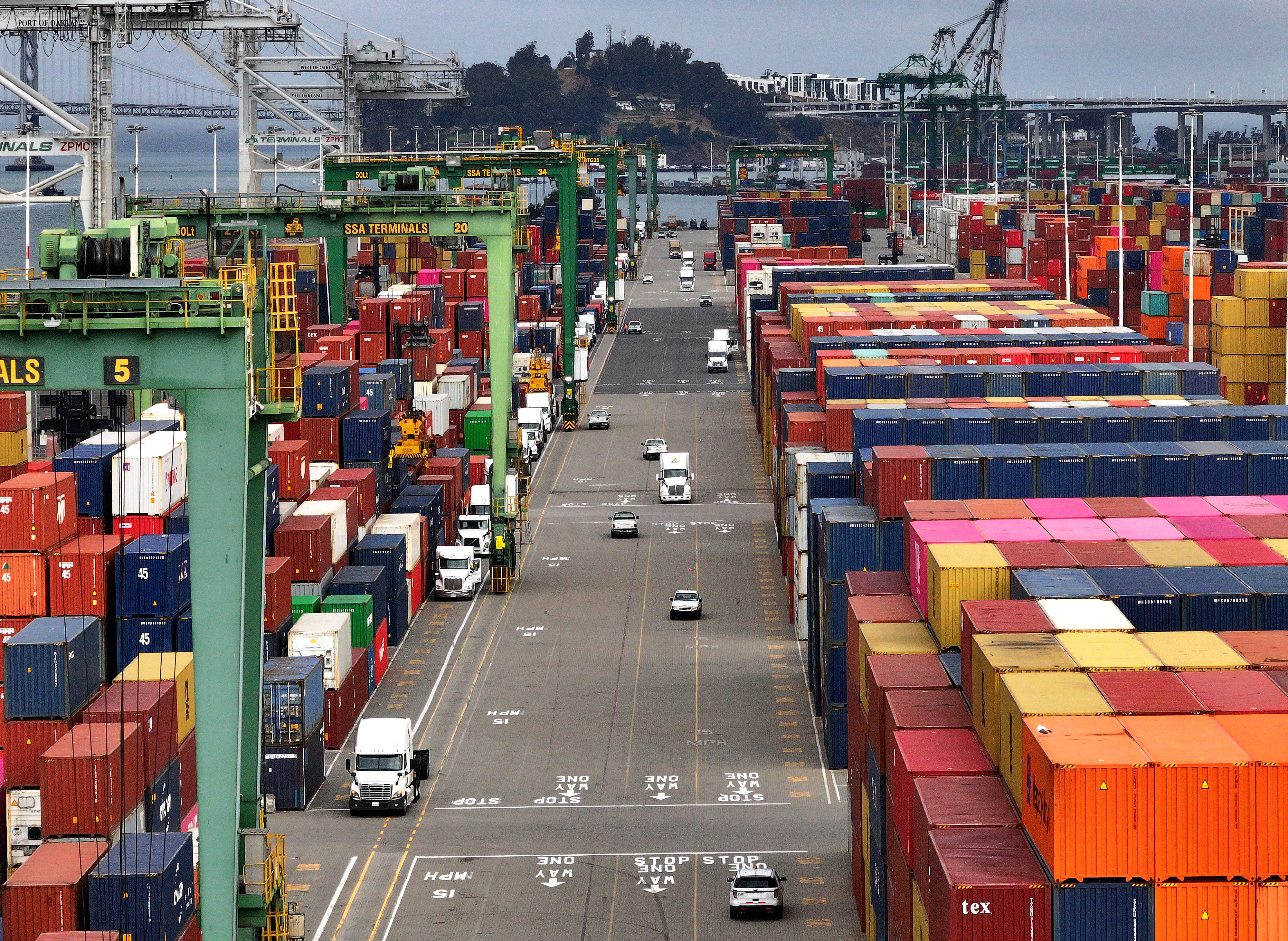

President Donald Trump’s new tariffs on dozens of countries went into effect at midnight on Aug. 7.
The country-specific levies were initially scheduled to begin on Aug. 1, but the administration pushed back the start date to finalize the tariff regime.
Under an executive order, almost 70 U.S. trading partners will face tariff rates ranging from 10 percent to 41 percent.
However, goods already shipped to U.S. ports before the tariff start date are exempt from duties if entered for consumption by Oct. 5.
Transshipped goods—products manufactured in one country and rerouted to another market to avoid tariffs—will also be subject to a 40 percent import duty and other fees and penalties, as per the directive.
The president’s executive order codifies his reciprocal tariff rates unveiled four months ago and later paused for 90 days to allow for negotiations.
In addition to sending letters to various world leaders, which were also posted to Truth Social, the White House has negotiated multiple trade agreements, including with the European Union, Japan, and South Korea.
Amid concerns that the tariffs could disrupt businesses and upend global trade flows, Treasury Secretary Scott Bessent says it is “not the end of the world” that the April 2 tariffs are put into place.
“I would think that it’s not the end of the world if these snapback tariffs are on for anywhere from a few days to a few weeks, as long as the countries are moving forward and trying to negotiate in good faith,” Bessent said in a July 29 interview with CNBC’s “Squawk Box.”
At the same time, according to Trade Representative Jamieson Greer, these tariff rates are unlikely to come down anytime soon.
Speaking with CBS News’s “Face the Nation with Margaret Brennan” on Aug. 3, Greer said that the tariff rates “are pretty much set,” while noting that foreign officials can still reach out and work with the United States and establish better deals.
Still, he says, the world is “seeing truly the contours of the president’s tariff plan right now with these rates.”
According to The Yale Budget Lab, the current average effective tariff rate is 18.3 percent, the highest since 1934.
More to Come
Trump signaled that more tariff announcements are in the pipeline.
The president said on Aug. 6 that tariffs on semiconductors and computer microchips will be “approximately 100 percent.”
“But if you’re building in the United States of America, there’s no charge, even though you’re building and you’re not producing yet,” Trump told reporters.
He didn’t say when those tariffs will take effect.
In addition, Trump confirmed that he will implement levies on pharmaceuticals entering the U.S. market.
According to the president, a “small tariff” would be applied to pharmaceutical products. After more than a year, a “maximum” tariff would be introduced that could reach as high as 250 percent.

Medications on shelves at a pharmacy in Los Angeles, Calif., on May 12, 2025. (Eric Thayer/Getty Images)
The objective is to manufacture pharmaceuticals domestically, he said.
Hours before the Aug. 7 deadline, the president signed an executive order imposing an additional 25 percent levy on India, bringing its total tariff rate to 50 percent. This is now the largest of the tariffs imposed on U.S. trading partners.
The order stated that India’s government is “currently directly or indirectly importing Russian Federation oil.”
The Trump administration has been applying greater pressure on Russia to end the war in Ukraine. While calling Indian Prime Minister Narendra Modi a “friend,” Trump wants New Delhi to curtail its purchases of Russian energy.
India’s annual crude oil imports from Russia reached nearly $53 billion in 2024, up from approximately $1 billion before Moscow invaded Ukraine. India is Russia’s second-largest oil customer, accounting for more than one-third of the nation’s crude exports.
Canada and Mexico, meanwhile, remain countries unable to reach trade agreements with the United States.
Last week, Trump agreed to a 90-day extension with Mexico, delaying any potential additional tariffs. However, the current tariff regime—50 percent levies on steel, aluminum, and copper, and a 25 percent tariff on automobiles—will remain in effect.
U.S.–Canada talks are still up in the air as Trump raised tariffs on Canadian goods from 25 percent to 35 percent on Aug. 1, while excepting goods covered by the United States–Mexico–Canada Agreement. The president also imposed a 40 percent transshipment penalty on Ottawa.
‘Net Positive’
U.S. stocks finished the Aug. 6 trading session higher, before the higher tariffs took effect.
The tech-heavy Nasdaq Composite Index surged by more than 1.2 percent, or 253 points, to 21,169. The blue-chip Dow Jones Industrial Average ticked up by 0.18 percent, or 81 points, to 44,193. The broader S&P 500 climbed by 0.73 percent, or 46 points, to 6,345.
While the financial markets plummeted at the onset of Trump’s global tariff agenda, investors have turned more optimistic on greater trade certainty.
“I think where we’re heading with tariffs remains net positive for both the economy and the stock market,” David Miller, chief investment officer and senior portfolio manager at Catalyst Funds, said in a note emailed to The Epoch Times. “That regime, more likely than not, is more of the same over the next year to two years.”
Miller pointed to strong trade deals, greater reciprocity, and trillions of dollars of commitments in U.S. investment.
The greenback struggled to sustain the momentum it enjoyed heading into August.
The U.S. Dollar Index (DXY), a gauge of the dollar against a weighted basket of currencies such as the Japanese yen and British pound, tumbled 0.6 percent. This year, the index is down about 9.5 percent.