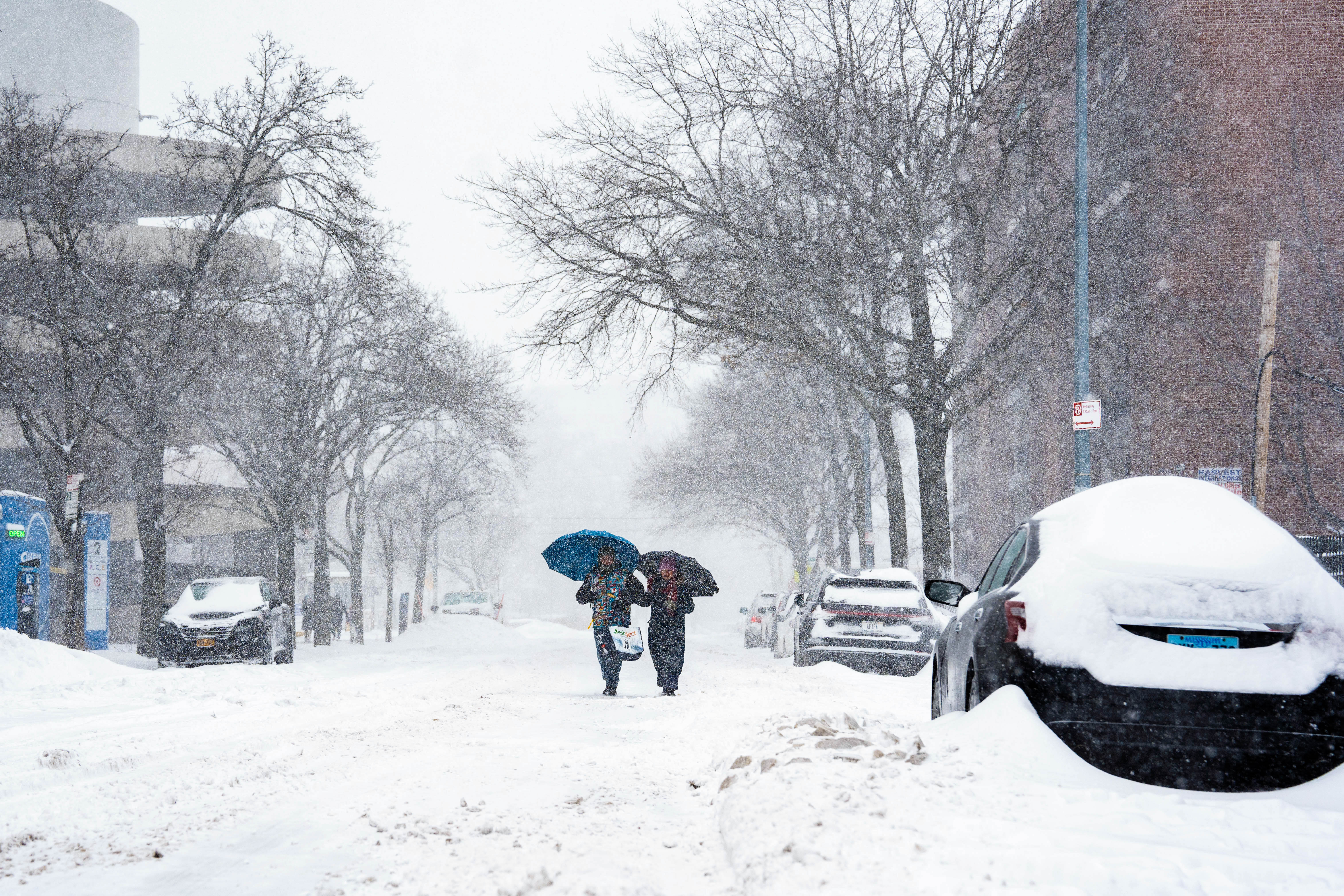

TAMPA, Fla.—The deadly bout of freezing winter weather will begin another round this weekend, pushing arctic conditions to several coastal communities across the eastern and southern United States and possibly leading to snowfall from Tampa Bay to Chesapeake Bay and beyond.
The winter weather is expected to be triggered by atmospheric movement from above and below the Lower 48.
“The next blast of Arctic air surges south down the Plains, across the Great Lakes and through the Southeast and East [Jan. 30] through [Jan. 31],” the National Weather Service (NWS) stated on its website.
The arctic air is forecast to surge southward and eastward across the Plains and Great Lakes through the weekend, the NWS warned. At the same time, a low-pressure system is expected to move across the Southern Plains over the next few days.
Forecasters warn that it could be caught by the Gulf Stream upon reaching the coast, turning it into a bomb cyclone—a quickly intensifying, hurricane-like storm—capable of dumping significant amounts of snowfall on the Carolinas, Virginia, and the surrounding Interstate 95 corridor. The Global Forecast System models show developing weather being pushed north by Feb. 1, skirting the coastline of New York state and New England.
Starting on Jan. 30, Appalachian states such as Kentucky, Tennessee, West Virginia, North and South Carolina, Virginia, and Maryland could see more than half a foot of snow.
Daily record low temperatures are also expected for the Ohio Valley and Mid-Atlantic regions.
Snowflakes could also be seen this weekend on Florida’s beaches as far south as Tampa Bay, thanks to a phenomenon called the “Gulf effect.”
Austen Flannery, a meteorologist in the NWS’s Tampa Bay/Ruskin Office in Florida, told The Epoch Times that the Gulf effect is like the lake effect seen on the Great Lakes: Cold air and low-level moisture move onshore over relatively warm water. Although the air temperature could be below freezing, the Gulf of America is expected to remain warmer than 60 degrees Fahrenheit.
Flannery said on Jan. 28 that Gulf effect snow has the best chance of manifesting between the evening of Saturday, Jan. 31, and the morning of Sunday, Feb. 1, across the west coast of Florida’s peninsula. The last time Gulf effect snow was present in Pinellas County, Florida, was Jan. 9, 2010.
However, this snow will be different from the snowfall recently seen in the Florida Panhandle, which he said was caused by a cold front moving south across northern states.
To have the Gulf effect or lake effect, the winds have to be coming off the water, Flannery said, noting that the phenomenon could manifest as rain as well.
A significant majority of the Sunshine State is expected to face extremely cold temperatures. The NWS has put out freeze warnings for most of the counties within the peninsula. Even Miami-Dade County could register freezing or near-freezing temperatures. Agricultural interests in Florida and around the Gulf were told to prepare for hard freezes.
This freeze comes immediately behind an arctic blast that dumped snow and ice across the eastern half of the United States.
The NWS stated, “This could be [the] longest duration of cold in several decades.”
Since the previous arctic blast descended on a 1,300-mile swath of the country from Montana to Florida last weekend, at least 30 people have died directly or indirectly because of the weather.
Authorities in multiple states reported deaths related to hypothermia, as well as other deaths due to sledding accidents. Bodies were found frozen beneath multiple inches of snow.
Since Jan. 26, the NWS has reported instances of multiple feet of snowfall, tracking a line from New Mexico across the Mississippi Valley and Appalachian Mountains to Maine.
States and communities farther south were dealt freezing rain, prompting ice storm warnings to be issued across the southeast.
States of emergency were declared in a dozen states ahead of the weather. Schools were shuttered for multiple days, thousands of flights were delayed or canceled, and more than 1 million people across multiple states lost power.
According to PowerOutage.com, hundreds of thousands of people across Texas, Louisiana, Mississippi, Tennessee, and Kentucky are still without power.
Nonprofits, including the United Cajun Navy, have responded to the storm in communities that are without power and struggling in the cold across the country from Mississippi to Ohio, delivering warm clothes, meals, and other supplies.
“Cover up if you are outside, ensure pets and animals have protection from the cold, and continue to mitigate against frozen pipes,” the NWS advised.
The Associated Press contributed to this report.