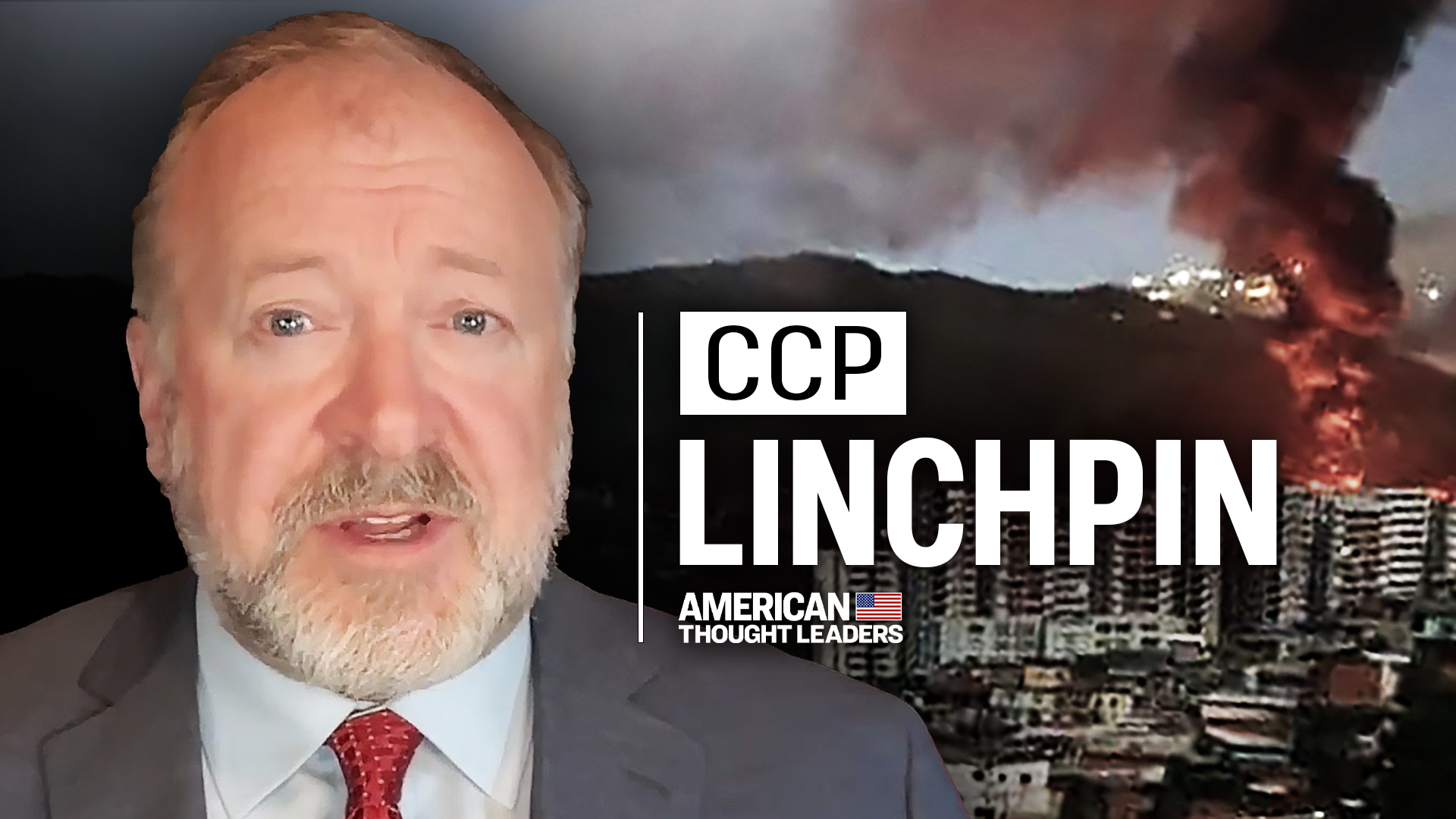

[RUSH TRANSCRIPT BELOW] In this episode, we sit down with J. Michael Waller, a senior analyst for strategy at the Center for Security Policy and author of “Big Intel,” to understand the geopolitical implications of America’s capture of Venezuelan leader Nicolás Maduro.
“For the first time in a very long time, the President of the United States has reasserted the Monroe Doctrine to keep foreign empires out of our hemisphere,” he says.
By capturing Maduro, President Donald Trump sent a signal to all of America’s adversaries, but first and foremost to communist China. “Trump has just pulled out a linchpin in an elaborate piece of machinery for the CCP’s sprawling global empire,” he says.
How did Venezuela devolve from a once prosperous country into an authoritarian hub for drug cartels and a key node of Chinese and Iranian influence? How does Maduro’s capture affect Beijing’s strategy and calculations when it comes to Taiwan? How will this impact Cuba and Iran? And what does the future hold for Venezuela and its people?
Views expressed in this video are opinions of the host and the guest, and do not necessarily reflect the views of The Epoch Times.
RUSH TRANSCRIPT
Jan Jekielek:
Michael Waller, such a pleasure to have you on American Thought Leaders.
Michael Waller:
It’s good to see you.
Mr. Jekielek:
Let’s talk about Venezuelan leader Maduro being captured by the United States. What are the geopolitical implications here? What’s going on?
Mr. Waller:
There are potentially huge geopolitical implications because now no leader on earth is safe from the United States. If we have the capability to undetectedly come into a huge fortified military base and break into the inner sanctum of where a leader is hiding and snatch him out undetected, then the whole world has changed.
Mr. Jekielek:
I mean, but it goes far beyond that, doesn’t it? I mean, Venezuela, almost a failed state, if not a failed state. I mean, we have all sorts of terror groups operating in there. We have every adversary or enemy of America operating there. And we have, you know, him ostensibly being a massive drug dealer per U.S. indictment. How does that change that dynamic?
Mr. Waller:
Well, first of all, the whole cartel that he led is still intact. It’s still in place. It’s unhurt. It’s still running that country. So what happened with Venezuela? You had a very prosperous, very democratic, very sophisticated country taken over by a dictator, Hugo Chavez, who then used an electoral system that he had developed, an electronic vote counting system to keep power and then to control a referendum to change the constitution to make sure that his people always stayed in power. So when he left the scene, his designated successor, Nicolas Maduro, came in and now then we got what we got.
But what they did was they turned their power base into a vast criminal enterprise. They stopped really governing the country and they looted; they not only looted the country, but they let what they were looting deteriorate to such a point where they couldn’t even pump the oil that they’re sitting on, the world’s largest reserves. So they turned it into a gangster state, and in so doing, they just simply allowed any bad element in the world who hated the United States to come there and operate freely. Whether it was the Russians, whether it was the communist Chinese, whether it was Hezbollah, whether it was cocaine traffickers, you name it, they were allowed to go in and stay and really build their own little enclaves in there.
Mr. Jekielek:
What are the implications with respect to communist China? I’ve seen quite a bit of commentary on this issue. Notably, there was actually a delegation from China there, you know, hours before the raid that took Maduro actually took place? What do you think?
Mr. Waller:
Well, it was interesting because just a couple of days before Trump removed Maduro, the Chinese regime had said, we’re not going to give up an inch of our gains in Latin America. So Trump just went and took away a lot of those gains. Venezuela was an important linchpin for the CCP and for its global strategy in building a blue-water navy that will ultimately be able to operate in any part of the world. It will become a trans-Pacific power on the sea. It will become an Atlantic maritime power.
The PLA [People’s Liberation Army] Navy would become, under this plan, a Caribbean power, which means control over the Panama Canal, which means control over shipping from Houston, Galveston, the Mississippi River Delta, anywhere in the world. So it would use its Belt and Road dual-use port facilities, both seaport and airport facilities, to expand its power projection and then to potentially allow—not potentially, but this is the whole theory behind it—to allow any Chinese warships existing now or those that are being built now to dock at these Belt and Road facilities anywhere in the world.
So Venezuela was a colossal asset for China as a piece of real estate from which the CCP could operate against us, but also a huge resource sitting on the world’s largest reserves of oil. Once that infrastructure was restored, Venezuela could provide the Chinese communists with any amount of oil. And for them, it’s embargoed oil, right? It’s under sanctions.
So the Venezuelans can’t sell it on the open market for dollars. They have to sell it at a steep discount. And the Chinese communists don’t even have to pay in petrodollars. They’re paying in yuan or they’re paying in barter. So this is super, super cheap oil that’s keeping Xi Jinping’s whole domestic and global agenda afloat. And they’ve just lost it.
Mr. Jekielek:
There’s this other dimension I heard about. There was commentary about how it was Chinese radar systems that had been basically invaded by the American force. Have you actually followed the dynamics of the raid and what we actually know as a fact? And how did this fit in?
Mr. Waller:
Oh, this is a big defeat for the CCP’s military hardware industry and for the Huawei telecommunications industry because Venezuela is wired with Huawei. So Beijing is so smug about controlling the world through Huawei. Well, it looks like the United States was able to break in through cyber attacks into the whole Huawei system and shut it down. And also to break into the logic systems of the computers running the Chinese-made air defense systems and to shut those down.
Mr. Jekielek:
Fascinating. So it wasn’t that the systems weren’t working. It was that they were disabled. They were disabled. Let’s go back to the first thing that you said, which is that the cartel that Maduro was the head of is still entirely in place. Is that part of the plan?
Mr. Waller:
Well, you have a very vibrant, very numerically strong and morally strong Venezuelan opposition. They’ve won repeated presidential elections legitimately, but that was lost through the phony vote counting. So the regime doesn’t have a whole lot of domestic support. And the domestic support it has, by and large, is flimsy. It’s just you go along to get along because that’s the system that you’re stuck in.
The problem is, though, the opposition is not in a position to take power. It’s not in a position to take control of the military or the security apparatus or the secret police or anything like that. And in fact, a lot of those positions are being run by Cuban nationals, Cuban security and intelligence officers. So Venezuela surrendered its sovereignty long ago under Maduro to other countries that are literally running this cartel system for them.
So because the opposition is not well organized, I mean, the presidential candidate is still living in Spain. What’s he doing over there? Why isn’t he, you know, in Florida or some other place working every single day with his colleagues to form a government? They’re doing that virtually, but they’re not doing that personally yet. And the fact that they’re waiting until now to do it shows they didn’t have a plan to take power in the first place.
So we as Americans are stuck with what we have. You can remove the entire regime and destroy it, but then you throw Venezuela into chaos and civil war, and you’re letting the bad actors potentially take control of the situation that would require a commitment of U.S. troops. So by plucking out Maduro and his wife, who were already under indictment, whose regime is not recognized as legitimate by the majority of our allies and civilized countries around the world, some 60-odd countries don’t recognize it as legitimate. So he is really just a cartel leader running a country.
But we couldn’t simply install somebody in his place because there’s no way to control the army, the generals, the colonels, all the other officers, the secret police, the Cubans running things, the Iranian Revolutionary Guard Quds Force, and Hezbollah running all over the place. So what do you do? You decapitate it but then you’ve sent a message to the regime as Trump has very bluntly done, you know, stay in your lane or we’re going to come and get you, okay?
Mr. Jekielek:
This is actually exactly what I wanted to ask you next: like, what is the purpose of this, right? So I think you’ve started to tell me, right? You’re basically, I mean, does this mean America’s getting its investment in the oil sector of Venezuela back? Does this mean that, you know, Hezbollah activity there is going to be neutralized? Does it mean, what does it mean?
Mr. Waller:
It means a lot of things. Now, it can mean a lot of things to you and me. It can mean maybe one or two things to the president. We don’t really know. But what we do know is that the president went out of his way in his national security strategy that came out in November to say that he is restoring the Monroe Doctrine of 1823. But he is creating what he calls the Trump Corollary to the Monroe Doctrine, which is to expand the Monroe Doctrine’s meaning because President James Monroe was thinking of keeping out the European empires from the hemisphere to defend the independence of the new Spanish-speaking Latin American republics.
Well, there was no Chinese empire bothering us at that time. So what Trump has done is to expand the Monroe Doctrine to include the CCP as an imperial hostile power that has to be pushed out of the hemisphere. That’s one thing. So this is part of Trump’s global vision that he enunciated in his strategy. Another part of it is that Maduro and his wife and others in the regime have been under indictment for many years. And it’s incumbent on us to stop the flow of illegal drugs and to stop narco-terrorism in the region.
And what better way than to topple the man sitting on top of the world’s greatest reserves of oil? Not oil so that we can control it, because it’s probably cheaper just to buy the oil and to build the infrastructure to drill the oil, but to prevent the oil from being used to fund the Cuban communist regime that won’t exist without this oil. To prevent the oil from becoming the private reserve of the Chinese Communist Party. If you look at the new coastal refineries in much of China right now, a lot of them have been built specifically to refine Venezuelan heavy crude coming out of Venezuela. So it was the CCP’s long-term plan for this.
Trump has just pulled out a linchpin in an elaborate piece of machinery for the CCP’s sprawling global empire. And when you think of Venezuela and the events going on there, coinciding with the events going on right now in Iran, which is also under an embargo or under sanctions for its oil, Iran also cannot sell its oil on the open market anymore. The CCP is buying as much as 90 percent of Iran’s oil export output, paying in yuan or non-petrodollars at a steep, steep discount. So the CCP is going to lose all of that steeply discounted oil as well once the Iranian regime goes. So it’s losing both of those, that sanctioned oil that was sort of a private reserve and becoming an increasing private reserve for the party. So what is going to happen to Xi Jinping and his agenda?
Mr. Jekielek:
Actually, what is going to happen to Xi Jinping and his agenda?
Mr. Waller:
Well, we can only guess. But if you think of how interest groups work within the party, the big national oil companies are a huge interest group. They have new refineries that haven’t been paid for yet. They need to make profits. So you have these oil billionaires who are also CCP officials. You have provincial officials that depend on the oil refining industry who also have a lot of power within the CCP and Xi Jinping’s base within the party.
All right. Now, while Xi is purging the military yet again, he’s feeling unstable. So can you imagine how, you know, he has to seem invincible? He has to seem flawless. His whole domestic image is one of flawless perfection. And he’s making China a superpower and an extremely modern, economically powerful future of the world.
Well, what’s happening now? That whole thing risks collapse. The CCP is super leveraged out. It cannot afford to lose anything economically right now. So its only other main source of sanctioned oil is Russia. And Russia is happy to sell more oil to China, but Russia is also being forced to sell it at a heavy discount because its oil is under sanction. So while Xi can squeeze more discounts out of Russia, he can’t squeeze too much more because Russia is not going to sell its oil at a loss.
So I think the CCP has painted itself into a corner, and Trump has taken advantage of this by two things: pulling out Maduro and beginning the end of the regime there, the cartel regime, and supporting the Iranians in their revolution against the mullahs.
Mr. Jekielek:
So one of the criticisms of this whole operation is that it actually is regime change, something that we’re not actually supposed to be doing per Trump doctrine or per, you know, many of the expectations of the coalition that brought Trump and others in the administration to power. What’s your take?
Mr. Waller:
Well, it is regime change. It’s changing the leadership of a regime. And frankly, it’s not a forever war. You can criticize regime change all you want, but it’s far better for us to maintain our interests by getting rid of enemy regimes that threaten us, that attack us, that flood us with drugs and illegal aliens and criminals and gangs, and that support terrorism. Better to do it the way we did it, at no cost to American lives. And it’s not like it’s in some far-flung part of the world. It’s right here in our hemisphere.
And that’s been part of the American tradition for 200 years, with the exception of Obama, really, who renounced the Monroe Doctrine. And that is to preserve order. in our hemisphere. And when a regime has acted not in a sovereign way, but as a colonial asset or an imperial asset of external powers like the Chinese Communist Party, then it’s fair game. Because this fight is against the CCP every bit as much as it is against the drug cartels.
Mr. Jekielek:
Fascinating. And so what are the implications of what’s happened for China’s calculus around Taiwan then?
Mr. Waller:
Well, we don’t know what the real calculus is, but we can certainly guess. Part of it is, you know, the whole fervor to invade Taiwan is very popular in much of mainland China, and especially within the CCP. Well, to do that, though, you can’t cause pain and suffering at home, whether it’s with the population there that’s dependent on gasoline and oil, or whether it’s the party itself that’s dependent on gasoline and oil to have not just a strategic reserve and not just enough fuel to invade Taiwan, but enough to make sure that the economy is cushioned among the party elites so that these guys don’t go broke supporting Xi Jinping’s war against Taiwan.
So now, you know, the party needs stability to plan. To plan its instability, it needs stability at home, and it needs a stable geopolitical situation among other powers. What Trump did was he threw a wrench into that by pulling out that linchpin, and now he’s made it so that the CCP cannot calculate the impact of oil on the Chinese economy should the CCP or when the CCP decides to go ahead and invade Taiwan. So I think Taiwan’s been given an extra lease on life for the moment and maybe even Xi Jinping’s own rule has had a bit of its lease on life taken away.
Mr. Jekielek:
Well, and you also said at the beginning that basically this is a message that the U.S., if you keep up bad behavior, if I recall something, I believe it was Secretary Rubio said, he said, you know, we gave him lots of chances, right? And so, and I’m not 100 percent sure what exactly the chances were other than kind of standing down around the cartel activity and so forth, that anyone is fair game. When you say anyone, does that include some of the great
Mr. Waller:
Well, just think of what was done. They were using the best air defense systems that the Russians and the Chinese regime could produce, and they’re complete failures. What does this say to everybody else in the world who wants to integrate themselves with Russian and Chinese military systems? It’s like, you’re selling us junk. You’re not making us safer at all. You’re a terrible ally. And then both Russia and the Chinese government are completely helpless to do anything to help Maduro.
If you’re a strongman somewhere, you’re a dictator, you’re somebody who’s just on the take. from the CCP, the party can’t defend you. So this is going to cause, potentially, especially if Trump plays it right and keeps pushing, it’s going to cause a complete change around the world in regimes that want to ally themselves with the Chinese Communist Party.
Mr. Jekielek:
That’s interesting. You’re basically portraying this as a kind of test of these capabilities, and the test has shown that they fail and that has, so, I mean, it almost seems to me like what you just described, that itself could have even the most of the, or it could be a very major element of the significance of this whole action. I hadn’t thought of this before.
Mr. Waller:
Yes, there are so many far-reaching dimensions to this, but the key is that this in Venezuela is happening in parallel with what’s happening in Iran. Given also the closeness between the mullahs in Iran and the cartel regime in Venezuela, they’re working in tandem together. So there’s a global strategy and global coordination among this network of hostile allies. And all of a sudden, those two points are just being crushed.
So imagine the CCP can no longer plan to buy oil in their own principal currency; they’re going to be forced to pay it on the world market in dollars. They already are. They’re buying about 40 percent or so of their oil from the Arab states, and they have to pay in petrodollars, but they’ve been negotiating and doing deals where they can also pay in yuan. Well, you know what? That just might change because Saudi Arabia, Iraq, United Arab Emirates, and the other Arab countries that are supplying oil to China, they’re all very sensitive to American pressure. And over the years, they’ve often been very cooperative with us about controlling production or who they sell to.
So this is not discounted oil that China’s getting. This is full-priced oil that China’s buying from the Arabs. But most importantly, if Trump can influence them, those Arab states, on what they sell to China and how, and the new Iranian and Venezuelan future governments are pro-American. Between Iran and Venezuela, counting the Malaysian cutouts to relabel Venezuelan oil, that’s roughly 30 percent of China’s imports of oil. Plus the Arab states, it’s 40 percent. That means Trump now is in a position to regulate 75 percent of the CCP’s oil imports.
Mr. Jekielek:
Well, let’s talk about the little communist state that we don’t often think about, and that’s Cuba, because Cuba had a very significant role in Venezuela. Apparently, a lot of the guard of Maduro were Cuban-trained, if not Cubans themselves. What is the impact on Cuba?
Mr. Waller:
Huge. Cuba has been nursing at the breast of some wealthy, larger power ever since the Castro revolution. It’s never been able to stand on its own two feet. Its only exports really are sugar, rum, cigars, and subversion. And the fact that it has its own personnel running the Venezuelan cartel’s security apparatus shows that the Venezuelan regime itself was really being controlled by the Cuban security apparatus, which in turn was being sustained by Venezuelan oil.
All that’s falling apart now. Cuba has no means to generate any of the foreign exchange that it needs to survive under the government that it has. So, as the president said yesterday on Air Force One, Cuba’s down for the count. There’s no need for the U.S. to take any offensive action against the Cuban regime because it can’t help but collapse unless China or Russia comes in at the last minute to bail it out.
Mr. Jekielek:
Well, one group that we haven’t really talked about much yet, which I think is of profound import here, is the Venezuelan people themselves. You know, famously, it’s the biggest migration, certainly in South America, but one of the biggest in the world out of the country because of the disaster that the country has become. And, you know, there’s the famous Maduro diet, which is starvation, in fact. And so, as you suggested, there are not a lot of Venezuelans that are unhappy about what happened. But, I mean, realistically, at the same time, you said the cartel is still in full force. And, you know, it’s unclear how easy it will be for elected leaders and Venezuelan leaders to actually try to take power. What are the implications for the Venezuelan people?
Mr. Waller:
Well, first, there‘ll probably be more hardship. They’ve gone through an awful lot. There’s going to be more hardship. If this lingers for a long time, there’ll be much more hardship. If a civil war breaks out, there will be much more hardship. So there has to be a practical way to make a lot of ugly choices between the United States and members of the Venezuelan cartel, let’s say the unindicted ones, just like World War II with the Nazis.
You had to let a lot of them get away. You had to integrate them into post-World War II society. And it was just an ugly thing that we had to do just to stabilize things in Europe. And the same might have to be done for Venezuela. Personally, I'd like to see every last one of them get the severest punishment possible, but that’s how you get constant resistance and sabotage and guerrilla warfare and terrorism when certain elements are looking out after their own interests.
So it will be to the Venezuelan people’s benefit if, first of all, they get their act together and have a real functioning government in exile where they can take over these instruments of power. But it’s not going to be like the cartel is going to let them do it. This is where the United States has to come in and essentially say, you will surrender command to this legally elected democratic opposition leader or whatever other opposition force is created. And that’s what’s going to happen, or you'll all meet Maduro’s fate, or worse.
Mr. Jekielek:
You know, but this is beginning to sound more like one of these, you know, forever wars or forever occupation scenarios. I mean, correct me here.
Mr. Waller:
Well, no, the whole object is not to have a forever war, because it would be, I mean, the conventional thinking would be, the U.S. goes in, ousts the government, takes control of whatever it can, and then what? Then you have to have nation-building. No way. So in this case, it was simply executing an existing federal grand jury indictment to arrest a wanted narco-terrorism leader. So that’s what was done.
So you didn’t see our military attacking regime targets. They weren’t destroying the Ministry of Defense. They weren’t destroying the secret police headquarters. They were merely taking out targets that would threaten our successful execution of the warrant to arrest Maduro and then leave. So the whole operation took really about an hour inside Venezuela.
Now, we might or might not be able to do that again, but we can’t keep repeating this. The regime itself has to go. So what do you do? You have to incentivize certain elements of the regime to turn against other elements of the regime, to get them to fight among themselves, and then to have a separate peace with those regime elements that recognize that the jig is up.
Mr. Jekielek:
But really, the U.S. is who has to orchestrate this. That’s kind of what you’re suggesting here.
Mr. Waller:
Yes. Who else is going to do it? Nobody can do it. It’s really a black mark on the Venezuelan opposition because just as in Trump’s previous presidency, when you had Juan Guaido, who was elected and then cheated of his presidency, and you had the massive power of millions of Venezuelans in the streets.All they were doing was yelling and chanting and shaking their fists. They weren’t attacking regime elements, as opposed to the Iranian people who are.
So the Iranian people really know how to do this. You want to get the security forces out? You attack them at the village level, at the precinct level, at every single level. You overwhelm the security forces with the sheer power of civic action by the public. Venezuelans aren’t doing that. And the Iranian regime was every bit as repressive and awful as the Maduro regime, maybe even worse. Venezuelans have been pretty passive in that. I mean, they like to shout and stamp their feet and say how much they oppose the regime.
But back then, in Trump 45, nobody was prepared to attack regime elements with people power. And that’s how you do it. You overwhelm the system. You pull out its eyes and ears; you isolate and overextend the security apparatus, just like the people are doing in Iran. That’s not happening in Venezuela, and it should.
Mr. Jekielek:
Yes, well, and because there’s always the cost, which is lives.
Mr. Waller:
That’s going to happen either way. You’re either going to fight for your country or go into exile, but if you choose not to fight for your country, you really shouldn’t be coming for sanctuary in America.
Mr. Jekielek:
Wow, so, I mean, you’ve been saying that the situation is very difficult to predict at this point.
Mr. Waller:
It’s unpredictable for a number of reasons. First, not just the situation on the ground, but we don’t really know what President Trump’s intentions are. If you look at what he did with Iran, when he bombed the nuclear weapons system of the Iranian government, he did a super job at that with the Israelis, but it seemed very last minute. He didn’t strike regime targets to destroy the regime; he kept the regime intact. With Israel’s fight against Hamas, he was really putting the handcuffs on Israel from greater freedom of action and from completely destroying Hamas.
So you see Trump take certain positions, but then he doesn’t go all the way on them. But then he might surprise you later on and finally go all the way. So we really can’t predict what he’s going to do in Venezuela and what his ultimate decisions are going to be. We can guess that Secretary Rubio would like to see things to their logical end. But Trump’s a different kind of guy. He’s much more prone to making a deal.
Mr. Jekielek:
You know, and there’s also this: you were talking about Iran and Venezuela, but there’s also, you know, Iran has a pretty significant, I guess, influence in Venezuela. And I’m also aware that there are hundreds of thousands of Venezuelans living in Iran as well.
Mr. Waller:
Right. The two countries have, the two regimes have close relations, but also the two countries have had relations for a long time. There’s a large, or not a large, but substantial Arabic and Iranian presence in Venezuela going back a long, long time, going back generations. And so there are still clan relationships going back to the Middle East. There are familial relationships. There are ideological relationships. There are business relationships.
So it’s not unusual to see some type of ties like that. So there are ethnic minorities in Venezuela like there are here. But the regimes themselves have been now for, what, a couple of generations at least, working together with exchange programs, with business programs, with military, political, and terrorist training programs.
Mr. Jekielek:
So you have, just like you have a smaller Iranian population representing the current regime in Venezuela, you have a much larger Venezuelan population working, studying, training, or collaborating inside Iran. Based on your analysis, is this, you know, there’s a lot of discussion about whether this is actually legal action that was taken. Is this, you know, is this war? Is this, as you’ve been describing, you know, executing a warrant? Where are we at?
Mr. Waller:
Well, just look at our country. If you have certain cases where authorities want to execute an arrest warrant, they don’t just go up and knock on your door and say, turn yourself in. They‘ll show up with SWAT teams. They’ll show up with helicopters, with armored vehicles, you know, on American citizens. And yes, that’s abuse, but that’s how our system is and how it works. And oftentimes it’s necessary to do that. So if you’re executing an arrest warrant abroad against a nominal chief of state, well, you need to go in with a lot of power as well.
If you look at what the Trump administration says it did and what it actually did, in fact, it took the grand jury indictments and then it executed the warrants for arrest. So this was a law enforcement-led operation with military support to keep those serving the warrant safe and actually to enable them to serve the warrants in the first place. So the Trump administration is saying, no, this is simply executing a warrant. It is not a military operation for military ends. It’s military support for a judicial operation. That under the law, under U.S. custom and U.S. law, is indeed very legal.
Mr. Jekielek:
And, you know, the other criticism I’ve heard a lot is that, you know, this sets a precedent. And you kind of alluded to it, too, in what you were saying earlier, that this sets a, you know, it’s a violation of Venezuelan sovereignty. Now, of course, there’s the debate whether, I don’t know if it’s even a debate, whether he’s, if he’s not a legitimate leader, is that a violation of sovereignty? I don’t know. But you did say that now, basically, everyone is on notice, or the whole world is on notice that America will come in where it feels it needs to.
Mr. Waller:
Yes, good.
Mr. Jekielek:
So is it a violation of sovereignty or not?
Mr. Waller:
If it was to grab the president of Brazil or Mexico, that’s a very different thing. They’re not cartel leaders. We have diplomatic relations. We recognize their governments. They were elected to those positions. Whereas, with Maduro, we don’t have diplomatic relations. Our allies don’t have diplomatic relations. It’s a criminal regime. And this is a narco-terrorist kingpin. So if we don’t recognize the regime, then we’re not bound to the diplomatic and legal niceties that would go along with apprehending a criminal leader.
Mr. Jekielek:
So as we finish up, what would you say is the bottom line here? I know that there’s a lot of unpredictability and it’s very hard to predict. The U.S. has asserted itself; that much is clear from our discussion. We have a weakened Cuban regime. We have the Chinese needing to recalculate. We have Iran. There’s a whole lot of illicit oil that’s kind of off the map, unavailable to people who would want it. That’s what I’m hearing. What’s the bottom line?
Mr. Waller:
The bottom line is that for the first time in a very long time, the president of the United States has reasserted the Monroe Doctrine to keep foreign empires out of our hemisphere. He did this with Maduro, who had subsumed his country’s sovereignty to the Chinese Communist Party, to the Cuban regime, to the Iranians, to the Russians, and then turned it into a gangster state. So it was incumbent on Trump, as president, to do this. No other president would have done such a thing. And this shows that the United States is very serious, that Trump’s national security strategy is not merely another nice piece of paper that every president puts out, but there’s real force and real teeth behind it and that no one in the world can challenge us.
Mr. Jekielek:
Well, Michael Waller, it’s such a pleasure to have had you on.
Mr. Waller:
Good to be with you, Jan.
This interview was partially edited for clarity and brevity.