
As Republicans push to advance a voter ID law through the U.S. Senate, talks are again swirling on Capitol Hill about making changes to the filibuster.
Some Republicans are calling for the “standing filibuster” to be brought back in order to pass the Safeguarding American Voter Eligibility (SAVE) America Act, a bill that would impose nationwide proof-of-citizenship requirements in order to register to vote.
The SAVE America Act would require individuals to present two forms of government identification and a Social Security card to vote. The rule change would require a lawmaker to be speaking on the floor to keep debate on a measure open, making it harder for the minority party to block bills put forward by the Legislature.
The push has been particularly popular among House Republicans who have tied changing the filibuster rules to passing the SAVE America Act.
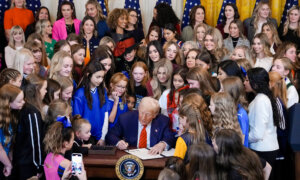
Though President Donald Trump didn’t mention the rule change during his State of the Union address to Congress, he did call for the passage of voter ID legislation.
“I’m asking you to approve the Save America Act to stop illegal aliens and others who are unpermitted persons from voting in our sacred American elections,” Trump said. “It’s very simple, all voters must show voter ID.”
The push to change the Senate procedure has gained less traction in the upper chamber than in the House.
Here’s what to know.
Standing Filibuster
The current rules of the Senate make it relatively easy for the minority party to block legislation.
Under this process, the “silent filibuster,” most legislation must garner 60 votes to move forward to a final simple majority vote.
For much of U.S. history, the filibuster required lawmakers to remain physically standing and speaking on the floor—the “standing filibuster,” sometimes known otherwise as the “speaking” or “talking” filibuster—to block legislation.
Proponents of the rule change have noted this history in their push to bring back the standing filibuster.
Thune: No Agreement Among Senators
Speaking to reporters on Feb. 25, Senate Majority Leader John Thune (R-S.D.) indicated that Republicans were far from agreeing on changing the filibuster.
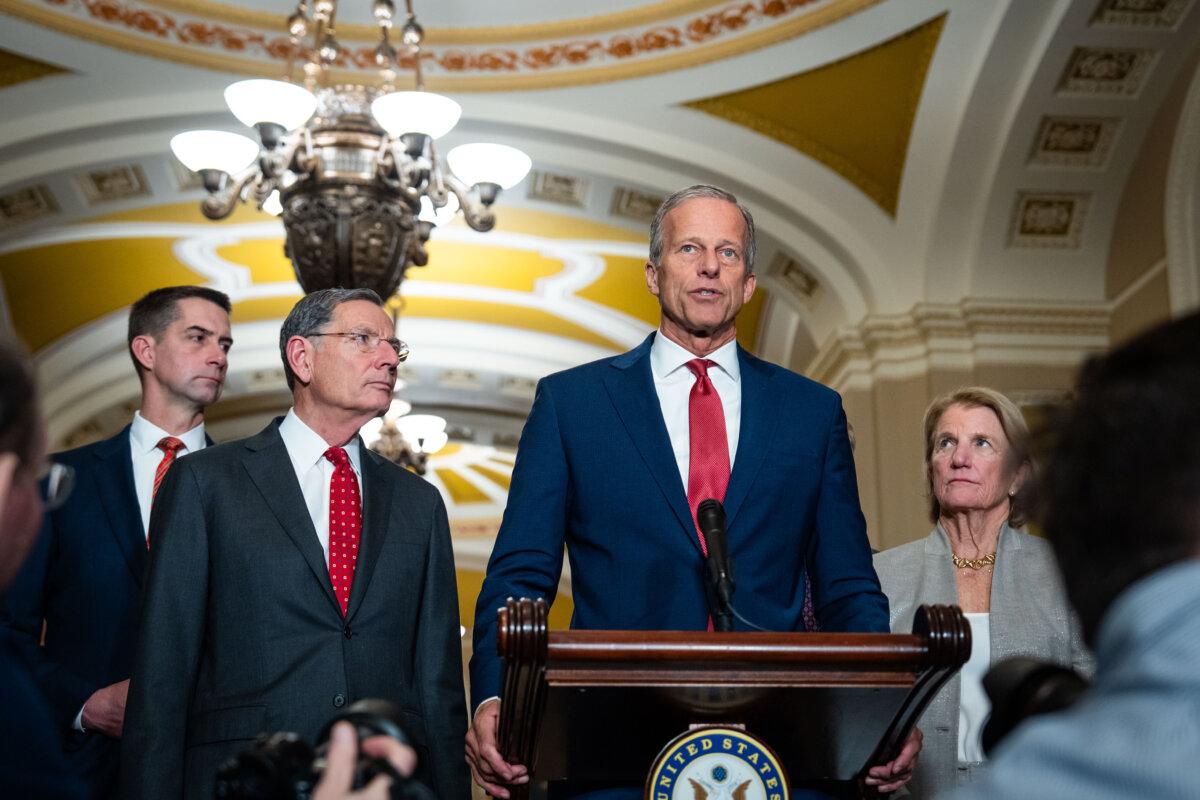
Senate Majority Leader John Thune (R-S.D.), joined by other Senate Republicans, speaks during the weekly press conference on Capitol Hill in Washington on Dec. 2, 2025. (Madalina Kilroy/The Epoch Times)
The filibuster has become practically sacrosanct in the Senate, given its role in protecting minority interests and preventing rapid shifts in federal policy. That has led many lawmakers on both sides to reject sweeping changes to the current filibuster rules.
Before now, the issue most recently cropped up under the Biden administration, when President Joe Biden called for changes to the filibuster.
Thune said Republicans are hesitant to make sweeping changes to the system, noting that amending the Senate rules would likely require several tweaks, and thus, several votes in which at least 50 Republicans would need to back the rule change.
“The talking filibuster issue is on which there is not certainly a unified Republican Conference and there would have to be. If you go down that path, you’re talking about the need to table what are going to be numerous amendments and an ability to keep 50 Republicans unified pretty much on every single vote,” he said. “There just isn’t the support for doing that at this point.”
Sen. Mike Lee (R-Utah), a leading proponent of bringing back the standing filibuster, was critical.
“Not unified on using the talking filibuster to pass the SAVE America Act? It’s time to *get* unified,” Lee wrote in a post on X, in response to a reporter’s post on Thune’s comments.
“We can’t afford the consequences of inaction. GOP senators who aren’t supportive should identify themselves & make their case—rather than silently stalling.”