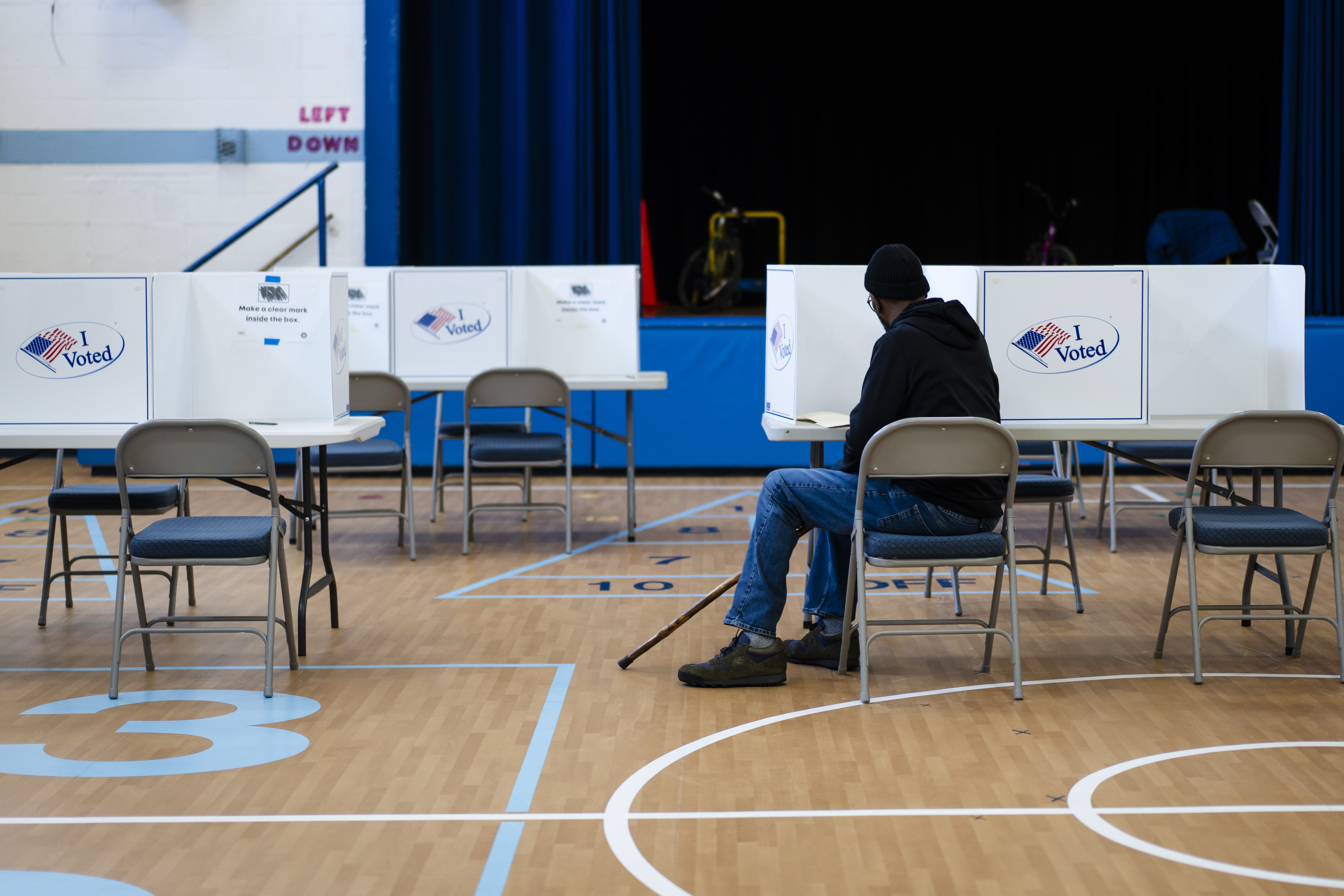
ALEXANDRIA, Va.—Virginia voters approved a constitutional amendment on April 21 that would redraw the commonwealth’s congressional map, giving Democrats an advantage.
The Associated Press called the special election for the “Yes” vote at about 8:50 p.m. ET.
The vote, as of 10:50 p.m., was 51.4 percent for “Yes” and 48.6 percent for “No,” with 96.6 percent of the votes counted.
Voters endorsed a new map drawn by the state’s Democrat-led General Assembly, bypassing a bipartisan redistricting commission. The result is a victory for Democrats who are looking to even the score with Republican states, such as Texas, that redrew their maps to add districts to favor their own party.
But the map will not go into effect immediately, as it is currently being challenged in the courts. The state Supreme Court is considering whether the plan is illegal.
The plan is aimed at giving the Democratic Party 10 out of the 11 seats in the House—a drastic shift from the current map, which is six Democratic districts and five Republican districts. The new map would last through the end of the decade.
Prominent Democrats were quick to praise the plan.
“Congratulations, Virginia!” former President Barack Obama wrote on X. “Republicans are trying to tilt the midterm elections in their favor, but they haven’t done it yet. Thanks for showing us what it looks like to stand up for our democracy and fight back.”
Sen. Tim Kaine (D-Va.) also praised the outcome on X.
“We did it, Virginia!” he said. “Tonight, we fought back against Trump’s efforts to rig congressional maps in his favor—and won. A moment of hope for Americans across the country. Sic semper tyrannis!”
The phrase means “thus always to tyrants.”
Virginia Republican Party Chairman Jeff Ryer lamented the result in a statement.
“I know we are disappointed by tonight’s result,” Ryer wrote. “Evidently, a sufficient number of Virginians trusted the blatantly dishonest language the Democrats placed on the ballot to make our Commonwealth the most severely gerrymandered state in the nation.
“Now, the referendum portion of this fight is behind us. Now, we enter the phase that will be decided through litigation. We don’t know whether the Supreme Court of Virginia will rule that the General Assembly is not above the law and does not have license to violate the Constitution. For the sake of Virginia, we will hope and pray that they do.”
Virginia House GOP Leader Terry Kilgore told a state media outlet that the ballot language and Democrats’ substantial spending advantage had contributed to the result. He indicated that Republicans would turn their focus to the courts.
Precarious Legal Status
Despite voters’ approval, the new maps won’t go into effect immediately. They still face the challenge of a lower court order that ruled the redistricting illegal. That decision is under appeal, but the court allowed the referendum to move ahead in the meantime.
“It is the process, not the outcome, of this effort that we may ultimately have to address,” the ruling reads. “Issuing an injunction to keep Virginians from the polls is not the proper way to make this decision.”
The state Supreme Court is chosen by an officially nonpartisan process in the state legislature, and justices serve on a nonpartisan basis.
For Republicans, the legal system offers a last resort to prevent the implementation of the maps.
If the new maps are ultimately approved after litigation, it would all but ensure four pick-ups for Democrats in the 2026 midterms.
Debate
Proponents of the redistricting measure said it was needed after Republicans redrew congressional maps in states such as Texas.
“Donald Trump’s decision to prioritize redrawing voting maps across the country instead of focusing on lowering costs for families has created extraordinary circumstances for states like Virginia,” Sens. Tim Kaine (D-Va.) and Mark Warner (D-Va.) said in a Feb. 21 statement. “There is now a temporary proposal aimed at preserving a fair playing field and protecting Virginia voters.”
Critics, such as former Virginia Gov. Glenn Youngkin, called the vote a Democratic power grab.
“What we see here is the worst of the worst trying to disenfranchise millions and millions of Virginians,” Youngkin told Fox News on April 17.
The New Maps
Northern Virginia, long a Democratic stronghold, will be divided into five separate districts under the proposal. Several of these districts will extend outward from the Washington area in winding shapes designed to incorporate more conservative rural regions.
The reconfigured Seventh Congressional District, for instance, will start in Northern Virginia and stretch so far that it splits into two sections to avoid including additional Democratic-leaning communities around Charlottesville, which would instead be assigned to a neighboring district. Its unusual shape has drawn comparisons to a lobster, featuring a narrow extension and two wider ends.
A new Sixth Congressional District would trace the Blue Ridge Parkway across central Virginia, connecting a chain of Democratic-leaning communities. It will run from Harrisonburg, home to James Madison University, through Charlottesville and the University of Virginia, then continue to Lynchburg—where Liberty University is located—before passing through Roanoke and ending in Blacksburg, home to Virginia Tech.
By comparison, Virginia’s current congressional map largely keeps the Richmond area within the Fourth District. That district extends from the state capital south to the North Carolina border and backed former Vice President Kamala Harris by a 32-point margin.
The most subtle change will occur in the Norfolk area, particularly in the competitive Second Congressional District. Under the proposed map, a district that was nearly evenly split in the 2024 presidential election will become more favorable to Democrats by replacing rural, Republican-leaning areas with more densely populated, strongly Democratic communities closer to Norfolk.
Overall, the addition of four seats in Virginia could be enough to give Democrats control of the House during the final two years of President Donald Trump’s administration, amid a broader wave of redistricting efforts nationwide.

Lara Meehan and her dog Gigi after voting in the redistricting referendum in Alexandria, Va., on April 21, 2026. (Madalina Kilroy/The Epoch Times)
Voters Weigh In
Voters who spoke with The Epoch Times in Northern Virginia, a key area that determines the outcome of races in the state, said they voted “Yes.”
Gillian Maupin said that the measure “is sort of the opposite of gerrymandering.” She did not elaborate.
Mike Sallosi said he is in favor of redistricting and that the amendment is going to give “a more fair balance” amid the redistricting that has occurred throughout the United States, such as in Texas.
“I think it’s a power balancing by the Democrats because of all the other gerrymandering that’s going on in the rest of the country,” he said.
Lara Meehan, who took her small dog to the polls, said she voted in favor of the referendum because of GOP redistricting throughout the United States.
“I am going to do everything in my power to stop MAGA from taking any more seats, any more power, giving them anything,” she said. “I’m here for the temporary gerrymandering of Virginia.”
Tim Strutzel said he does not like redistricting but said voting in favor of the amendment was necessary in response to Republicans in states such as Texas redrawing their congressional maps.
“I’m hoping, after we do this and the dust settles, put a law in place that says you can’t redistrict until [the] 10-year census,” he said.