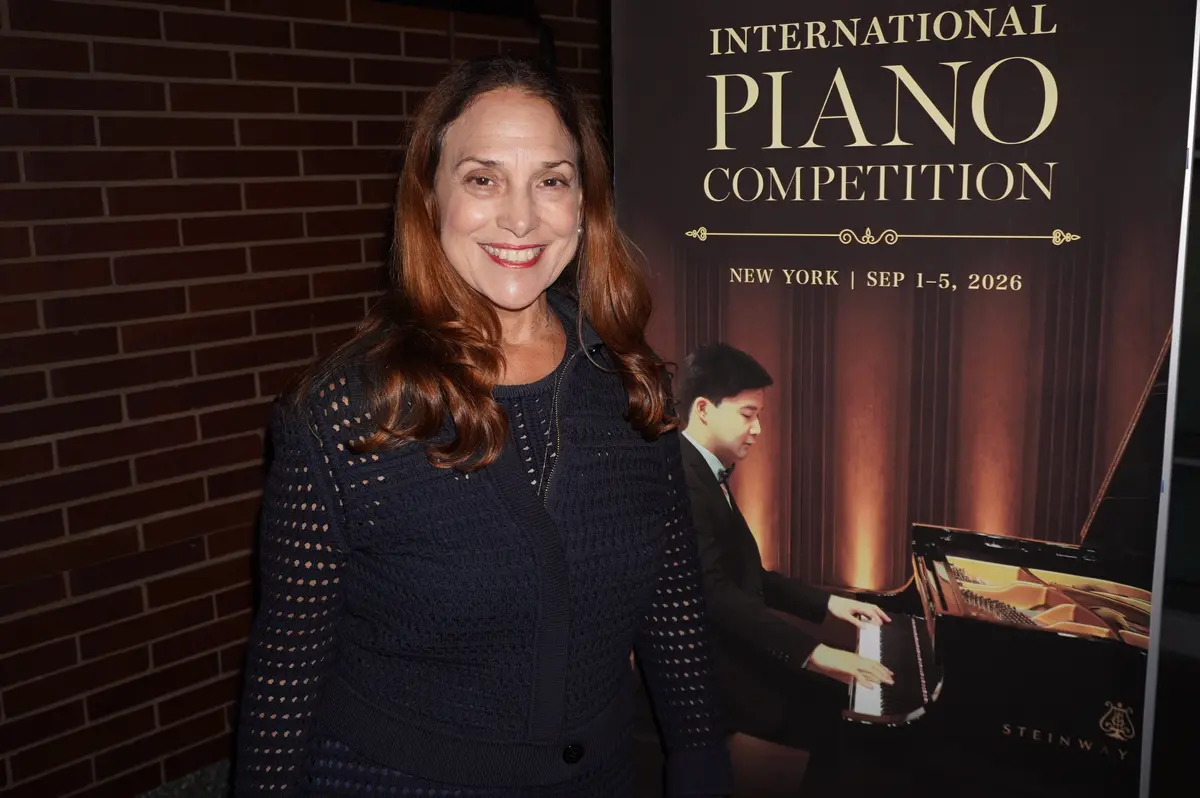


After attending several days of performances at NTD’s 8th International Piano Competition in New York, veteran piano pedagogue Irene Diamond walked away deeply moved by the caliber, dedication, and promise of the young artists taking the stage.
For Diamond, who has taught piano in New York for decades, the competition was far more than a technical contest—it was a formative milestone in a lifelong musical journey.
“They’re all young, and they have their whole life ahead of them. This is just the beginning,” Diamond told The Epoch Times. “They have this head start with all this beautiful repertoire that they’re learning. They can just incubate it. It can just get better, it can just grow and get better.”
Diamond, whose mother and sister were also piano teachers, began teaching at age 12 while her peers were babysitting. She later double-majored in piano performance and pedagogy—the art and science of teaching—in both her undergraduate and graduate studies, earning a full assistantship to teach college and preparatory students.
Drawing on a lifetime of teaching and collegiate competition experience, Diamond paid close attention to the sheer scale and difficulty of the pieces chosen by the competitors, who each had to prepare a demanding 45-minute solo recital for the finals.
One standout moment for her was hearing a finalist tackle Robert Schumann’s monumental “Kreisleriana,” Op. 16.
“That Schumann ‘Kreisleriana’—that is one of the most advanced pieces right there,” Diamond said. “It’s like a 40- to 45-minute piece, and very sophisticated. That’s like doctoral music, you know. He did quite a job of that.”
She noted that grappling with such complex literature at a young age leaves an indelible mark on an artist.
“This will stay with him for life now, because as he matures, he’s just going to bring more to the music,” she said. “He was technically very sound. He’s just going to grow—he’s young. Well, they’re all pretty young, actually.”
Diamond also commended the overall technical preparation of the contestants, highlighting the exacting standards displayed on stage. Among the finalists, she praised the refined technique of the American competitors, as well as Polish pianist Elżbieta Bilicka, noting that her “technique and her playing ability was very exacting.”
The Art of ‘Internalizing’ a Masterwork
A hallmark of the NTD International Piano Competition is its specially commissioned composition, which is arranged from a vocal piece by D.F., the artistic director of Shen Yun Performing Arts. Blending classical Western piano tradition with distinct Eastern melodies, this year’s piece, “Divine’s Calling,” was required of all semifinalists.
Diamond described the piece as “very beautiful” and commended the composer for crafting a work rich in both expressive depth and technical challenge.
“I felt like what was the most fundamental aspect of that piece for this competition was the way that the pianists could show off their skills,” she said. “The composer did a great job of incorporating a lot of pianistic skills at the piano so they could really demonstrate their virtuosity.”
She noted that the piece begins with dramatic tension before shifting early on.
“It then became more ethereal sounding, and I could hear the influence of ‘Divine’s Calling,’” she said.
What impressed Diamond most, however, was hearing how differently each pianist interpreted the same work. In particular, she felt that Elzbieta Bilicka’s rendition was “particularly internalized.”
“When you internalize a piece, one aspect is you think again: what does the composer want to get across? It’s not just me playing this piece. It’s like, what makes this piece beautiful? What were the composer’s intentions?” Diamond said.
Upon learning that the Polish pianist had recorded herself repeatedly, experimenting and refining her tone until the very moments before walking on stage, Diamond was not surprised.
“That doesn’t surprise me,” she said. “That’s what I mean when I use the word ‘internalized.’ Because it’s like everything synthesizes—the spirituality as well as the emotion.”
Honoring the Eras: Composer’s Intent vs. Personal Feeling
The competition focuses exclusively on reviving and preserving the traditional repertoire of three core eras: Baroque, Classical, and Romantic.
Diamond emphasized that understanding the distinct character of these eras is essential for any serious musician.
“Fundamentally, each of these periods is like 100 years apart,” she said. “The Baroque period is the 17th century, the Classical period is the 18th century, and the Romantic period is the 19th century. Just like artwork, when you go to the art museum, you can see the difference in the artwork. There are many differences from period to period as to how they express the music.”
With those differences comes the responsibility of fidelity to the score.
“One of the things that we strive to do with classical music is to perform what the composer’s intentions were,” Diamond said. “Of course, we didn’t live at that time, so it’s based on our research and what’s been passed down, so there are some differences with interpretation.”
Listening to the field of competitors, she noticed that finding the balance between self-expression and historical fidelity is an ongoing challenge for young artists.
“What I heard today, I felt that a few of the pianists did more like what they felt like, instead of necessarily what the composer would have wanted,” she said. “Which, you know, that comes with study—and also a good teacher, someone who can really correct them. ... You can’t learn this overnight.”
‘Nurtured by Love’: Keeping Joy at the Center
Beyond the stage performances, Diamond reflected on the pedagogical discipline required to enter a world-class competition. Preparing multi-movement masterworks across consecutive rounds requires immense stamina.
“Most of these performers that I heard in the last two days really worked to get here,” she said. “They all practiced. It didn’t just come to them miraculously. You can tell they all had to really discipline themselves and use a lot of determination to get here.”
While Diamond enthusiastically supports students entering competitions, setting ambitious goals, and building comprehensive recital programs, she cautioned that external achievement must never overshadow an artist’s inner well-being.
As a certified teacher of the Suzuki approach—founded on the philosophy “Nurtured by Love”—Diamond begins teaching children as young as age 4. She stresses that long-term artistic growth requires a healthy foundation of body, mind, and spirit.
“It’s nurtured by love,” she said. “You want to create the right environment ... keeping a steady diet of all the things that make you a healthy person and a whole person. Once you’re listening to beautiful music and you’re creating beautiful music and art, then this also creates a beautiful heart.”
For parents and teachers guiding young talent, Diamond offered a vital reminder.
“It’s very, extremely important that they have the joy of music first, before they start doing competitions and performing,” she said. “Because you don’t want them to crash. You want them to know and have that love—they know that they’re loved, and know that they have the enjoyment of it first, and then have the exterior motivations. Because otherwise, what are they going to do if they don’t win?”
When asked about prodigies and young talents who risk losing their passion as the demands of professional training increase, Diamond noted that lasting artistry requires something deeper than natural facility.
“The genius, what accompanies the genius trait—and I see this with my students—is heart,” Diamond said. “They should have a connection from heart to the genius. ... It has to come from them inside. No one—no parent, no teacher—can drive them to do that. It has to come from inside.”
Watching the competitors leave the stage, Diamond expressed hope that they will carry their experience forward, buoyed by the music they have mastered.
“Hopefully, if they stick with it, if they don’t get disillusioned or discouraged, it’s important that they keep a bright outlook, a positive outlook, and one that’s nurtured by love,” she said. “So they continue with their journey as whole musicians.”