Character is a word often used but rarely defined.
Sometimes it serves as a neutral expression of description, as in Martin Luther King’s famous remark: “I have a dream that my four little children will one day live in a nation where they will not be judged by the color of their skin but by the content of their character.”
On the other hand, we often associate character with positive virtues. Dennis Prager took this approach in a 2014 Facebook comment: “Goodness is about character; integrity, honesty, kindness, generosity, moral courage, and the like. More than anything else, it is about how we treat other people.”
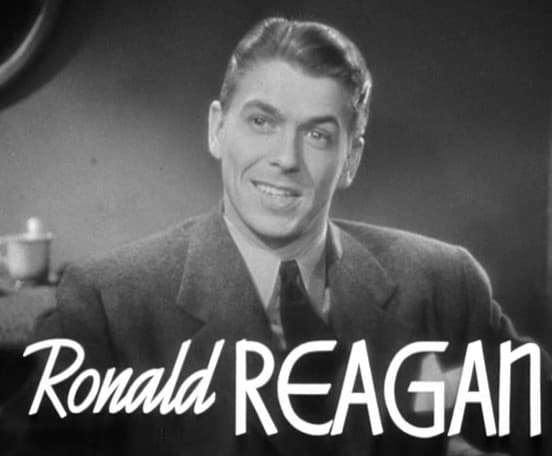
The Hollywood mask: Long before taking office, Reagan learned the importance of appearance and image-making as an actor. (Public Domain)
Historians, psychologists, and the rest of us may attribute great character to a public figure, yet for the most part, though we may pretend otherwise, we lack full knowledge of the origins of that person’s character or how it developed. We pick some singular circumstance, like the influence of Lincoln’s mother and stepmother in molding him, but in fact countless little daily acts and words shape who we are and what we become. As Lincoln himself is reputed to have said to journalist Noah Brooks: “Perhaps a man’s character is like a tree and his reputation like its shadow. The shadow is what we think of it; the tree is the real thing.”
In some ways, large or small, human beings are always a mystery to one another. In any final analysis, we are even mysteries to ourselves. Yet sometimes, the tree appears.
On June 12, 1987, for instance, during a speech in Berlin, Ronald Reagan gave us a look at the tree rather than the shadow and consequently brought change to the world.
The Shadow
In his 1999 article, “The Reagan I Knew,” Christian Science Monitor journalist and Reagan admirer Godfrey Sperling briefly critiques the Edmund Morris biography “Dutch: A Memoir of Ronald Reagan.” Like many other historians, Morris found Reagan an enigma: a man who wore a mask in public and who only really shared himself with his wife, Nancy. Sperling counters by writing: “There really is no mystery about Mr. Reagan. He knew where he was going and where he wanted to take this country.”
Yet Sperling, who had frequently interviewed Reagan both as governor of California and as president, in the same article later admits:
“I am well acquainted with Morris’s problem of getting to know who Reagan, the man, really was. … I am making a point of citing how much access I had to Reagan to underscore that, even then, I still couldn’t get inside the man.”
Biographers and contemporaries of some other presidents have expressed similar frustrations. Like Reagan, for example, both George Washington and Dwight Eisenhower often seemed enigmas even to their inner circles, a persona rather than a person, admired rather than truly known. They cast the shadow of good character, but the tree remained invisible.
So, did Reagan first put on his affable personality as protection against the shame of growing up with his alcoholic father, Jack? Perhaps. After all, at age 11 he had to drag the passed-out Jack out of the snow and through the front door of their house. Yet Reagan always spoke sincerely of his love for his father and lessons he had learned from him, like the value of persistence and hard work.
Did becoming a Hollywood actor, always aware of maintaining an image in public as well as on the screen, teach him to conceal his true feelings? Likely so. He learned in those years the importance of appearance and how it often triumphs, for better or worse, like a shadow of the tree.
Did his years in politics—his terms as president of the Screen Actors Guild, his time as governor—reinforce those early lessons of wearing a mask and being a conciliator? Of course.
Yet behind Reagan’s congenial manner and his famous bowl of jelly beans was a man with some steel in him.
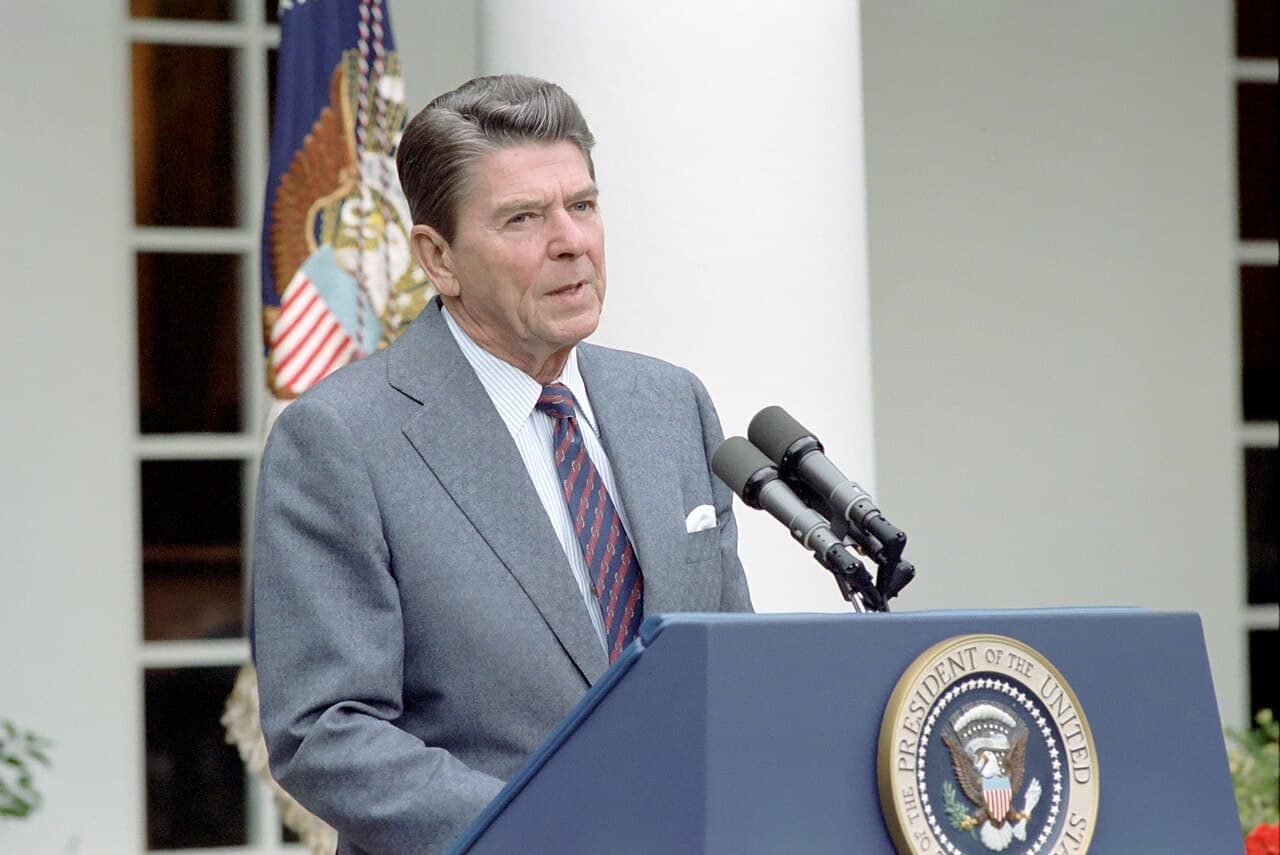
Early in his first term, Reagan faced down a massive illegal strike by federal air traffic controllers, giving them 48 hours to return to work before firing them—proving that he made no empty threats. (Public Domain)
The Tree Revealed
One crisis early in his first term in the White House illustrates Reagan’s courage and strength.
Just six months after he took office, the nation’s federal air traffic controllers threatened a strike, demanding a huge pay increase. When that demand was refused, more than 70 percent of the air controllers walked off the job. While a former union man, Reagan could countenance neither this illegal strike by federal employees nor negotiating while the strike was in progress. He gave the strikers 48 hours to return to work or be fired. Many stayed away, and they were in turn given the boot. Both friends and enemies abroad, as well as Americans at home, took note of this incident. Here was a president who didn’t make empty threats.
That same staunch ability to stand his ground occurred throughout his negotiations with the Soviet Union. His Strategic Defense Initiative, a space-based missile defense program designed to thwart nuclear attack, was mockingly dubbed “Star Wars” by the press, but the Soviet Union was paying attention. Eventually, that regime realized the limits of its own technology and the economic impossibility of matching U.S. development, one of the factors that would bring about its collapse.
Another of these sword thrusts at communism and, in particular, the Soviet Union came in Berlin during Reagan’s second term.
The Words That Helped Destroy a Wall
By 1987, the Berlin Wall had separated the city for more than a quarter century. West Berlin was home to freedom and relative prosperity, while the city’s eastern sector was a place of collectivism, repression, and food shortages. The difference between the two was stark.
In 1987, following a G7 summit, Reagan visited the city to participate in its 750th anniversary celebration. On June 12, near the historic Brandenburg Gate, which was just inside the eastern sector and closed to inhabitants on both sides of the wall, Reagan delivered a speech with an impassioned line that echoed around the world: “Tear down this wall!” Time Magazine later wrote that these were the “four most famous words of Ronald Reagan’s Presidency.”
Those same four words almost didn’t make it into the speech. Some of Reagan’s advisers wanted them cut, fearing they might imperil the recent improvements in Soviet-American relations. They argued that there was no need to poke the Russian bear.
But Reagan insisted they stay in place.
In the speech, during which he praised Berlin and saluted its birthday, he also spent much time criticizing the wall. He spoke of the barriers dividing Europe between the free and the oppressed, then said: “Yet, it is here in Berlin where the wall emerges most clearly; here, cutting across your city, where the news photo and the television screen have imprinted this brutal division of a continent upon the mind of the world. Standing before the Brandenburg Gate, every man is a German separated from his fellow men. Every man is a Berliner, forced to look upon a scar.”
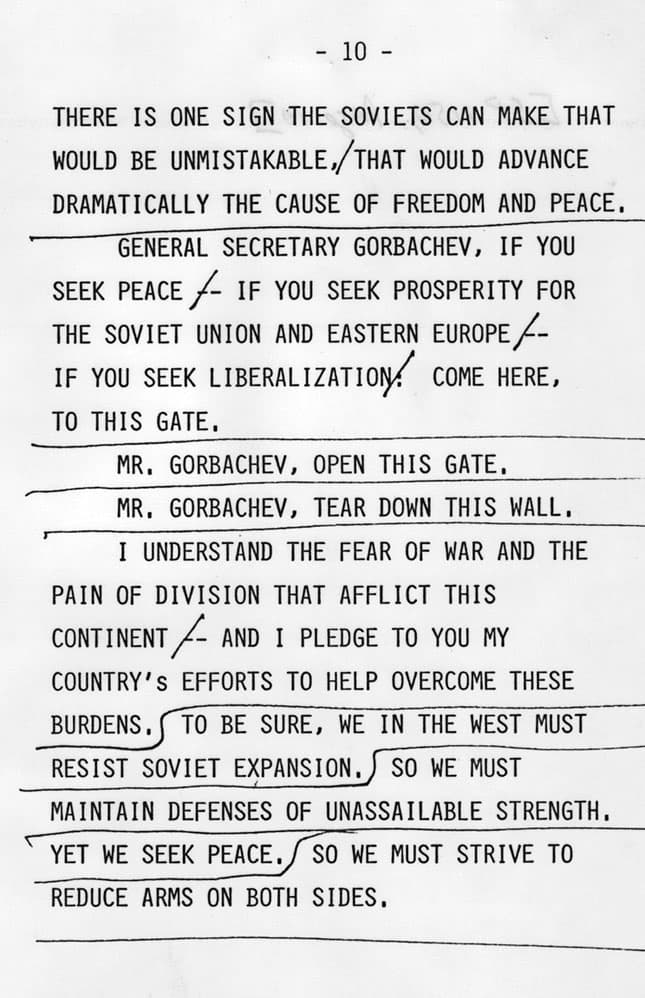
Reagan's actual typed cue card featuring his famous line. Though some advisers wanted it cut out, Reagan insisted it stay, revealing the inner strength behind his public persona. (Public Domain)
Later, speaking again of this great divide, he said:
“There is one sign the Soviets can make that would be unmistakable, that would advance dramatically the cause of freedom and peace. General Secretary Gorbachev, if you seek peace, if you seek prosperity for the Soviet Union and Eastern Europe, if you seek liberalization: Come here to this gate. Mr. Gorbachev, open this gate.
“Mr. Gorbachev—Mr. Gorbachev, tear down this wall!”
Reagan continued speaking for a good while after that remark. Near his conclusion, however, he came back to the wall: “As I looked out a moment ago from the Reichstag, that embodiment of German unity, I noticed words crudely spray-painted upon the wall, perhaps by a young Berliner ... : “This wall will fall. Beliefs become reality.”
‘Beliefs Become Realities’
Two years later, on Nov. 9, 1989, which is 37 years ago this month, that spray-painted prophecy did indeed become reality.
On that date, and amid half a million East Berlin protesters demanding reform and more across the country, Gunter Schabowski, an East Berlin Politburo spokesman, declared that East Berliners were now free to cross into the western sector of the city. Hundreds of thousands, many of them at the Brandenburg Gate, rushed to breathe the air of freedom that this declaration brought, to see friends and relatives, and to begin smashing the wall with picks and sledgehammers.
In another two years, on Dec. 26, 1991, an equally astounding historical event occurred. The Soviet Union itself officially dissolved.
Many Americans who remember these momentous events will recollect the astonishment they felt. Most, including American politicians and bureaucrats, had assumed the Cold War would last through their lifetimes and beyond. That the wall and the Soviet Union would disappear so quickly, ending the Cold War, had seemed beyond imagining.
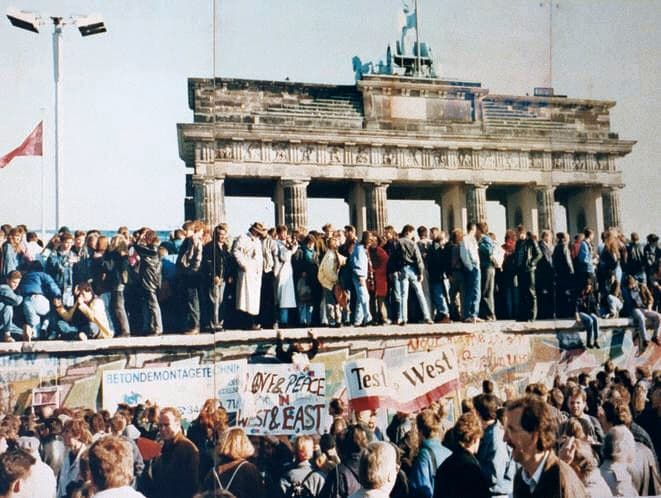
Jubilant crowds of East and West Berliners gather atop the barrier on Nov. 9, 1989, to celebrate the fall of the Berlin Wall. (Unknown photographer/<a href="https://commons.wikimedia.org/wiki/File:West_and_East_Germans_at_the_Brandenburg_Gate_in_1989.jpg">CC BY-SA 3.0</a>)
An addendum: Today in the United States, walls have gone up, separating citizens from one another. These walls are built not of concrete, brick, and barbed wire, but of ideology and hatred.
In his speech, Reagan asked why West Berliners remained in such a divided city, working and hoping for change rather than living with fewer restrictions in West Germany. He then answered his question this way: “In a word, I would submit that what keeps you in Berlin—is ‘love.’ Love both profound and abiding.”
Reagan helped give a push against the wall, but it was love—love of their city, love of their fellow Germans on the other side of that border, and love of liberty—that brought down that wall.
Americans today would do well to remember that “beliefs become realities” can lead us not only into sunshine but also into darkness. The choice is ours.
What arts and culture topics would you like us to cover? Please email ideas or feedback to features@epochtimes.nyc.