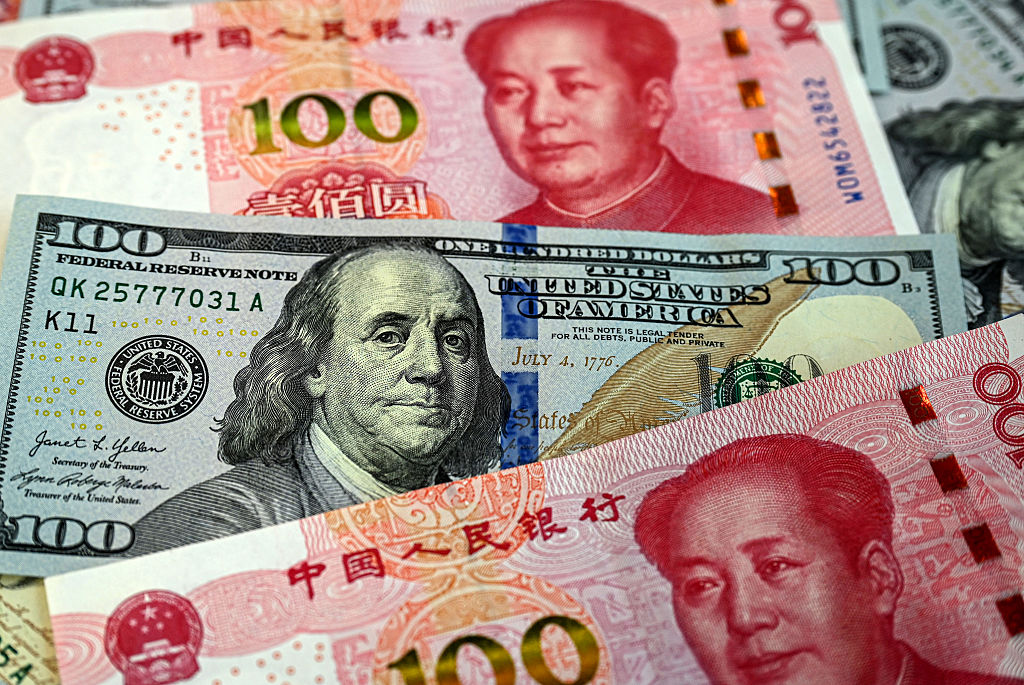

The U.S. Treasury is pressing China to allow the yuan to strengthen, arguing the currency is “substantially undervalued” and should move higher in line with market pressure and economic fundamentals.
The call came in Treasury’s semiannual report to Congress on exchange-rate policies, which covers the four quarters through June 2025.
The Treasury did not label any major trading partner a currency manipulator, but it singled out China for unusually low transparency around how it manages its exchange rate—and warned that poor disclosure won’t shield Beijing from a future designation if evidence shows it is blocking yuan appreciation.
The Treasury’s yardstick comes from the Trade Facilitation and Trade Enforcement Act of 2015, which lays out how the department evaluates whether a trading partner may be keeping its currency out of line.
Under that law, the Treasury focuses on three metrics: a large trade surplus with the United States, which the Treasury defines as at least $15 billion in goods and services; a large overall current account surplus of at least 3 percent of GDP; and repeated one-sided currency-market interventions, typically defined as net purchases of foreign currency in at least eight of 12 months, totaling at least 2 percent of GDP over a year.
Economies that meet two of the three tests are placed on the Treasury’s Monitoring List. In the latest report, the list includes China and nine other economies, with Thailand newly added.
Over the report period, the Treasury shows China with a $246 billion goods-and-services surplus with the United States and a current account surplus of 3.2 percent of GDP.
The report also flags “statistical anomalies” that could mean the surplus is larger than what official balance-of-payments data show, noting that using customs data would put the current account surplus at 4.3 percent of GDP.
China’s recent official trade figures, despite widespread questions about the data’s reliability, may add context to Washington’s focus on large surpluses and exchange-rate policy.
China’s customs agency says the country posted a 2025 goods trade surplus of about $1.19 trillion, with exports of $3.77 trillion and imports of $2.58 trillion.
Exports to the United States fell 20 percent from a year earlier, while exports to the European Union rose 8.4 percent and exports to the Association of Southeast Asian Nations (ASEAN) rose 13.4 percent, pointing to stronger sales into other major markets even as U.S. tariffs weigh on shipments to America.
The currency debate also depends on prices, not just the yuan’s daily moves against the dollar.
The International Monetary Fund (IMF) has said that China’s relatively low inflation has contributed to a decline in its “real” exchange rate—meaning China’s goods become cheaper compared with trading partners even if the nominal exchange rate changes only modestly.
The IMF said China’s low-inflation-driven price advantage has supported exports while “exacerbating external imbalances,” and it projected China’s current account surplus would reach 3.3 percent of GDP in 2025.
The Treasury also used this report to signal that it is widening the toolkit it uses to judge currency behavior.
It highlighted new joint statements with Japan, Switzerland, Malaysia, Thailand, Korea, and Taiwan that reaffirm pledges not to target exchange rates for competitive advantage and to improve transparency.
The Treasury says it will also look beyond simple spot-market intervention—paying closer attention to things such as forward positions, capital-flow measures, and other government vehicles that can influence currency markets.
How Currency Intervention Works
Currency policy can matter as much as a tariff because it shifts prices across the whole economy. When a country holds its currency down, its exports look cheaper to foreign buyers, and imports look more expensive at home, which can boost exports and reduce demand for foreign goods and overseas spending.
Governments can influence an exchange rate most directly through currency-market intervention: the central bank, or state-linked banks, buying foreign currency and selling the local currency, increasing supply and putting downward pressure on the exchange rate. Limits on cross-border capital flows can also reduce the market forces that would otherwise push the currency higher.
China manages the yuan more tightly than a free-floating currency. Authorities set a daily reference rate and allow trading within a band, alongside comparatively strict controls on capital moving in and out of the country. Together, those tools can dampen market-driven upward pressure. China has also accumulated a large stock of foreign-exchange reserves over time, which reflects the state’s capacity to influence currency conditions.