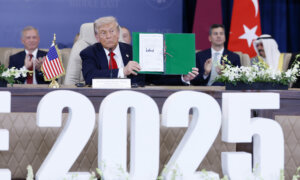

It’s happening. The Chinese Ministry of Foreign Affairs has confirmed that the Trump–Xi summit will take place in Beijing from May 13 to 15, about a month later than originally expected.
The world will be watching closely. Although analysts don’t expect much because the chips-for-rare-earth-playbook remains the theme, a lot is at stake, especially when the Iran war ceasefire appears to be on “life support,” in President Donald Trump’s words.
For months, experts have debated a central question about U.S. foreign policy: Is Washington’s strategy ultimately centered on China, or is a series of overlapping crises simply giving Beijing the upper hand?
The Iranian Presiden Masoud Pezeshkian appears to endorse the first view. He said that the United States “intends to take [Iran] down first, and then deal with China” when making a surprise appearance at an event receiving Chinese humanitarian supplies in Tehran.
Notably, his remarks came on April 15—the same day Washington launched “Operation Economic Fury” in coordination with a U.S. naval blockade aimed at increasing pressure on Iran’s economy.
That inevitably drags Beijing—Iran’s biggest oil customer—into the fray.
Over the past 30 days, Washington has sanctioned Hengli, China’s largest supposedly independent oil refinery. It also imposed sanctions on three Chinese companies accused of providing satellite imagery to Iran during the war.
In response, Beijing invoked its anti-sanctions law for the first time, ordering companies in China not to comply with certain U.S. sanctions measures.
Secretary of State Marco Rubio warned in comments to The Epoch Times that China should prepare for secondary sanctions if it continues ignoring U.S. restrictions. “We don’t do these things for symbolic purposes.”
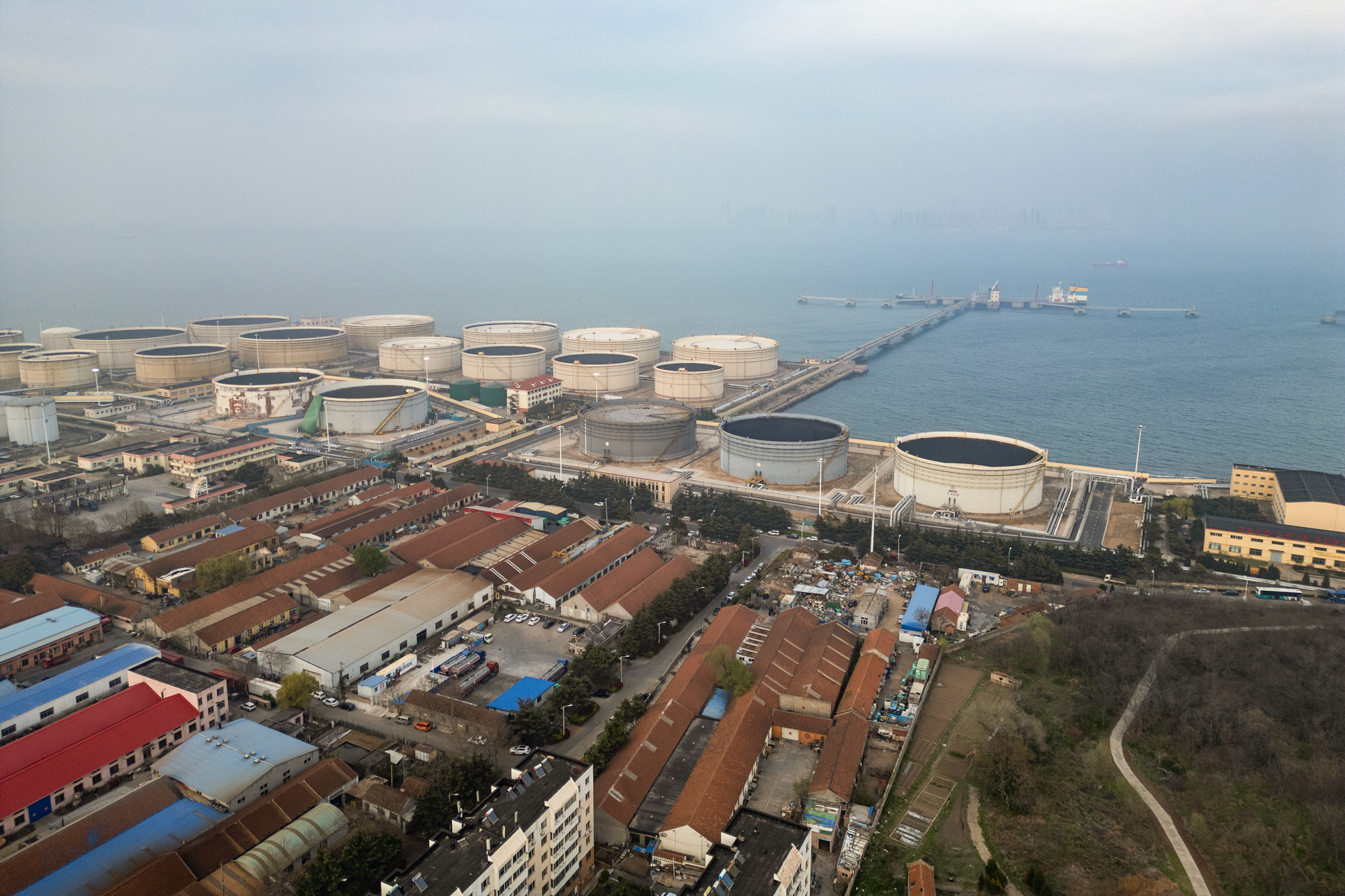
China’s so-called “teapots”—supposedly independent oil refineries—have long been major buyers of Iranian crude. Hengli alone can process roughly 400,000 barrels per day, equivalent to about one-third of China’s daily imports of Iranian oil.
But this teapot is far from being independent.
A 2018 Chinese media report revealed that Hengli is a minority-owned company of China’s state-owned conglomerate Sinochem. Hengli’s chairman also positioned his company as an energy champion for the Belt and Road Initiative, Chinese leader Xi Jinping’s signature geopolitical platform.
Hengli is also more entrenched in the Chinese banking system, unlike the previously sanctioned small “teapots,” said Max Meizlish, a research fellow at the Foundation for Defense of Democracies.
As early as a year ago, Chinese scholars well-connected to the regime expressed the concern that “financial sanctions and countermeasures will probably become a battlefield of U.S.-China competition in the next phase.”
At the time, such a scenario seemed likely only in the event of a direct military conflict over Taiwan. The Iran war has changed that calculation.
If Washington ultimately moves to impose secondary sanctions, the consequences for Chinese banks could be severe. Most major Chinese banks still rely heavily on access to the U.S. dollar system.
That vulnerability helps explain Beijing’s unusually forceful response. If Washington uses dollar-based financial jurisdiction to pressure Chinese institutions, Beijing appears prepared to retaliate against the China operations of U.S. companies that comply with secondary sanctions.
Much like the U.S. naval pressure campaign around the Strait of Hormuz, Beijing is attempting to create a form of sanctions gridlock. Chinese banks—already strained by a weak domestic economy and mounting financial stress—have become one of the regime’s most sensitive pressure points.
Analysts say that the sanctions campaign gives Trump additional leverage heading into the Beijing summit.
But until the United States achieves greater independence in rare earth supply chains, Washington is unlikely to pursue the “nuclear option” of sanctioning major Chinese banks, according to Yeh Yao-Yuan, a professor of international studies at the University of St. Thomas in Houston.
Still, Beijing now faces a far more serious strategic question, said June G. Liao, a veteran journalist and China expert.
“The United States sanctions Hengli as a way of confronting Xi Jinping about the role the Chinese regime plays in the Iran issue,“ she told The Epoch Times. ”Will Beijing continue to enable Iran, and what price is it willing to pay for that role? Can Beijing afford to pay that price?”
Read more about the shadow fleet and Chinese military support to Iran.
—Terri Wu
BOOKMARKS
Virginia Democrats want the U.S. Supreme Court to block a lower court ruling that struck down the state’s recent voter-approved congressional map. That map would have given Democrats a 10-1 advantage over the GOP, but the Virginia Supreme Court ruled it was invalidly approved.
British Prime Minister Keir Starmer said on Monday that he’s not stepping down from office, despite massive Labour Party losses in recent local elections. “On growth, defence, Europe, energy, we need a bigger response than we anticipated in 2024 because these are not ordinary times, and this is a political challenge just as much as it’s a policy challenge,” he said.
The U.S. Supreme Court has extended an order allowing the abortion pill mifepristone to continue to be sent in the mail, allowing the practice at least until May 14. The U.S. Court of Appeals for the Fifth Circuit previously ruled it cannot be sold by mail, but the Supreme Court has paused that ruling.
A cruise ship has docked at Port Canaveral in Florida, ending nearly two weeks at sea after 160 people on board reported symptoms of norovirus. Norovirus is a foodborne illness that causes vomiting and diarrhea and is spread quickly through contaminated food, water, or surfaces.
The National Fraud Enforcement Division of the Department of Justice says it has carried out enforcement actions across the United States worth nearly $1 billion. Read about some of the schemes they uncovered in Naveen Athrappully’s latest report.