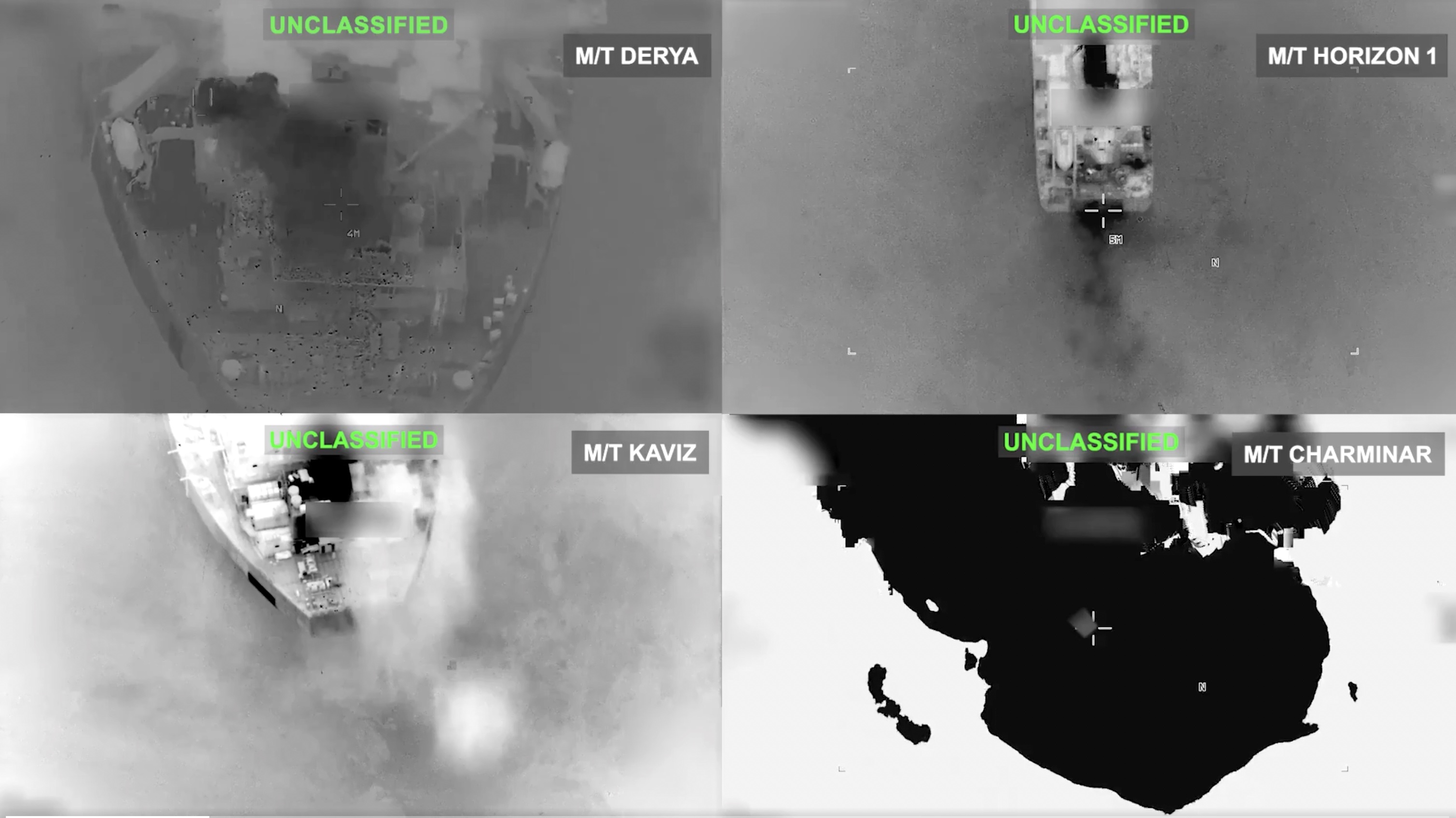

U.S. forces launched new strikes targeting multiple Iranian tankers on Sept. 8, marking the latest kinetic engagement in the multi-month armed standoff.
In a press statement, U.S. Central Command (CENTCOM) said U.S. forces destroyed five tankers with ties to Iran’s Islamic Revolutionary Guard Corps (IRGC), in retaliation for an earlier attempted missile attack targeting a U.S. warship. According to CENTCOM, the U.S. warship evaded the Iranian attack without any harm to U.S. personnel on board.
CENTCOM said U.S. forces targeted four of the Iranian tankers—M/T Kaviz, M/T Charminar, M/T Horizon 1, and M/T Riesco—while they were operating near the Gulf of Oman. The fifth tanker, identified as M/T Derya, was operating near Kharg Island when it was struck.
Earlier on Tuesday, Iranian military spokesman Ebrahim Zolfaghari claimed three Iranian tankers had received warnings of pending U.S. strikes. Zolfaghari said Iranian forces would respond to any such strikes by launching new attacks on U.S. military bases and interests throughout the Middle East.
In a further statement shared through state media, the IRGC said that Iran’s retaliation would also target port facilities of neighboring nations that have played host to U.S. forces. The IRGC warned the crews of vessels using these ports to abandon their ships, as these “will be targeted.”
Following these threats, Iranian state media published footage purporting to show missile launches targeting multiple military bases in Jordan.
Jordan’s military said its air defense systems intercepted 18 ballistic missiles launched toward its territory and two others fell in places where no one lives. It said it has no reports of casualties. Jordan is a staunch U.S. ally that hosts American forces, making the kingdom’s military bases a target of repeat Iranian strikes.
The IRGC also claimed attacks targeting two more U.S. warships on Sept. 8. In response to a request for comment about this Iranian claim, CENTCOM spokesman Capt. Timothy Hawkins said, “All IRGC attempts against U.S. Navy warships have failed—that’s fact, not rhetoric.”
The Sept. 8 strikes mark the second time U.S. forces have fired upon Iranian tankers in response to an Iranian attack targeting a U.S. warship. U.S. forces carried out disabling strikes on three Iranian vessels on Sept. 5 in response to Iran’s targeting of two U.S. Navy warships. Iranian authorities have since threatened to implement a maritime exclusion zone over the Persian Gulf and impose sanctions on vessels that attempt to transit the waterway without first coordinating with Iranian authorities.
U.S. Secretary of State Marco Rubio told reporters during a visit to Colombia on Tuesday that the United States would continue to strike Iranian oil tankers in retaliation for any attempted attacks on U.S. warships.
In early trade on Wednesday, oil prices jumped for the fourth straight session, gaining more than $1 after the second round of Iranian attacks on U.S. military assets in the Gulf.
Brent crude futures rose $1.57, or 1.6 percent, to $99.49 a barrel by 0001 GMT. U.S. West Texas Intermediate crude was at $94.63 a barrel, up $1.60, or 1.72 percent.
Saudi-Yemen Front
Meanwhile, on Tuesday, the Iran-backed Houthis in Yemen launched their own attacks on four cities in the south of Saudi Arabia.
Saudi authorities said that women and children were among the 73 people hurt by the strikes. The reports of such large numbers of wounded suggested the attacks were among the biggest carried out against Saudi Arabia since the conflict escalated in February.
In recent days, Saudi-backed Yemeni forces of a government based in the south have launched a multipronged offensive on Houthi-held areas, after the Houthis tried to advance on government-held positions. The government, which was driven by the Houthis from the capital 12 years ago, says it now aims to recapture all Houthi-held territory.
The Houthis said Tuesday their operation used drones and missiles to strike a Saudi airbase in the southern city of Khamis Mushait as well as Saudi state oil company assets in the cities of Abha, Najran, and Jazan.
NASA satellite images showed a thick cloud of black smoke over the Jazan refinery and a column of white smoke rising from an oil distribution centre in Abha.
Reuters contributed to this report.