
Job openings soared to a higher-than-expected level in May, signaling the U.S. labor market’s persistent resilience amid economic uncertainty.
Job Openings and Labor Turnover Summary (JOLTS) data show that the number of job vacancies climbed by 374,000 to 7.769 million in May, from an upwardly revised 7.395 million in April.
The consensus estimate pointed to a modest decline, coming in at 7.3 million.
Most of the May increase was concentrated in accommodation and food services (314,000), and finance and insurance (91,000). Conversely, the number of job openings in the federal government tumbled by 39,000.
Job quits—the number of individuals resigning from their positions—surged by 99,000 to 3.293 million. Quits were centered in trade, transportation, utilities (70,000), and leisure and hospitality (53,000).
The quits rate, which measures voluntary quitters as a share of total employment, edged up to 2.1 percent from 2 percent.
Economists monitor this gauge to determine workers’ confidence in finding additional employment.
As has been the case for the last several months, employers are neither firing nor hiring workers.
The number of layoffs and discharges was flat at 1.6 million, while the number of new hires was also little changed at 5.5 million.
Recent numbers suggest that the United States is facing structural challenges rather than cyclical ones, says Mike Reid, a senior U.S. economist at RBC. In other words, the country is experiencing a labor shortage amid an aging population, a skills gap, and a slowing immigration rate.
“Our long-standing thesis on the labor market has been that retirements are providing a hidden tailwind for the US economy. Not only does it help keep the unemployment rate low, but it represents a fundamental shift in terms of how people behave after leaving a job,” Reid said in a June 26 research note.
Reading the Labor Tea Leaves
The Bureau of Labor Statistics’ monthly JOLTS report kicked off the holiday-shortened week of employment numbers, which will be capped off by the June jobs report.
Early estimates indicate that the U.S. economy created 110,000 new jobs last month and the unemployment rate ticked up to 4.3 percent.
“Pervasive uncertainty around trade and immigration policy figures to have dampened demand for labor in June,” Joseph Brusuelas, the chief economist at RSM, said in a note.
These numbers will come out a day earlier than usual on July 3.
The U.S. labor market has faced numerous headwinds this year, including elevated interest rates, tariffs, and economic uncertainty. But while business optimism and hiring plans have diminished, employers “haven’t resorted broadly to wholesale job cuts,” Mark Hamrick, a senior economic analyst at Bankrate, said in a statement to The Epoch Times.
“In contrast to recent weather in the U.S., the job market has been in a cooling phase. That pattern is expected to be evident in the June employment report.”
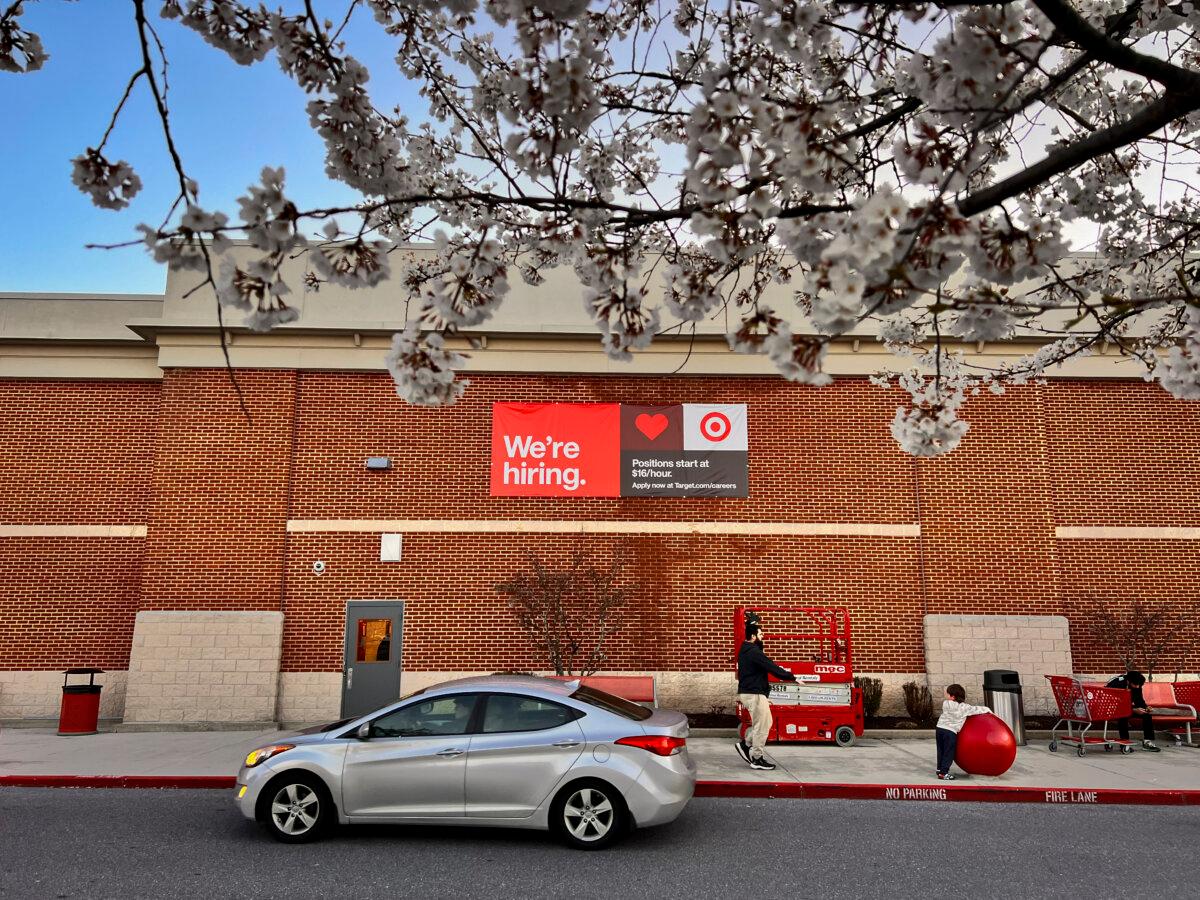
A hiring sign at a grocery store in Ellicott City, Md., on March 24, 2024. (Madalina Vasiliu/The Epoch Times)
In addition, global outplacement firm Challenger, Gray & Christmas will publish layoff figures for June, and payroll processor ADP will release last month’s private-sector employment data.
Initial jobless claims—a measure of the number of individuals filing for first-time unemployment benefits—will also be released this week. The market is projected to experience a slight uptick in claims, rising to 240,000. Recurring claims, meanwhile, are forecast to dip to 1.96 million.
According to the updated Summary of Economic Projections in June, Federal Reserve policymakers anticipate the unemployment rate will rise to 4.5 percent by the year’s end.
Consumers have downgraded their outlook for the U.S. labor market.
The Conference Board’s June Consumer Confidence Index showed that consumers were more pessimistic about business conditions, job availability, and future income prospects.
Following a sharp rebound from the abysmal April readings, recent surveys suggest that consumer projections have eroded.
The July RealClearMarkets/TIPP Economic Optimism Index slipped as the six-month economic outlook and confidence in federal economic policies dropped. However, the six-month Personal Financial Outlook gauge, a metric of how individuals feel about their finances, improved modestly.