
The number of job openings in January exceeded expectations, signaling potential renewed demand for labor amid sluggish employment conditions.
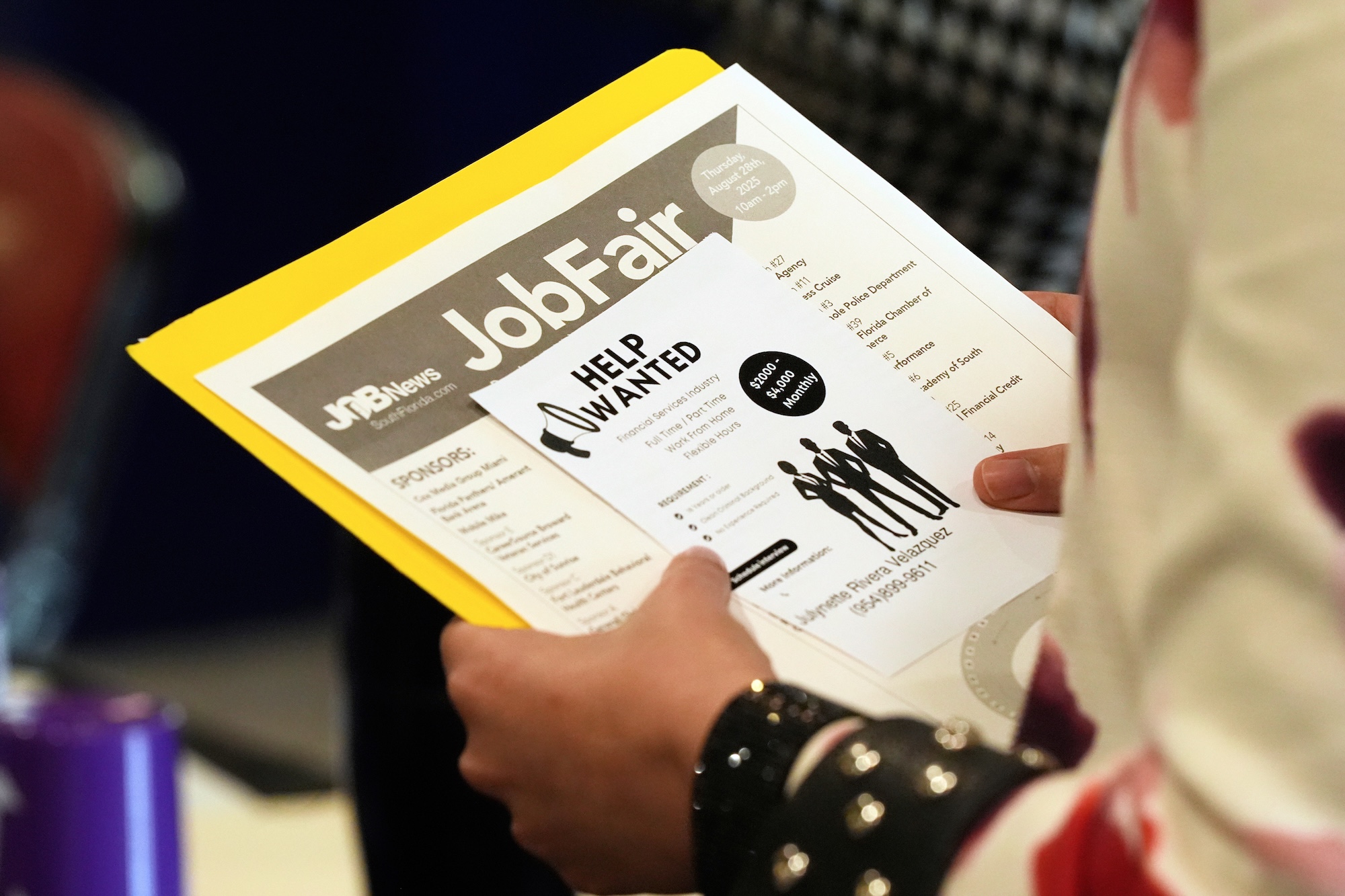
Job vacancies climbed to 6.94 million, from an upwardly revised 6.55 million in December, the Bureau of Labor Statistics said in its delayed report on March 13.
This is a sizable rebound from the more than five-year low recorded at the end of last year.
January’s gains also topped market estimates, which pointed to a reading of 6.7 million.
The jump in vacancies was broad-based, led by financial activities (169,000), trade, transportation, and utilities (155,000), and private education and health services (123,000).
Job openings in the manufacturing sector also increased by 69,000.
This could be the start of thawing out the labor market, says Jeff Korzenik, chief economist at Fifth Third Bank.
“The end of the paralysis caused by tariff policy—what we have termed, ‘tariff fatigue’—this has been evident in a pickup in deal flow and in capex,” Korzenik said in a note to The Epoch Times.
“We’re hopeful that this will eventually lead to an increase in the hiring rate, but job openings are the first step.”
A flurry of economic data has presented a complicated picture of the national labor market.
The February nonfarm payrolls report, for example, showed that the economy lost 92,000 jobs.
Hiring remained frozen at the start of 2026, as the number of new hires was little changed at 5.3 million.
Two industries posted notable decreases: transportation, warehousing, and utilities (negative 67,000) and real estate, rental, and leasing (negative 20,000).
Labor demand has softened since job openings peaked at 12.3 million in March 2022, when the U.S. economy reopened following the COVID-19 pandemic.
But while employers might be hesitant about adding to their headcount, companies are also not laying off workers in vast numbers, supporting a stable labor market.
The number of layoffs and discharges was flat at 1.6 million, further adding evidence of the longstanding and oft-described “low fire, low hire” climate.
Data gathered by the global outplacement firm Challenger, Gray, and Christmas suggests that planned layoffs slowed to 48,307 in February, following the previous month’s surge of 108,435.
Meanwhile, total separations—quits, layoffs, discharges, retirements, and deaths—also held steady at 3.1 million.
A proxy for worker confidence in the labor market fell slightly.
The number of quits declined to 3.137 million, from an upwardly adjusted 3.225 million.
The quits rate—share of workers who voluntarily leave their job as a percentage of total employment—was unchanged at 2 percent.
Slow and Steady
After the U.S. economy added 126,000 new jobs in January, market watchers had thought the labor market was turning a corner, even if the employment gains were largely centered in health care and social assistance.
But February’s data may have dashed these hopes.
The three-month average is 6,000, and the six-month average is negative for the fourth time in five months, according to LPL Financial data.

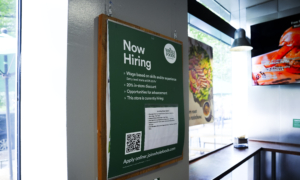
A hiring sign at a restaurant in Columbia, Md., on June 15, 2024. (Madalina Vasiliu/The Epoch Times)
“Looking ahead, we should expect the unemployment rate to rise,” Jeffrey Roach, chief economist at LPL Financial, said in a note emailed to The Epoch Times.
Economic observers have closely monitored the breakeven rate—the level of new jobs necessary to keep the unemployment rate stable.
The rate has come down sharply in recent years.
The U.S. breakeven job growth rate was about 250,000 in 2023 but plummeted to approximately 30,000 by the middle of 2025.
Experts have attributed the decline to lower immigration levels, slower population growth, an aging workforce, rising retirements, and the boom in health care hiring, which has potentially masked structural weakness.
Estimates vary, but the breakeven rate could be around 60,000 by sometime next year.
At the same time, Roach notes, underlying employment conditions are stable.
The labor force participation rate and the employment-to-population rate stand at 62 percent and 59.3 percent, respectively.
“These measures showed little change over the year,” he added.
For Federal Reserve policymakers, it is a balancing act.
While the Fed is widely expected to leave interest rates higher for longer—investors have priced in a September rate cut—this policy stance could also risk a further deterioration in the labor market.
Cleveland Fed President Beth Hammack, in a March 6 appearance at a University of Chicago forum, expressed support for a wait-and-see approach before taking rate action.
“Under my base case, I think policy should be on hold for quite some time as we see evidence that inflation is coming down and the labor market stabilizes further,” Hammack said in prepared remarks.
“But it’s easy to envision other scenarios, as well, so I see two-sided risks to rates.”
The war in Iran has thrown a fresh hurdle in the way of the Fed loosening monetary policy.
The policy outlook has likely been obscured by the Iranian conflict, says Minneapolis Fed President Neel Kashkari.
Before the conflict began, Kashkari said he was confident economic conditions were “in a pretty good place,” and that the Fed had the luxury of just letting it [policy] gradually glide back to neutral.
“If headline inflation is going to be elevated for an extended period of time, coming off of five years of elevated inflation, boy, that’s a scenario that we need to pay close attention to,” Kashkari said at a Bloomberg event earlier this month.
The 12-month core Personal Consumption Expenditures (PCE) Price Index—the Fed’s preferred inflation measure that strips out food and energy—ticked up to 3.1 percent in January.