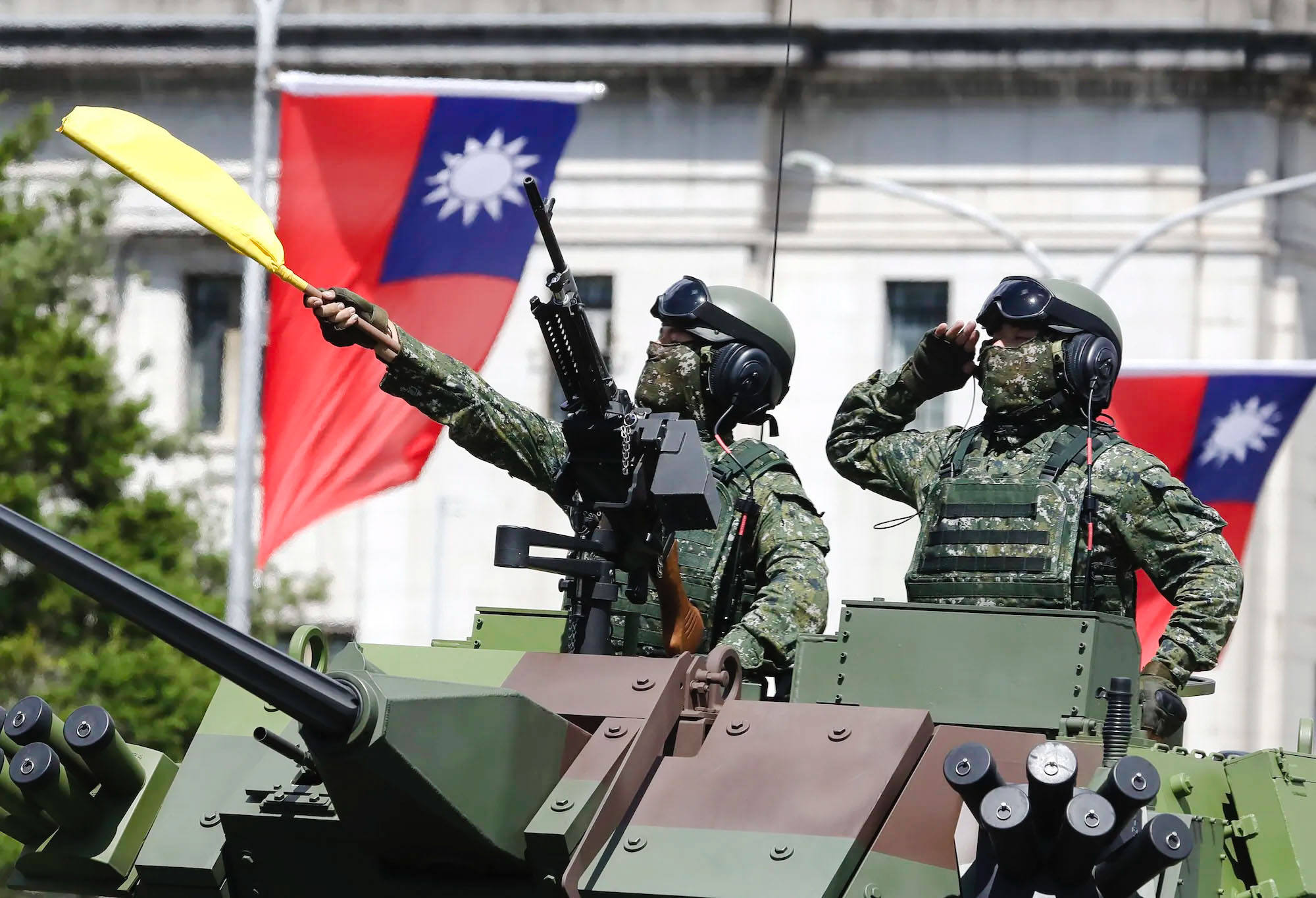

The Trump administration has approved an $11.1 billion arms sale to Taiwan, the largest U.S. weapons package ever proposed for the island.
The arms sale, announced by the Pentagon’s Defense Security Cooperation Agency (DSCA) on Dec. 17, is the second deal under President Donald Trump’s current administration, following a $330 million arms sale in November for spare and repair parts for Taiwan’s aircraft fleet, including F-16s.
The sale covers a wide range of items, including High Mobility Artillery Rocket Systems valued at $4.05 billion, self-propelled howitzers worth $4.03 billion, two different Altius loitering munition drones and related equipment for $1.1 billion, military software and equipment valued at $1.01 billion, Javelin anti-tank missiles worth $375 million, anti-armor missiles worth $353 million, AH-1W helicopter spare and repair parts valued at $96 million, and refurbishment kits for Harpoon missiles worth $91.4 million.
DSCA said the arms sale “serves U.S. national, economic, and security interests” and will “help improve the security of the recipient and assist in maintaining political stability, military balance, and economic progress in the region.”
The sale also serves to help Taiwan’s “efforts to modernize its armed forces and to maintain a credible defensive capability,” DSCA said.
The U.S. State Department has approved the proposed arms sale, but it still requires approval by Congress, in which Taiwan enjoys widespread cross-party support.
The timing of the latest arms sale announcement comes as Taiwan faces mounting military pressure and gray-zone coercion from the Chinese communist regime, which considers the self-governing island part of its territory.
In November, Taiwanese President Lai Ching-te announced $40 billion in new proposed military spending to counter Beijing’s potential military attack on the island by 2027. The latest budget would be allocated from 2026 to 2033 for projects, including the construction of an air defense system called “Taiwan Dome,” according to Lai.
Taiwanese presidential office spokesperson Karen Kuo characterized the latest arms sale as an indication of the “close Taiwan–U.S. partnership,” according to a statement.
“Taiwan will continue to reform national defense, strengthen whole-of-society defense resilience, demonstrate our determination for self-defense, and maintain peace through strength,” Kuo said.
Kuo reiterated the Lai administration’s commitment to raising its defense budget to more than 3 percent of gross domestic product in 2026.
“Taiwan will continue to deepen its partnerships with the U.S. and other like-minded countries in order to safeguard the universal values of freedom and democracy and uphold regional peace, stability, and prosperity,” Kuo said.
The Taiwanese Ministry of National Defense issued a statement on Dec. 18 thanking the United States for its assistance in building up the island’s self-defense.
“The United States continues to assist Taiwan in maintaining sufficient self‑defence capabilities and in rapidly building strong deterrent power and leveraging asymmetric warfare advantages, which form the foundation for maintaining regional peace and stability,” the ministry stated.
In China, Chen Binhua, spokesperson of the State Council’s Taiwan Affairs Office, said the U.S. arms sale “constitutes a flagrant interference in China’s internal affairs,” according to China’s state-run media Xinhua.
Rupert Hammond-Chambers, president of the U.S.–Taiwan Business Council, said the High Mobility Artillery Rocket Systems and howitzers “could play an essential role in destroying ships and landing craft seeking to disembark [People’s Liberation Army] forces on Taiwan’s shores, and any [People’s Liberation Army] forces that have managed to establish a bridgehead,” according to a Dec. 17 statement.
“This bundle of notifications—a record amount notified at one time in U.S. security assistance for Taiwan—is a response to the threat from China and speaks to the demand from Mr. Trump that partners and allies do more to secure their own defense,” Hammond-Chambers said.
The Trump administration’s national security strategy, released on Dec. 5, states that the United States is prioritizing deterring a conflict over Taiwan by “preserving military overmatch” against China.
The strategy also highlights the importance of Taiwan’s strategic location, noting that it “splits Northeast and Southeast Asia into two distinct theaters.”
On Dec. 2, Trump signed the Taiwan Assurance Implementation Act into law, requiring the U.S. State Department to review and update its guidelines for U.S. engagements with Taiwan at least once every five years. The measure is designed to deepen the U.S.–Taiwan relationship in the absence of formal diplomatic relations.
Reuters contributed to this report.