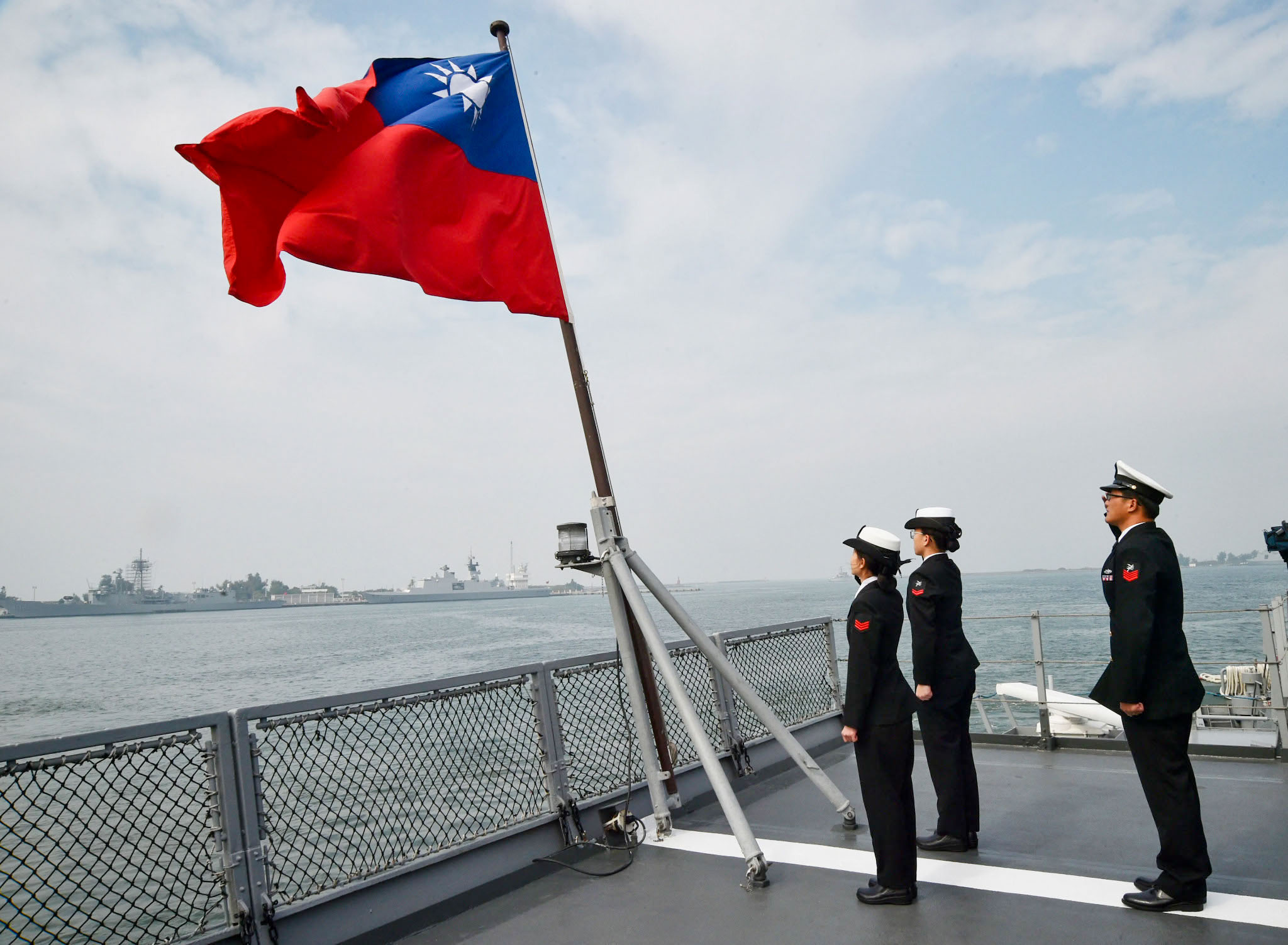

The top U.S. envoy to Taiwan should be elevated to ambassador-level status as part of Washington’s deterrence strategy to protect the island from aggression by communist China, according to a recent bipartisan report from the House Select Committee on China.
The report, titled “Ten More for Taiwan,” is an update of the original version published in 2023. It offered a range of policy recommendations, calling them a “near-term roadmap for action,” and said that a military conflict over Taiwan would have “disastrous consequences” for the self-governing island, the United States, and the rest of the world.
“[Chinese leader] Xi Jinping has ordered his military to be ready to take Taiwan by 2027 if necessary, so 2026 is an urgent year to build deterrence in the Taiwan Strait,” Rep. John Moolenaar (R-Mich.), the committee’s chairman, said in a Dec. 18 statement accompanying the release of the report.
“This means increasing weapons stockpiles, enhancing logistics capabilities, and creating dilemmas for the PLA that will deter an attack on Taiwan,” Moolenaar stated, using the abbreviated name of China’s military, the People’s Liberation Army.
“The United States and the American people have a strong partnership with Taiwan, and we must take definitive steps to strengthen it before it is too late.”
The United States and Taiwan have not maintained formal diplomatic ties since Washington shifted its recognition from Taipei to Beijing in January 1979. Later that year, then-U.S. President Jimmy Carter signed the Taiwan Relations Act into law, authorizing U.S. arms sales to Taiwan for self-defense and establishing the American Institute in Taiwan (AIT). This nonprofit, private corporation now serves as the de facto U.S. embassy on the island.
AIT, headquartered in Arlington, Virginia, is led by a chairperson, a post that is currently vacant. In Taiwan, AIT has offices in Taipei and Kaohsiung and is headed by a director, currently Raymond F. Greene.
“Congress should take steps to authorize the Director of the American Institute in Taiwan (AIT) to be considered, for all practical purposes, equivalent to the position of a U.S. Ambassador,” the report reads.
“This step would promote the AIT Director’s inclusion in regional strategic dialogues and internal policy meetings with other senior-level officials, while also highlighting the importance of the United States’ diplomatic presence on Taiwan.”
Currently, the AIT chairperson is chosen by the institute’s board of trustees, with recommendations from the U.S. State Department.
The AIT director is selected by the State Department, according to the Formosan Association for Public Affairs, a Washington-based organization known for its advocacy work in the U.S. Congress supporting Taiwan.
A bipartisan bill reintroduced in May seeks to change how the AIT director is named. The legislation, called the Taiwan Relations Reinforcement Act (S.1588), would rename the top U.S. envoy to Taiwan as a “representative,” whose appointment would be made by the U.S. president with the Senate’s approval.
The legislation was first introduced in October 2020 by Sen. Jeff Merkley (D-Ore.) and then-Sen. Marco Rubio (R-Fla.).
Other policy recommendations in the report include moving forward with pending trade, tax, travel, and technology with Taiwan; establishing mutually beneficial defense industrial partnerships; enhancing joint operations along the First Island Chain with U.S., Japanese, Philippine, and other allied forces; collaborating with Taiwan to expand and diversify its energy supply; providing more opportunities for Taiwan’s miltary personnel to participate in U.S. training programs; and supporting Taiwan’s greater involvement in international organizations.
To bolster the economic security of the United States and Taiwan, Congress should consider legislation to improve supply chain resilience by imposing “carefully targeted tariffs” on China-origin products in strategic sectors, according to the report.
Congress should also advise the Pentagon to work with NATO allies to “better coordinate deployments to the Indo-Pacific,” including transiting through the Taiwan Strait and the South China Sea, to signal that Chinese aggression against Taiwan would trigger a global response, according to the report.
“This bipartisan report makes explicit that Taiwan is not—and will not be—a bargaining chip with the Chinese Communist Party,” Rep. Raja Krishnamoorthi (D-Ill.), the committee’s ranking member, said in a statement on Dec. 18 to accompany the report.
“Ten More for Taiwan shows that effective deterrence is not only military, but comes from clear political messaging, strengthened economic ties, and a firm commitment to our shared values.”