The Pentagon has released its first batch of long-discussed files on unidentified flying objects (UFOs) and unidentified anomalous phenomena documented between 1947 and 1968.
President Donald Trump’s directive for transparency in government information mandated the document release on May 8.
“These files, hidden behind classifications, have long fueled justified speculation—and it’s time the American people see it for themselves,” Secretary of War Pete Hegseth wrote in a statement.
Whether the latest disclosures answered public questions and what the findings signify is a matter of debate among Epoch Times readers, who offered their takes on the revelation.
The Epoch Times conducted this reader survey May 13–14 by email and social media, and 842 responded.
Transparency
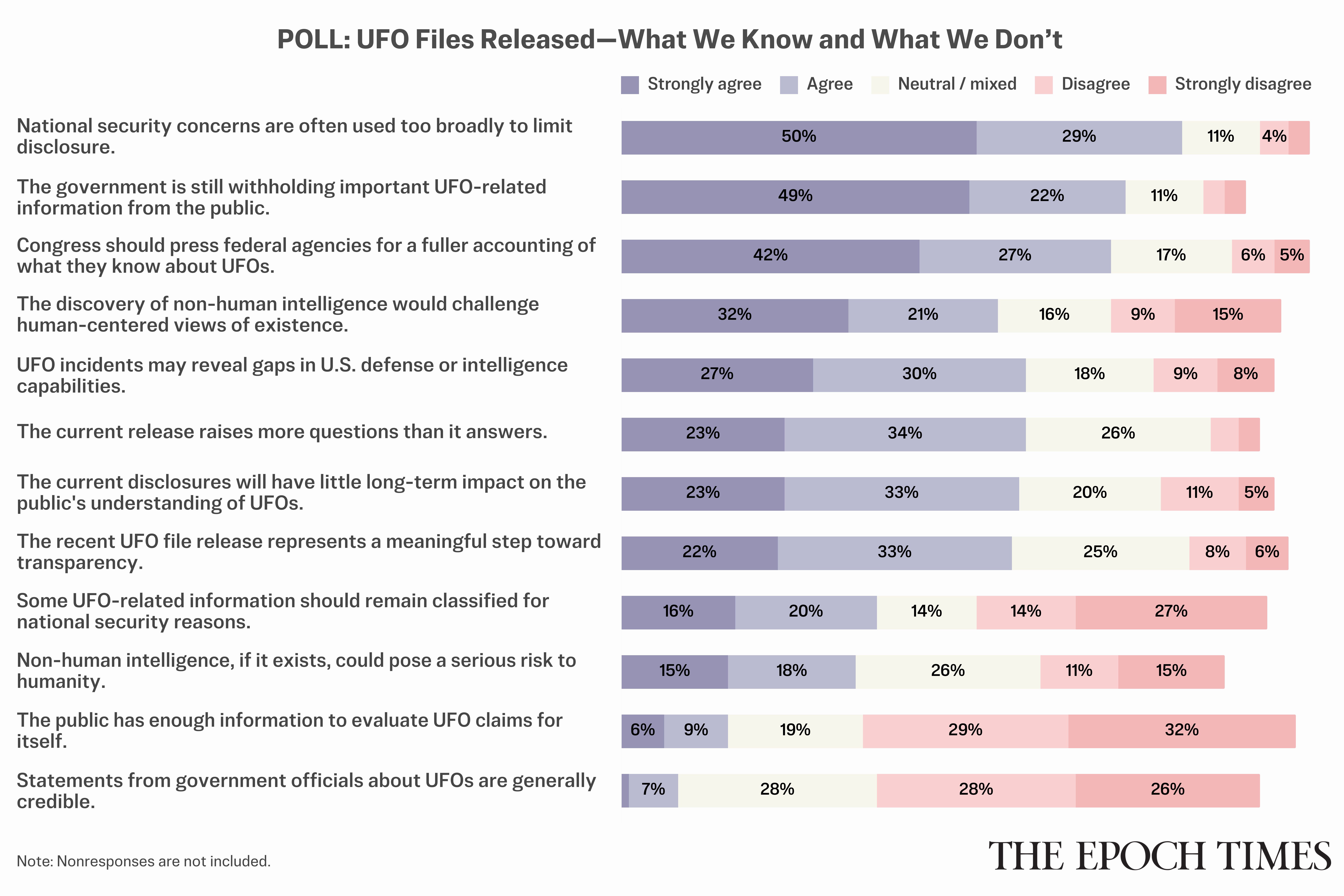
A majority (55 percent) of responders agreed that the recent UFO file release represents a meaningful step toward transparency. Roughly 14 percent disagreed, and nearly one-third (31 percent) answered neutral or unsure.
More than 70 percent of those polled agreed that the government is still withholding important UFO-related information from the public, with nearly half (49 percent) strongly agreeing.
About 69 percent of those surveyed agreed Congress should press federal agencies for a fuller accounting of what they know about UFOs.
Asked whether statements from government officials about UFOs are generally credible, about 54 percent of survey respondents disagreed, just eight percent agreed, and the rest were neutral or unsure.
National Security
Nearly 80 percent of survey takers thought national security concerns are often used too broadly to limit disclosure, with 50 percent strongly agreeing.
Respondents were mixed on whether some UFO-related information should remain classified for national security reasons. Roughly 41 percent of respondents disagreed with the idea that some information should remain classified, 36 percent agreed, and 23 percent were neutral or unsure.
Unanswered Questions
The revelations left most respondents with unanswered questions about UFOs. A majority of 56 percent agreed the current disclosures will have little long-term impact on the public’s understanding of UFOs, roughly 16 percent disagreed, and the rest answered neutral or unsure.
More than 60 percent of those polled disagreed that the public has enough information to evaluate UFO claims for itself.
Similarly, 57 percent agreed that the information released raises more questions than it answers. Another 36 percent were either unsure or neutral on the question. Only seven percent thought more questions remain after the release of this information.
Most Matters
Nearly one-third said the most important unanswered question is how much the government actually knows about UFOs.
Almost one-fourth thought the most important question is whether or not the government has evidence of non-human intelligence.
About 18 percent were most concerned about whether any formal agreements or coordination with non-human intelligence have occurred, and another 12 percent were most concerned about whether UFOs pose risks that the government is not fully disclosing.
UFO Implications
Nearly 60 percent of responders agreed that UFO incidents may reveal gaps in U.S. defense or intelligence capabilities. About 26 percent were neutral or unsure, and 17 percent disagreed.
Additionally, more than half (53 percent) agreed that the discovery of non-human intelligence would challenge human-centered views of existence. Roughly one-quarter disagreed, and the rest were neutral or unsure.
Readers were divided on whether or not non-human intelligence, if it exists, could pose a serious risk to humanity. Roughly 33 percent agreed, 26 percent expressed disagreement, and another 26 percent neither agreed nor disagreed. The rest were unsure.