

Senate Majority Leader John Thune (R-S.D.) said Republicans have given Democrats their “last and final” offer to end the partial government shutdown affecting the Department of Homeland Security (DHS) and subsidiary agencies.
“Enough is enough,” Thune said.
He didn’t provide details, but the offer comes as lawmakers seek to find some solution to the 40-day ongoing funding lapse for DHS before the Senate’s spring recess. On Thursday, Thune indicated that it could be a long night as negotiations continue.
“Hopefully ... there will be some finality in this real soon,” Thune said.
During a Thursday White House meeting with the Cabinet, President Donald Trump indicated he may be forced to take “drastic measures” to end the shutdown if a solution isn’t reached soon.
Later the same day, Trump announced that he would order the DHS to pay TSA agents in spite of the funding lapse.
“I am going to sign an Order instructing the Secretary of Homeland Security, Markwayne Mullin, to immediately pay our TSA Agents in order to address this Emergency Situation, and to quickly stop the Democrat Chaos at the Airports,” the president wrote in a post on Truth Social.
“It is not an easy thing to do, but I am going to do it! I want to thank our hardworking TSA Agents and also, [Immigration and Customs Enforcement agents], for the incredible help they have given us at the Airports,” he added.
The House of Representatives earlier Thursday again approved a measure to fund DHS. It passed in a 218–206 vote.
Four Democrats, including Reps. Henry Cuellar (Texas), Don Davis (N.C.), Jared Golden (Maine), and Marie Gluesenkamp Perez (Wash.), voted with Republicans in favor, reprising their past support for ending the shutdown as soon as possible. Rep. Kevin Kiley (I-Calif.)—who recently left, but still caucuses with, the Republican Party—also backed the measure.
However, in the upper chamber, where any bill to fund DHS needs at least 60 votes to move forward, lawmakers remain split. Senate Democrats have blocked two previous efforts to pass the House version of the legislation.
At the center of the dispute is Immigration and Customs Enforcement (ICE).
Senate Minority Leader Chuck Schumer (D-N.Y.) accused ICE agents of using dangerous tactics, saying that Democrats are united in pushing for changes to how federal agents conduct immigration enforcement operations.
Democrats’ core demands have included body cameras, ending the use of administrative warrants—warrants issued by the executive branch to itself, as opposed to a judicial warrant from a judge—stronger identification requirements, and an end to the practice of wearing masks while on duty.
“We have to rein in ICE and stop the violence. We need reform,” Schumer said.
Republicans, meanwhile, have accused Democrats of trying to hinder immigration enforcement and deportations, and explored funding ICE through the budget reconciliation process, which would allow them to bypass the 60-vote threshold and pass the measure with a simple majority. The idea has drawn interest from the president, who said he would review the proposal but stopped short of endorsing it.
Some Democrats have signaled cautious openness to a compromise.
Sen. Chris Coons (D-Del.) said an agreement could be within reach but emphasized the need for a formal, written deal. He also made clear he would oppose any plan that does not address ICE detention and deportation practices. Coons voted against proceeding with the bill.
Negotiations have intensified following recent meetings between Republican senators and Trump at the White House, though major sticking points remain. Trump has said that any DHS funding package must include the SAVE America Act, which would require photo identification for voting and proof of citizenship to register—provisions most Democrats have opposed.
Leavitt reiterated Trump’s demand to end the impasse and restore full DHS funding.
“President Trump’s position is very clear,” Leavitt said during a Wednesday briefing. “He wants the federal government open, the Department of Homeland Security funded, and the Democrat shutdown to end immediately.”
The impasse has had real-world consequences. Much of the DHS has been partially shut down since Feb. 13, though ICE and Customs and Border Protection remain funded through 2029 under the One Big Beautiful Bill Act passed last year. The Senate has now failed five times to pass a funding bill for the rest of the department.
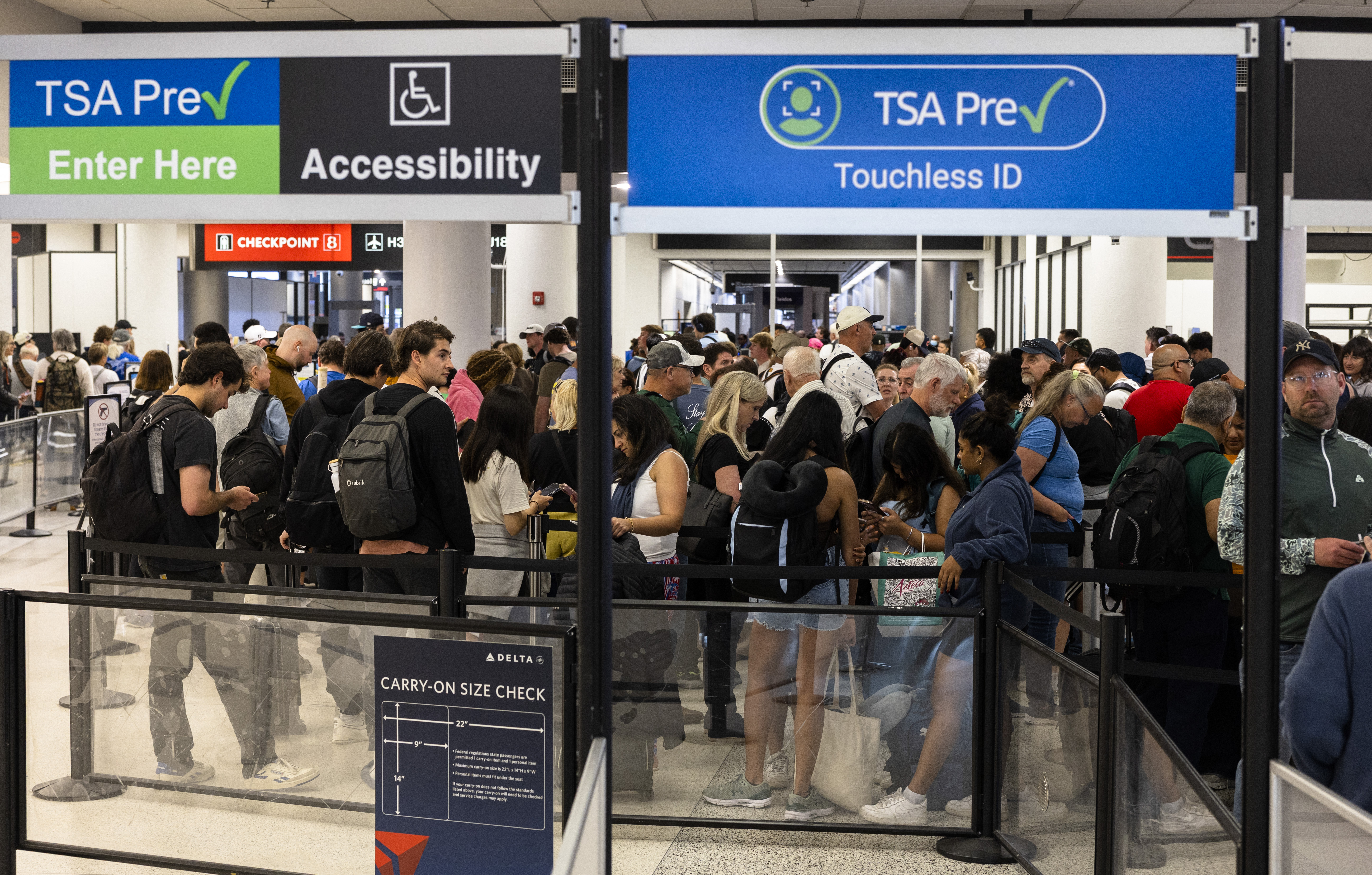
With Congress set to leave Washington for its spring recess, pressure is mounting to resolve the stalemate. TSA workers, deemed essential, have continued working without pay, leading to growing absenteeism and operational strain at airports nationwide.
At a House hearing, acting TSA Administrator Ha Nguyen McNeill described the toll on employees, citing mounting financial hardships such as unpaid bills, eviction risks, and even workers donating blood plasma to make ends meet. She warned that if staffing shortages worsen, airport disruptions could escalate significantly.
“This is a dire situation,” McNeill said, noting that daily callout rates have risen to 11 percent nationwide. “At this point, we have to look at all options on the table,” she added, including the possibility of reducing operations or closing some airports if staffing levels continue to decline.
The Associated Press contributed to this report.