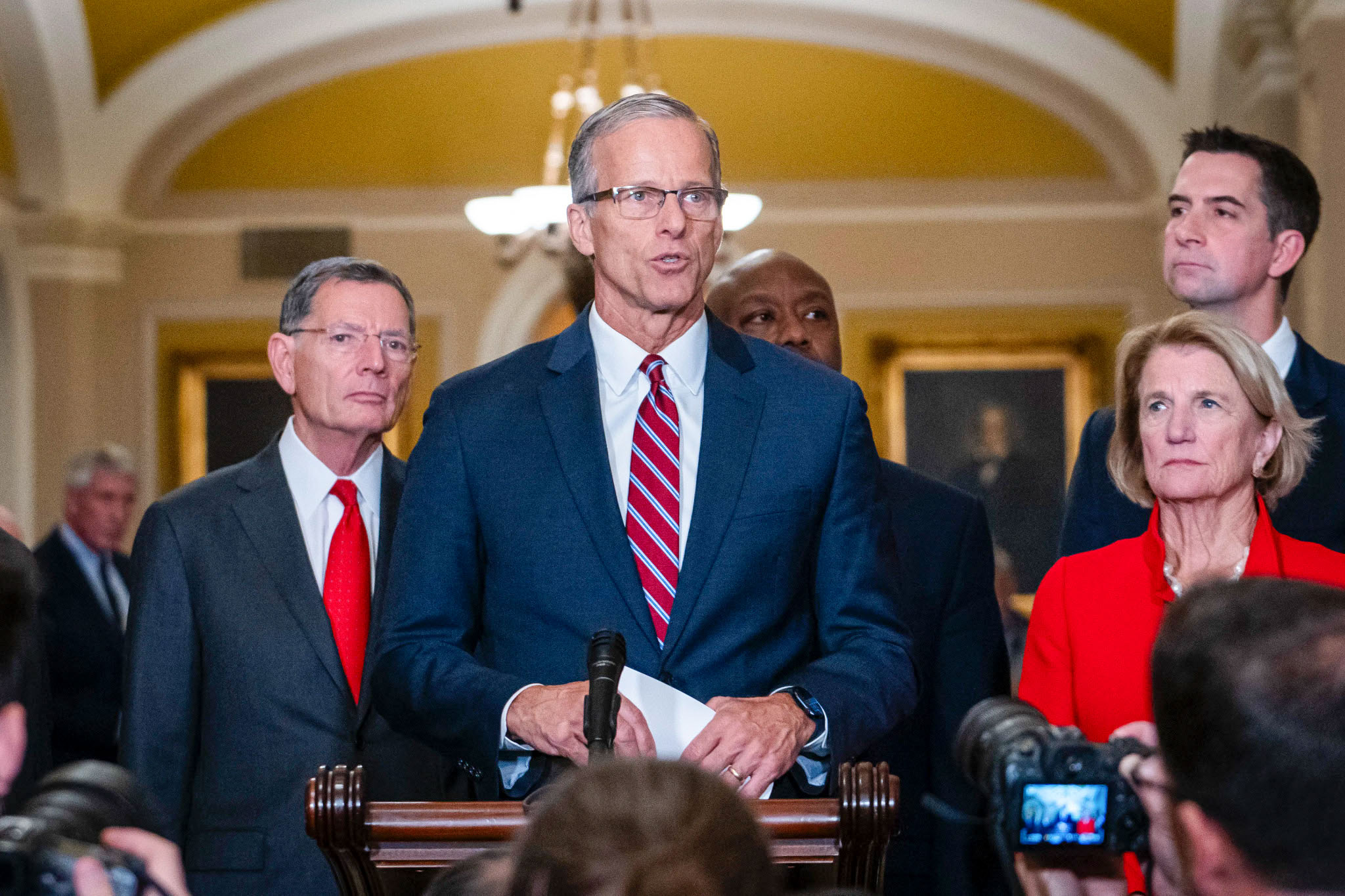

Senate Majority Leader John Thune (R-S.D.) has not ruled out recess appointments as an option to confirm a backlog of President Donald Trump’s nominees.
Recess appointments are ones that the president can make while the Senate is in recess, as spelled out in Article II, Section 3 of the Constitution. They are temporary, expiring once the next session of the Senate is over if the Senate does not ultimately confirm them.
For recess appointments to become a possibility, the Senate would have to enter a recess of 10 or more days.
The House is holding pro-forma sessions every three days during its recess, also known as a district work period. A longer adjournment would require the consent of the Senate.
“I think everything is on the table,” Thune told reporters.
He also floated the possibility of rule changes that would speed up the confirmation of nominees, describing them as “a better solution.”
“Either Democrats are going to play ball or we’re going to figure out a way to change it,” Thune said of the nominations impasse during a July 31 speech on the Senate floor.
Thune and other Republicans have highlighted the slow pace at which Trump’s nominees have moved through the Senate.
In a clip posted to X on July 31, Senate Majority Whip John Barrasso (R-Wyo.) drew attention to 161 nominees who have advanced through committees yet have not reached the Senate floor, saying they are “stuck in what I consider Senate procedural purgatory.”
During past administrations, many nominees have been advanced through unanimous consent or voice votes.
Democrats have made the nominations process more painful for Republicans, requiring roll call votes and time-consuming cloture motions. The latter can only get a vote two days after it is presented. Cloture also entails up to two hours of debate for most nominations.
Ezra Levin of Indivisible, a liberal activist group, previewed that approach during a February protest outside the Treasury Department.
“We need to withhold unanimous consent,” Levin said. “I know that’s wonky, but if we’re going to get our senators to actually do something, we have to tell them what we want to do.”
The use of roll call votes for nominations has become more common during recent Congresses.
A 2024 Congressional Research Service report found that just 41 percent of confirmed civilian nominations didn’t go through a roll call vote in the 118th Congress, when Joe Biden was president and Democrats controlled the Senate.
That’s down from 74 percent in the 115th Congress, when Trump was president and Republicans had a Senate majority.
The Supreme Court established the current 10-day requirement for recess appointments in 2014, after the Obama administration made recess appointments to the National Labor Relations Board while the Senate was holding pro-forma sessions.
Congress’s strategic use of pro-forma sessions in recent sessions has prevented presidents from making recess appointments since that decision was handed down more than a decade ago.
Thune would not just need assistance from the House to make recess appointments a possibility. He would also have to wrangle at least 50 votes, a task that could prove challenging with the narrow Republican majority in the Senate.
Sens. Lisa Murkowski (R-Alaska), Susan Collins (R-Maine), and Thom Tillis (R-N.C.) are among the lawmakers who could prove resistant.